Synthetic Data For Drone Detection: What The Research Shows
Synthetic data improves drone detectors most when mixed with real images. Published hybrids beat real-only training, while synthetic-only models trail on hard test sets.
43 stories
Synthetic data improves drone detectors most when mixed with real images. Published hybrids beat real-only training, while synthetic-only models trail on hard test sets.
For policy evaluation, the benchmark usually picks the simulator. LIBERO and RoboCasa run on MuJoCo, SimplerEnv on ManiSkill, Isaac Lab-Arena tasks on Isaac Lab.
Eval time goes to policy inference, sim stepping, rendering and resets. Vectorize environments, shard across GPUs, batch inference and serve the policy separately.
Lunar hazard detection models train on synthetic terrain because labeled lander-scale imagery barely exists. Teams build it from LOLA DEMs, procedural rocks and low sun.
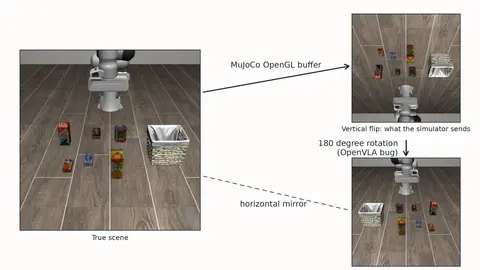
We found that the most widely used LIBERO training datasets store images that are horizontally mirrored relative to the simulated scene. Here is the history, the impact, and how Manifold catches this class of bug.
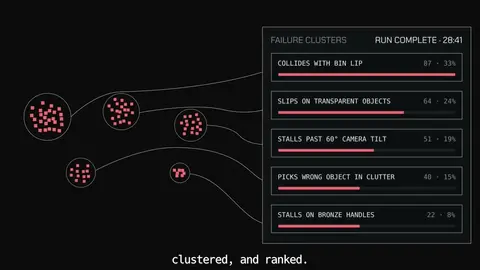
The platform for accelerating robotics research with failure analysis that explains itself. A month of experiments in a week.
Place up to 5 cameras in a single world and capture every angle of the same moment in one render.
A practical guide to VLA policy evaluation, covering LIBERO and RoboCasa, how many rollouts you actually need, and a reproducibility checklist for citable results.
A framework for evaluating manipulation datasets, plus 12 of the best open-source datasets for training VLA models and manipulation policies.
Edit notebooks and dispatch render jobs without a GPU instance, pre-warm instances for when you need them, and share packaged datasets across your organization.
Our upgraded 3D engine unlocks progressive improvements in visual quality and render performance, starting with a more realistic weather system.
A framework for evaluating maritime datasets, plus 14 of the best open-source datasets for USV perception, obstacle detection, and ship classification, scored on ontology, diversity, and label quality.
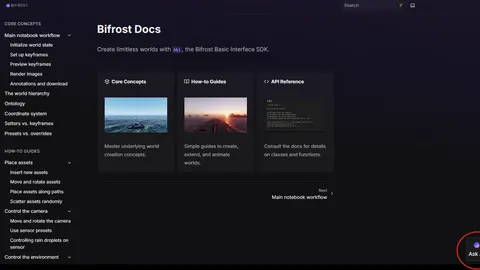
Get instant answers about the Bifrost platform with the new AI assistant built into our docs.
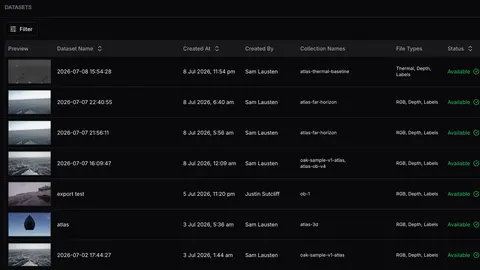
Generate thermal imagery with pixel-aligned depth maps from a single Bifrost render.
Explore and experiment freely in Bifrost notebooks - your credits now go entirely to rendering.
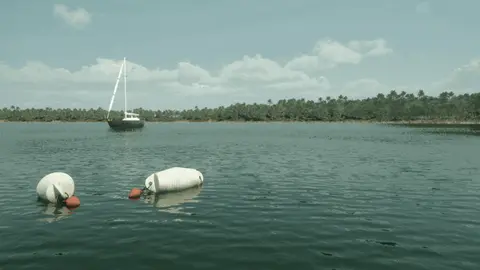
One engineer trained a USV sailboat-and-buoy detector to 82% F1 on real test footage in two days—using just 2,500 synthetic images and two training runs on a single desktop GPU.
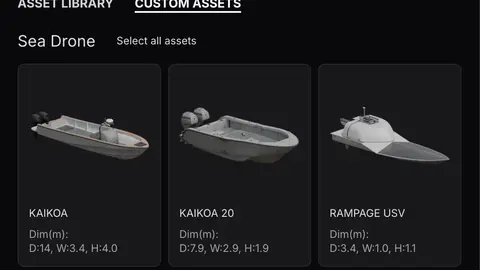
Request bespoke 3D assets directly in the Bifrost platform and track every request from submission to delivered asset.
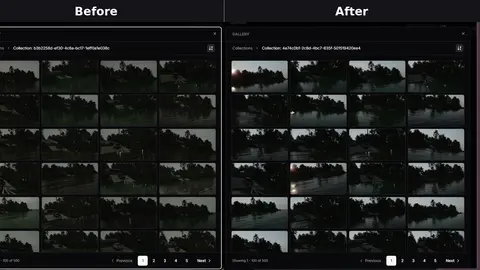
Neural rendering adds photoreal detail and new environmental diversity on top of Bifrost's 3D engine, without breaking your labels.
Showing 36 of 43 stories
Load more storiesGet the top AI news and tools straight to your inbox every week.
Weekly · AI news
Join 15,000+ AI enthusiasts