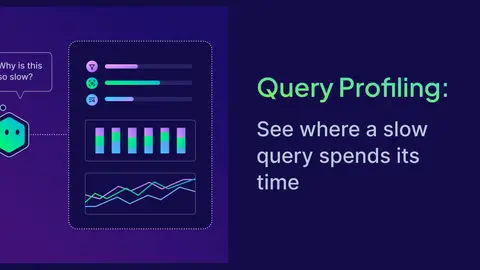
Query Profiling: See Where a Slow Query Spends Its Time
When a Weaviate query is slow, the first question is where the time went. Query profiling returns a per-stage, per-shard timing breakdown, making query performance issues visible.
33 stories
When a Weaviate query is slow, the first question is where the time went. Query profiling returns a per-stage, per-shard timing breakdown, making query performance issues visible.
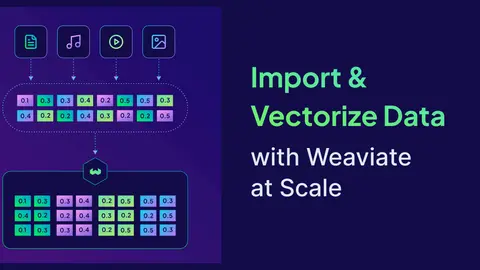
Server-side batching, retries, the blobHash data type, and multimodal ingestion — what to use when, with code.
Time-weighted and money-weighted returns answer different questions. A worked example, how Wealthfolio calculates TWR and XIRR, and what to check when the numbers disagree.
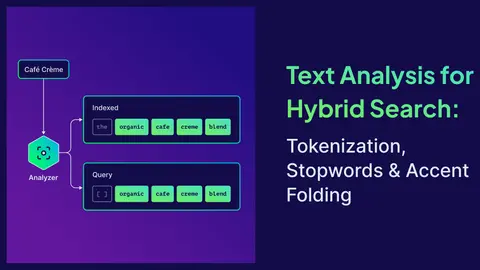
Tokenization makes or breaks hybrid search. See how Weaviate's accent folding, custom stopwords, and /v1/tokenize endpoint power multilingual BM25.
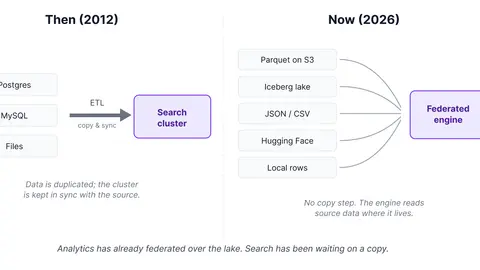
Elasticsearch shipped in 2012 and the deal was simple: your data lived in Postgres or MySQL; you copied it into Lucene; you got ranked search. The duplication tax was the price of admission.
A Researcher's Perspective on Retrieval Quality in RAG Systems
A deep dive into Engram, our managed memory service for agents which is simple to get started but adaptable to any use case.
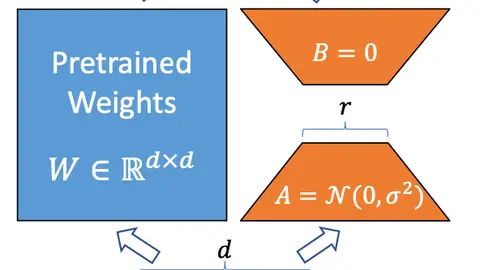
LoRA (Low Rank Adaptation) is a new technique for fine-tuning deep learning models that works by reducing the number of trainable parameters and enables efficient task switching. In this blog post we will talk about the key ideas behind LoRA in a very minimal torch example.
This is a high-level, introductory article about Large Language Models (LLMs), the core technology that enables the much-en-vogue chatbots as well as other Natural Language Processing (NLP) applications.
Escnn, built on PyTorch, is a library that, in the spirit of Geometric Deep Learning, provides a high-level interface to designing and training group-equivariant neural networks. This post introduces important mathematical concepts, the library's key actors, and essential library use.
Please allow us to introduce Deep Learning and Scientific Computing with R torch. Released in e-book format today, and available freely online, this book starts out by introducing torch basics. From there, it moves on to various deep-learning use cases.
In this first in a series of posts on group-equivariant convolutional neural networks (GCNNs), meet the main actors — groups — and concepts (equivariance).
torch does not have built-in functionality to do wavelet analysis. But we can efficiently implement what we need, making use of the Fast Fourier Transform (FFT). This post is a very first introduction to wavelets, suitable for readers that have not encountered it before.
About the Fourier Transform, it has been said that it is one of the greatest wonders of the universe. At the same time, it can be realized in a mere half-dozen lines of code.
Get to know torch's linalg module, all while learning about different ways to do least-squares regression from scratch. This post is a condensed version of the corresponding chapter in the forthcoming book, Deep Learning and Scientific Computing with R torch, to be published by CRC Press.
Showing 33 of 33 stories
You're all caught up.
Get the top AI news and tools straight to your inbox every week.
Weekly · AI news
Join 15,000+ AI enthusiasts