ICLR27 math and stats paper review experience [D]
For people who had papers submitted to ICLR that are applied theory style. For example, 60- 70% theory with some experiments at the end. What was your review experience like for ICLR27?
436 stories
For people who had papers submitted to ICLR that are applied theory style. For example, 60- 70% theory with some experiments at the end. What was your review experience like for ICLR27?
One reviewer criticizes it for lacking an implemented system, empirical validation, results and for making speculative arguments. But its a position/argumentative paper, it doesnt have to have any of those.
Official Review of Submission21893 by Reviewer Xz8e Paper Summary: The paper tries to learn correlations among components of each latent state in a world model to propagate the reward sensitivities to adaptively weight the uncertainties that most matter for long-horizon planning via a pessimistic…
I honestly feel like they just copy-pasted the review straight from an LLM, barely rewording it to sound human. When I ran my paper through ChatGPT, it gave me the exact same generic feedback: 'Run experiments A, B, C, and D.
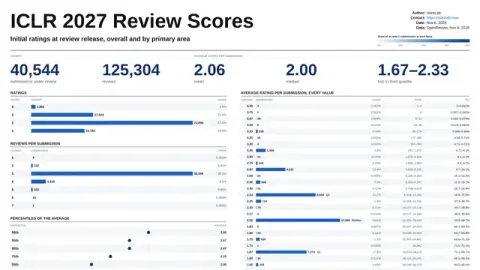
ICLR 2027 moved to a 4-point scale (1 clear reject, 2 weak reject, 3 weak accept, 4 clear accept), so nobody has a feel yet for what a given set of scores means. We counted the public scores on OpenReview: 73,410 reviews on 23,759 submissions.
I'm exploring the field of Embodied AI, particularly humanoid intelligence, cognitive architectures, and the intersection of AI and robotics.
It was clear to me that around 2012 - 2018ish, academic research was kind of paving the way for many applications in industry, from deep nets for vision to RL algorithms.
Disclosure: I'm at Boson AI and this is our release. Not open weights; the Duplex API has a waitlist, and the previous turn-based Higgs Realtime is available now.
Paper: https://arxiv.org/abs/2611.08376 | HF: https://huggingface.co/papers/2611.08376 At 10M tokens, a 1.3B Transformer needs 2.1 TB of KV cache (0.32 TB even at 2.5-bit quantization).
I submitted my paper to ICLR, after improving and correcting since I "published" it previously in a workshop/arXiv. In this process, I changed the name of the method and title.
I’m an MSc CS student with a background in 3D computer vision, trying to figure out how to build visibility and credibility in the AI/ML community. I’ve been thinking about contributing to established open source projects rather than building standalone GitHub projects.
Open‑source audits reveal that a non‑trivial slice of publicly released low‑bit LLM checkpoints cannot reliably generate code. Quantcheck automates the detection of these regressions by analysing GGUF quantised files before they ever reach a developer’s IDE.
https://www.youtube.com/watch?v=fsnKZQA4aZ0 这段视频是图灵奖得主、计算机体系结构泰斗大卫·帕 Patterson(David Patterson)接受访谈的内容,核心讨论了 CPU、GPU 和 TPU 的本质区别、各自的发展历程,以及它们在人工智能时代的定位。 以下是访谈的主要内容梳理: 1.
From what I’ve read on Reddit so far, I’m getting the impression that around 4 first-author papers at top ML conferences (NeurIPS, ICML, ICLR, etc.) is a fairly standard expectation for graduating from a top ML PhD program. Of course, my impression could be biased by the posts I’ve seen.
Hi. My AACL Main paper was just published on ACL Anthology, and I noticed that it appears as a Short Paper. My understanding that it was a long paper since that was what I selected during the ARR review, and my paper's main text runs through nine pages.
So I have been working on some general use agents that work with different domains but these require online simulations to test for some of the domains. And running agents in actual environments takes so much time and compute and then reproducing results is another headache.
Showing 72 of 436 stories
Load more storiesGet the top AI news and tools straight to your inbox every week.
Weekly · AI news
Join 15,000+ AI enthusiasts