OpenClaw Collaborates with NVIDIA for Stronger Agent Skill Security
Every ClawHub skill now ships with a Skill Card showing what it does and where it came from, and SkillSpector scans it for hidden instructions and agentic risks
Docs Blog5 min read
252 stories
Every ClawHub skill now ships with a Skill Card showing what it does and where it came from, and SkillSpector scans it for hidden instructions and agentic risks
LM Studio now supports NVIDIA DGX Station - GB300 Blackwell in a form factor you can run outside of the data center
The most powerful AI platform for enterprises. Customize, fine-tune, and deploy AI assistants, autonomous agents, and multimodal AI with open models.
We ran performance tests on release day firmware and an updated Ollama version to see how Ollama performs.
LM Studio now ships for Linux on ARM and launches with NVIDIA DGX Spark — a tiny but mighty Linux ARM box.
The latest NVIDIA DGX Spark is here! Ollama has partnered with NVIDIA to ensure it runs fast and efficiently out-of-the-box.
We're excited to announce our collaboration with NVIDIA to launch the Stable Diffusion 3.5 NIM microservice, enabling significant performance improvements and streamlined enterprise deployment for our leading image generation models.
In collaboration with NVIDIA, we've optimized the SD3.5 family of models using TensorRT and FP8, improving generation speed and reducing VRAM requirements on supported RTX GPUs.
NVIDIA H100 GPUs are here, with better performance and lower cost.
In retrieval-augmented generation (RAG) applications, the quality of the retrieved documents plays a critical role in delivering accurate and meaningful responses. But what happens when embedding similarity is not enough to get an accurate ordering of the reference documents?
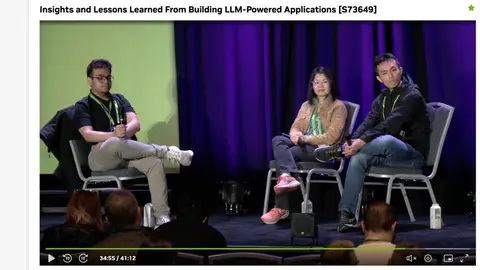
Chip Huyen and I share what we've learned, best practices, and insights at NVIDIA GTC 2025.
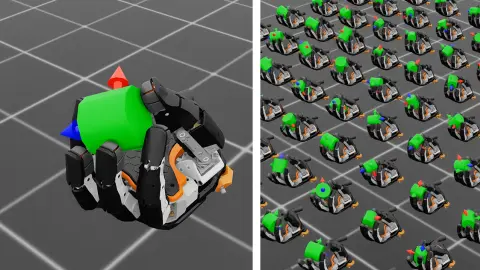
Sanctuary AI has demonstrated industry-leading sim-to-real transfer of learned dexterous manipulation policies for our unique, high degree-of-freedom, high strength, and high speed hydraulic hands… The post Sanctuary AI Leverages NVIDIA Isaac Lab to Accelerate Dexterous Learning appeared first on…
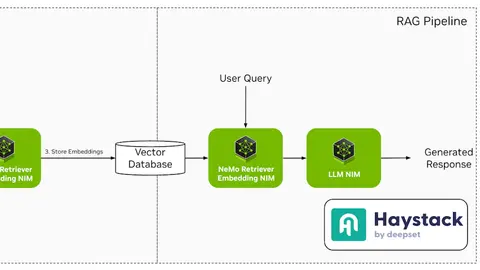
In our previous article, we explored how to build and deploy two key AI pipelines in a retrieval-augmented generation (RAG) application using Haystack with NVIDIA NIM: Indexing pipeline: Prepares data by preprocessing, chunking, and embedding PDF files, finally storing them in a vector database.
Dive deep to understand the architecture of high-performance H100 GPU which has marked a significant advancement in the field of AI.
Retrieval-augmented generation (RAG) systems combine generative AI with information retrieval for contextualized answer generation. Building reliable and performant RAG applications at scale is challenging.
Learning to Track Instances without Video Annotations Tracking segmentation masks of multiple instances has been intensively studied, but still faces two fundamental challenges: 1) the requirement of large-scale, frame-wise annotation, and 2) the complexity of two-stage approaches.
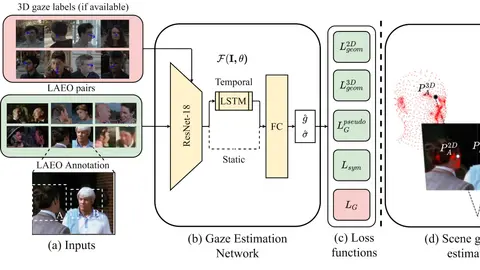
Weakly-Supervised Physically Unconstrained Gaze Estimation A major challenge for physically unconstrained gaze estimation is acquiring training data with 3D gaze annotations for in-the-wild and outdoor scenarios.
Contrastive Syn-to-Real Generalization Training on synthetic data can be beneficial for label or data-scarce scenarios. However, synthetically trained models often suffer from poor generalization in real domains due to domain gaps.
Showing 252 of 252 stories
You're all caught up.
Get the top AI news and tools straight to your inbox every week.
Weekly · AI news
Join 15,000+ AI enthusiasts