EmbeddingGemma 2: an open, lightweight multimodal embedding model
Introducing EmbeddingGemma 2, an open multimodal embedding model optimized for privacy-first use cases
Google AI Blog4 min read
240 stories
Introducing EmbeddingGemma 2, an open multimodal embedding model optimized for privacy-first use cases
TAI #225: OpenAI’s DevDay: Cheaper Intelligence, Unfinished Agents Also, Gemini 4 Argon, GPT-6.1 Sol, Dots, NVIDIA DGX Spark 64GB, Microsoft MAI-Transcribe-2-Streaming, and Cohere Embed 5. What …
It’s been over a year since Reflection launched with us with big goals on coding (and hinted about their RL approach):
An inference server cut off from the Internet. A dedicated disk for models. Mistral's tokenizer downloaded in advance, sitting in its folder. And at startup: FileNotFoundError: No local files found for the repo ID mistralai/Mistral-7B-v0.1 and revision None. The file is there.
Guardrail selection has typically meant choosing between a purpose-built classifier and an LLM acting as a judge. Decision models such The post The AI safety check that runs on a laptop and nearly matched a 35B model appeared first on The New Stack.
VentureBeat Intelligence surveyed respondents at organizations with 100 or more employees in August. We asked how they choose, run and judge their AI infrastructure.
See how Runpod benchmarked four models across sixteen workload profiles to measure Overdrive inference performance, efficiency, and scaling behavior.
CoreWeave RL Rollouts, CoreWeave Model Distillation, and the programmable training API on CoreWeave. Three new features that connect post-training back to inference.
TL;DR The Accelerator Integration Working Group plays a vital role in standardizing how new hardware architectures connect to the open source AI ecosystem. As compute platforms diversify across cloud, edge,...
Most KV-cache compression methods classify attention heads once, either offline or during prefill, and keep this classification fixed throughout generation.
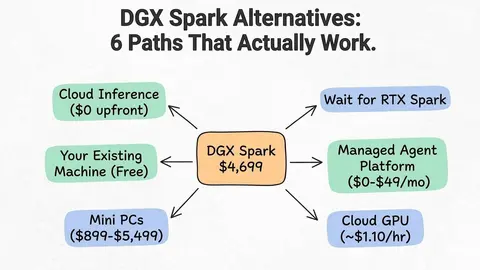
DGX Spark now costs $6,950 and runs Linux only. Six cheaper alternatives ranked by price, from free Ollama and cloud APIs to Strix Halo PCs and Mac Studio M5.
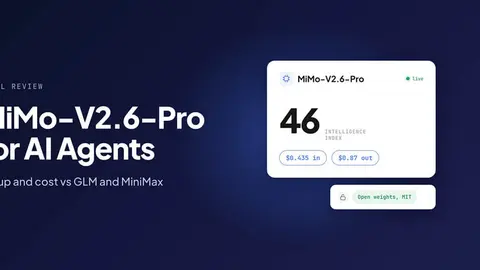
MiMo V2.6 Pro tops open-weight models at $0.435/$0.87 per million tokens. Agent setup, tool calling, real costs vs GLM-5.3 and MiniMax M3.
PyTorch, vLLM, Ray: the open source stack behind modern AI is moving fast. At PyTorch Conference, Oct 20–21 in San Jose, learn from the engineers and researchers building it.
Holo4 API vs local deployment compares setup burden, data control, and task economics for one computer-use agent workflow.
Holo4 27B vs 35B-A3B compares long-task reliability, task economics, and weight licenses so builders can choose an agent model.
Issue #4 of The State of Serene: faster search on every core and from a cold cache, regex and fuzzy search that always answer, text analyzers as expressions, HNSW, the docs inside the binary, OpenTelemetry ingestion, faster time histograms, MATCH_RECOGNIZE, spatial and AI functions.
KV cache explained: what it stores, a per-model memory table from 8K to 128K context, and the Ollama, llama.cpp, LM Studio and vLLM settings that shrink it.
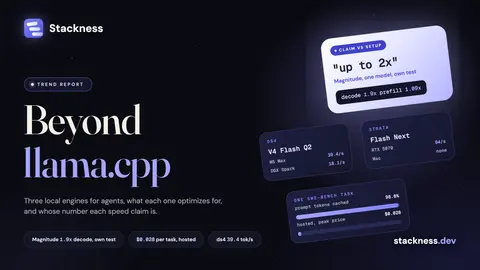
ds4 runs big MoE models on 96 GB Macs, Magnitude tunes kernels to your device, Strata puts one model on a gaming PC. Every speed claim is self-reported.
Showing 90 of 240 stories
Load more storiesGet the top AI news and tools straight to your inbox every week.
Weekly · AI news
Join 15,000+ AI enthusiasts