
Build a Security Questionnaire App With ToolJet MCP
Introduction Every enterprise deal brings a long security questionnaire, and most security and sales engineering teams still answer it from scratch. This tutorial shows how to build a security questionnaire app with ToolJet MCP for a B2B software company in Dublin.
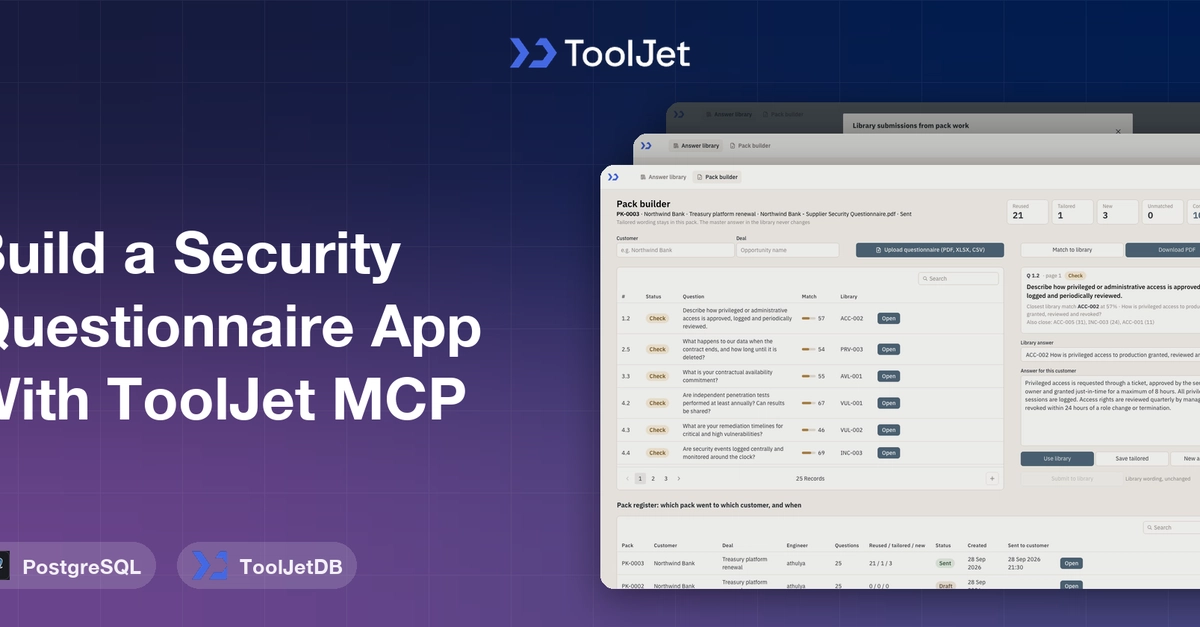
This article explains how to build a security questionnaire app using ToolJet MCP, which automates the process of matching questions to approved answers and generating a filled PDF for customers.
What happened
The article describes the development of a security questionnaire app using ToolJet MCP. The app allows teams to maintain an approved answer library, match uploaded questionnaires to these answers, and export completed forms as PDFs. The app includes features like an answer library with filters, a pack builder with confidence scoring, and a pack register for tracking completed questionnaires.
Why it matters
This app is important for B2B software companies that need to handle security questionnaires for regulated clients. It reduces the time and effort required to answer repetitive questions, improves consistency, and ensures compliance by maintaining a centralized library of approved answers.
- ToolJet MCP can generate a structured application with data, queries, and interface components for security questionnaires.
- Maintaining an approved answer library with filters and stale flags improves efficiency and compliance.
- The pack builder matches uploaded questionnaires to approved answers with confidence scores, allowing for tailored responses.
- The app exports completed questionnaires as PDFs, ensuring consistency and reducing manual effort.
- Role-based access control ensures that only authorized users can manage the answer library and approve changes.
The bigger picture
The app streamlines the security questionnaire process for B2B companies, reducing manual effort and ensuring consistency. It also improves compliance by maintaining a centralized library of approved answers and tracking changes and approvals.
The article demonstrates how ToolJet MCP can be used to build a security questionnaire app that automates the process of matching questions to approved answers and generating filled PDFs. This approach improves efficiency, consistency, and compliance for B2B companies.
Technical details
- The app uses PostgreSQL for the answer library and ToolJet DB for the pack register and activity log.
- The answer library includes filters for category and review status, along with stale flags and owner information.
- The pack builder uploads questionnaires, matches them to approved answers with confidence scores, and allows tailoring of responses.
- The app exports completed questionnaires as PDFs filled into the customer's form.
- The app enforces role-based access control, with compliance leads managing the answer library and sales engineers building packs.
FAQ
What is ToolJet MCP in this build?
ToolJet MCP takes the questionnaire requirements and turns them into a structured app inside ToolJet. The library, pack builder, matching logic, and PDF output live together instead of becoming a loose codebase.
What does the answer library page show?
It shows the approved answer set with search, category filters, review status, and a stale flag for items past their review cycle. Opening a row reveals the answer text, owner, review interval, keywords, and change history in one editor.
How do you reproduce the build from the prompt?
Use the prompt in this article as the full specification and build the two pages, tables, and matching rules in one pass. The consolidated prompt captures the page layout, review flow, and PDF output.
Do you need to write code for questionnaire matching?
You do not need to handwrite the whole app. The screens come from visual components, while parsing uploaded files, scoring matches, and filling the exported PDF use code where the workflow needs logic.
Can the app use PostgreSQL and ToolJet DB together?
Yes. The answer library, history, roles, submissions, and pack items live in PostgreSQL, while the pack register and activity log sit in ToolJet DB, which keeps operational state separate from the review content for the team.
This summary and analysis were generated with AI from the original article and may contain errors. Read the original for the full story.
Read the full story
Originally published by Dev.to AI on Oct 1, 2026.
Comments
Sign in to join the discussion.