
Building AI for Reliable Execution: Lessons From Industrial Robotics
Inside Standard Bots’ AI stack, pretrained models learn factory tasks from demonstrations and improve through corrections from real deployments.
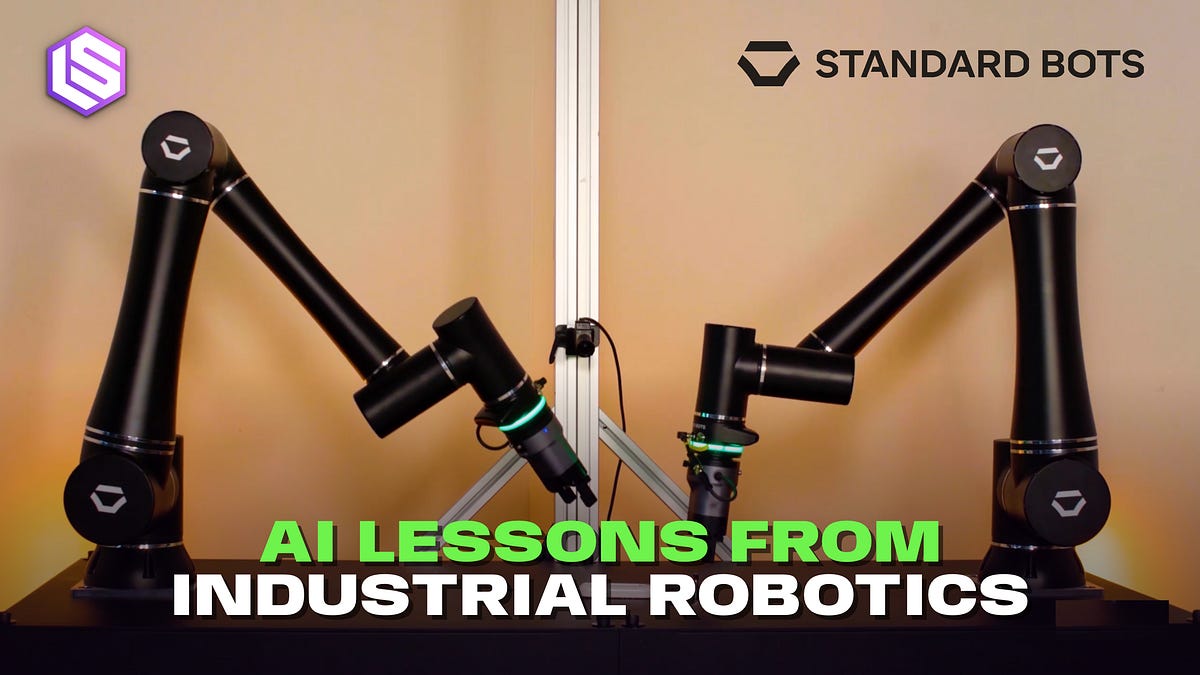
This article explores Standard Bots' approach to developing AI for industrial robotics, focusing on their strategies for reliable execution in manufacturing environments.
What happened
The article details Standard Bots' AI architecture for industrial robots, including their use of pretrained models, real-world deployment corrections, and hardware-software integration strategies. It describes their approach to machine tending tasks, where perception models identify parts while conventional programming handles motion control.
Why it matters
For AI developers and industrial professionals, the article demonstrates practical methods for deploying reliable AI in constrained manufacturing environments, emphasizing data efficiency and hardware integration over raw model size.
- Prioritize data quality and targeted datasets over large-scale data collection
- Co-optimizing AI with hardware control systems improves performance and reliability
- On-premise inference is critical for industrial environments with connectivity limitations
- Real-world deployment feedback is essential for refining AI models in production
- Hybrid approaches combining AI and conventional programming enable flexible automation
The bigger picture
The article highlights strategies for creating dependable AI systems in industrial settings, influencing approaches to AI deployment where reliability and latency are critical factors.
Standard Bots demonstrates how industrial AI can achieve reliability through focused model design, hardware integration, and iterative learning from real-world deployments, offering lessons for AI applications in constrained environments.
Technical details
- Zero-shot perception systems for object identification without task-specific training
- On-premise inference with edge GPUs for real-time decision-making
- Co-optimization of AI models with robotic control systems
- Simulation-based training with real-world deployment corrections
- APIs for external developers to integrate custom models with Standard Bots' platform
FAQ
How does Standard Bots handle data collection for AI training?
They focus on high-quality, targeted datasets rather than large volumes, using in-situ interventions to correct edge cases with minimal examples.
Why is on-premise inference important for their industrial robots?
Factories often lack reliable internet connectivity, making local processing critical for uptime and real-time decision-making.
How do they combine AI with traditional programming?
AI handles perception tasks like object identification, while conventional programming manages motion control and workflow logic.
This summary and analysis were generated with AI from the original article and may contain errors. Read the original for the full story.
Read the full story
Originally published by Latent Space on Oct 10, 2026.
Comments
Sign in to join the discussion.