
Decision models: when your AI should return a probability, not a paragraph
A support ticket comes in: "I was charged twice this month, please refund one of them." Most teams send that to a chat model with a prompt like "Classify this ticket.
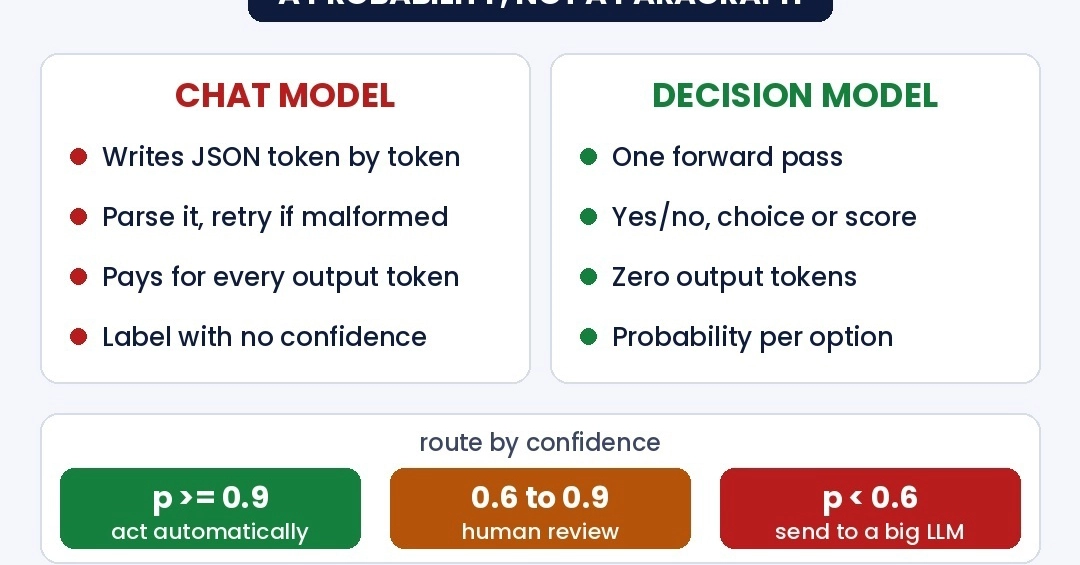
The article discusses Liquid AI's release of open-weight decision models, d1-3B and d1-omni-600M, which offer a new approach to AI decision-making by providing probabilities instead of text outputs.
What happened
Liquid AI released two open-weight decision models, d1-3B and d1-omni-600M, which are designed to make decisions by returning probabilities instead of text outputs, offering faster processing and lower costs compared to traditional chat models.
Why it matters
These models can improve efficiency in AI systems by reducing latency and cost for tasks that require quick, probabilistic decisions, such as ticket classification and moderation.
- Adopt decision models for tasks requiring quick, probabilistic decisions to reduce costs and latency.
- Use confidence scores to route tasks efficiently, automating confident decisions and escalating uncertain ones.
- Evaluate the models on your specific use cases and check calibration before deployment.
The bigger picture
The models can lead to cost and latency savings in AI systems by efficiently handling high-volume, low-complexity decisions, allowing larger models to focus on more complex tasks.
Liquid AI's decision models offer a new approach to AI decision-making, providing faster, cheaper, and more efficient solutions for tasks that require probabilistic outputs rather than text generation.
Technical details
- d1-3B: 3.1B parameters, trained from LFM2.5-VL-3B vision-language backbone, handles text and images.
- d1-omni-600M: 587M parameters, trained from a bidirectional encoder with added vision and audio encoders, handles text plus image or audio.
- Decision models return typed answers with probabilities, such as yes/no, choice among options, or scores on a scale.
- They use a single forward pass to generate answers, significantly reducing processing time compared to chat models.
FAQ
What are decision models, and how do they differ from traditional chat models?
Decision models are AI models designed to return typed answers with probabilities in a single forward pass, unlike chat models that generate text sequentially. They are optimized for quick, probabilistic decisions rather than text generation.
What are the key applications for Liquid AI's decision models?
They are suitable for tasks like moderation, intent classification, RAG relevance checks, and edge-based decision-making, but not for open-ended text generation.
What are the benefits of using decision models over traditional chat models?
Decision models offer reduced latency, lower costs, and the ability to provide confidence scores, allowing for more efficient task routing and resource allocation.
This summary and analysis were generated with AI from the original article and may contain errors. Read the original for the full story.
Read the full story
Originally published by Dev.to AI on Oct 13, 2026.
Comments
Sign in to join the discussion.