
Does being rude to AI work? What 6 models revealed
Does being rude to AI improve answers or lower costs? We tested six models to separate prompt tone from brevity instructions and examine what changes. The post Does being rude to AI work? What 6 models revealed appeared first on Arize AI.
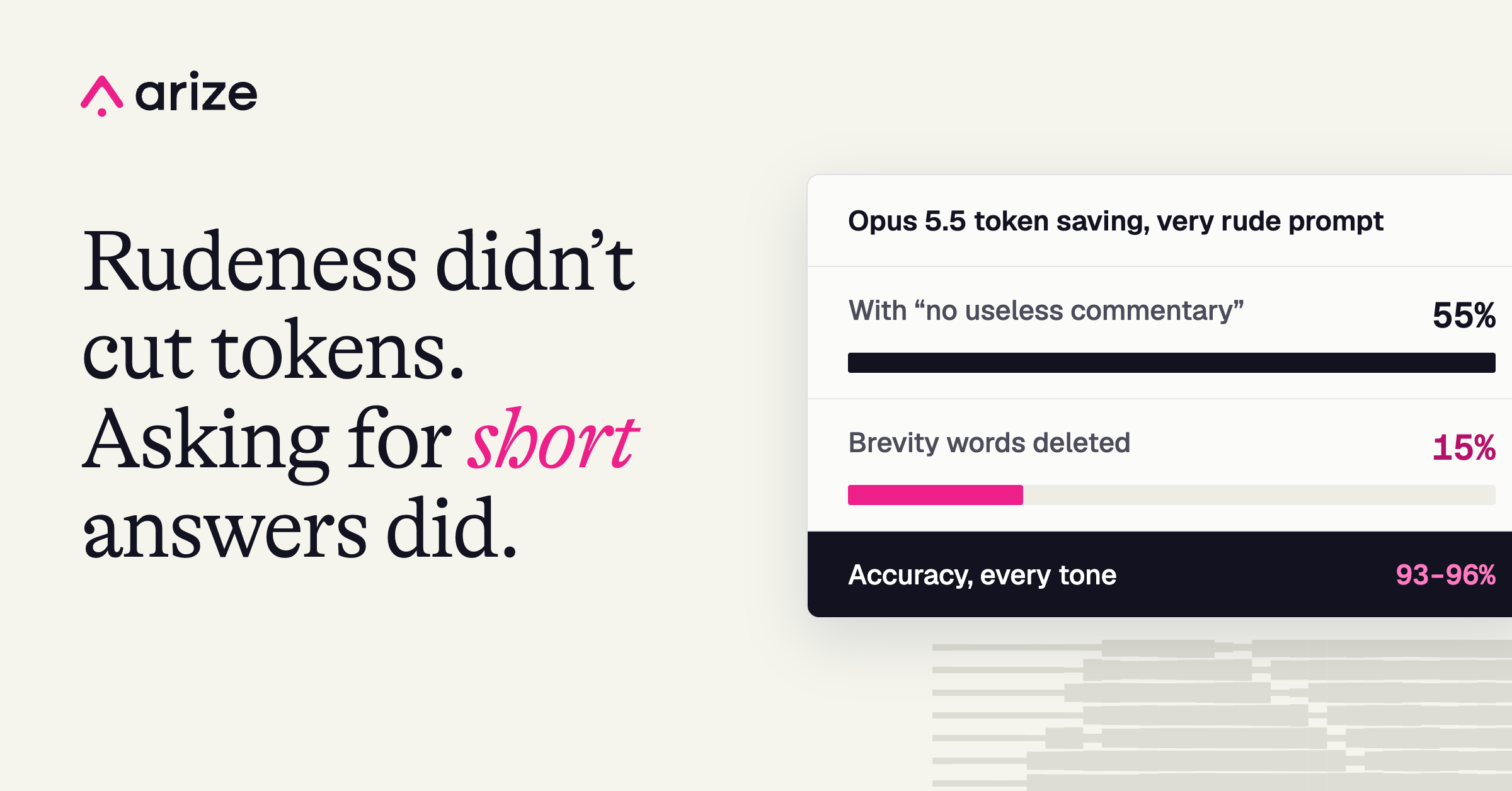
This article explores the impact of using rude or hostile prompts on AI models, examining whether such interactions improve accuracy, reduce costs, or affect model behavior.
What happened
The article presents a series of experiments conducted on six AI models to evaluate the effects of prompt tone on accuracy, token usage, and model behavior. The study found that while rude prompts sometimes reduced token usage, they did not consistently improve accuracy and often confounded results due to accompanying brevity instructions.
Why it matters
For AI developers and businesses, understanding how prompt tone affects model performance and cost is crucial. The findings suggest that users should focus on clear, direct instructions rather than resorting to rudeness to achieve better results.
- Rude prompts do not reliably improve AI accuracy.
- Token usage savings from rude prompts are often due to brevity instructions, not tone alone.
- Testing one variable at a time is essential for accurate results.
- Model behavior in response to abuse varies, with some models ignoring rudeness and others acknowledging it.
- Clear and direct instructions are more effective than hostile tones for achieving desired outcomes.
The bigger picture
The study suggests that users and developers should focus on clear, concise instructions rather than using rude prompts to achieve cost savings or better performance. It also emphasizes the need for careful evaluation of AI systems to avoid confounding variables.
The article concludes that being rude to AI does not consistently improve accuracy or reduce costs. Instead, users should focus on clear, concise instructions to achieve better results, and developers should ensure their evaluations account for confounding variables like brevity instructions.
Technical details
- Token usage: Rude prompts sometimes reduced output tokens, but this was often due to brevity instructions rather than tone alone.
- Model responses: Some models, like Claude Opus 5.5, acknowledged hostile prompts but provided answers without engaging with the rudeness.
- Accuracy: No consistent improvement in accuracy was found across models when using rude prompts.
- Brevity instructions: The study highlighted that asking for shorter answers significantly reduced token usage, independent of tone.
- Evaluation methods: The experiments involved testing different prompt tones and analyzing accuracy, token usage, and model behavior.
FAQ
Does being rude to AI improve its accuracy?
No, the study found that rude prompts did not consistently improve accuracy across the tested models.
Can rude prompts reduce AI costs?
While some rude prompts reduced token usage, this was often due to brevity instructions rather than the tone itself.
How do AI models respond to hostile prompts?
Some models, like Claude Opus 5.5, acknowledged hostile prompts but provided answers without engaging with the rudeness, while others ignored the tone entirely.
Why is it important to test one variable at a time in AI experiments?
Testing one variable at a time helps avoid confounding results, ensuring that changes in outcomes are due to the tested factor and not other variables like brevity instructions.
What should users do to get better results from AI models?
Users should focus on clear, concise instructions rather than using rude or hostile tones, as this leads to more reliable and effective outcomes.
This summary and analysis were generated with AI from the original article and may contain errors. Read the original for the full story.
Read the full story
Originally published by Arize Phoenix on Oct 13, 2026.
Comments
Sign in to join the discussion.