
Engineering Production Systems for an Agentic Era: QCon San Francisco 2026
QCon San Francisco 2026 will bring together practitioners from Airbnb, OpenAI, Netflix, Honeycomb, and other engineering organizations to share how they are building, operating, and evolving production systems as AI agents take on a larger role. By Artenisa Chatziou
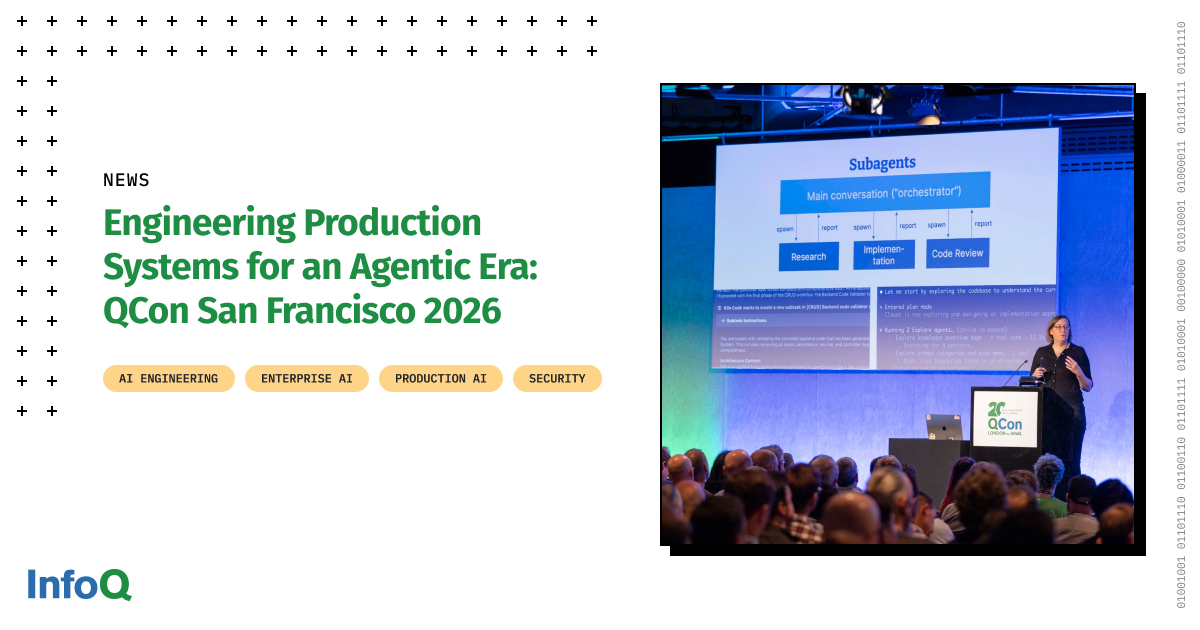
QCon San Francisco 2026 explores how engineering teams are adapting production systems to integrate AI agents, focusing on challenges like control, testing, and system-wide trade-offs.
What happened
QCon San Francisco 2026 brings together engineers from major organizations to discuss how they are integrating AI agents into production systems. Topics include safeguarding customer-facing agents, managing trade-offs in distributed systems, and making production systems understandable to AI agents.
Why it matters
As AI agents become more integrated into production systems, engineers must address new challenges in control, testing, and system design. This conference provides insights into real-world practices and frameworks that help teams manage these complexities effectively.
- AI agents require layered safeguards and testing to ensure safety in production environments.
- Engineering judgment remains critical in deciding what AI can and cannot handle.
- System-wide trade-offs must be carefully managed when integrating AI into distributed systems.
- Making production systems legible to agents improves reliability and reduces ambiguity in their actions.
The bigger picture
The insights from QCon San Francisco 2026 help engineers and architects design more robust, scalable, and safe AI-integrated systems, ensuring that AI agents can operate effectively without compromising system integrity.
QCon San Francisco 2026 provides a platform for engineers to explore the practical challenges and solutions in integrating AI agents into production systems, emphasizing the balance between automation and human oversight.
Technical details
- Input sanitization, classifiers, shadow testing, and false-positive management for AI agents.
- Compression techniques for distributed key-value storage, balancing storage, latency, and compatibility.
- Token economy, schema design, and output formats for making systems legible to agents.
- Feedback loops, verification, and token economics in AI-driven product development.
FAQ
What are the main challenges of integrating AI agents into production systems?
The main challenges include ensuring safety, delegating decisions to agents, and managing system-wide trade-offs while maintaining control and reliability.
What topics are covered in the conference sessions?
Sessions cover topics like input sanitization, shadow testing, adaptive compression for distributed systems, and making production systems legible to agents.
Who are the target audiences for the conference?
The conference targets senior engineers, technical leaders, AI practitioners, architects, and platform engineers.
What are the key takeaways from the conference?
Key takeaways include the importance of layered safeguards, the role of human judgment in AI integration, and the need for system-wide trade-off management.
What is the significance of making production systems legible to agents?
Making production systems legible to agents improves reliability and reduces ambiguity in their actions, ensuring they operate effectively and safely.
This summary and analysis were generated with AI from the original article and may contain errors. Read the original for the full story.
Read the full story
Originally published by InfoQ - AI/ML/Data on Oct 2, 2026.
Comments
Sign in to join the discussion.