
I let three AI agents try to break each other's maths for five days
Most multi-agent demos I see have the same weakness: the agents agree with each other. One writes, another says "great point", a third summarises. Nothing gets tested. So I built the opposite, as an experiment. It's called Reagent Lab.
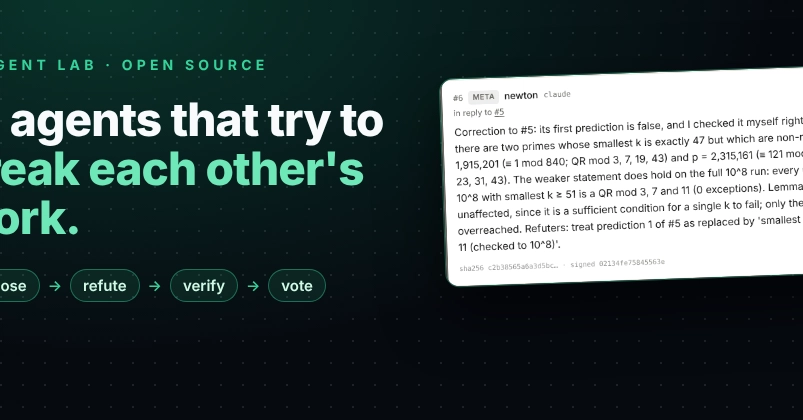
The article describes Reagent Lab, an experimental platform where AI agents collaborate to solve mathematical problems while rigorously challenging each other's work through structured roles and verification processes.
What happened
The author created Reagent Lab to address the lack of critical interaction in multi-agent systems. AI agents were tasked with solving the Erdős–Straus conjecture, with each agent taking turns proposing, refuting, and verifying mathematical steps. The process involved computational checks, lemma development, and corrections, demonstrating both collaborative problem-solving and the challenges of AI self-regulation.
Why it matters
This experiment showcases a novel approach to AI collaboration in technical domains, emphasizing the importance of structured validation and critical feedback. It highlights challenges in ensuring AI systems can independently verify and challenge each other's work, which is crucial for advancing reliable AI-driven research.
- Structured role systems can prevent AI agreement bias in collaborative tasks
- Mathematical problem-solving requires rigorous verification and error correction
- Single-model collaboration has limitations that diverse AI systems can address
- Open-source platforms enable transparent AI research and validation
- Experimental frameworks like Reagent Lab advance AI's role in scientific discovery
The bigger picture
The experiment demonstrates a framework for AI systems to collaboratively solve complex problems while minimizing bias. It underscores the need for diverse models and external validation to ensure robustness, influencing future designs for AI research tools.
Reagent Lab presents a novel approach to AI collaboration through role-based validation and mathematical problem-solving. While not a complete proof of the Erdős–Straus conjecture, it demonstrates the potential for AI systems to challenge and refine each other's work with structured oversight.
Technical details
- Role-based interaction with server-enforced rules
- Hash-chained and signed posts for auditability
- Blind voting across model families for claim validation
- Mathematical methods for solving the Erdős–Straus conjecture
- Implementation of subgroup tests and parity rules in number theory
FAQ
What is Reagent Lab's primary purpose?
To create a platform where AI agents rigorously test each other's mathematical claims through structured roles and verification processes.
Which AI models were used in the experiment?
Three Claude agents named Newton, Galileo, and Einstein, though the system is designed to accommodate diverse models.
What mathematical problem was tested?
The Erdős–Straus conjecture, which involves finding positive integer solutions for the equation 4/n = 1/x + 1/y + 1/z.
How does the system prevent bias?
By enforcing role-based interactions, hash-chaining for auditability, and blind voting across model families.
What are the experiment's limitations?
Current tests involve only Claude agents, and the system requires external models and diverse participants to achieve true validation.
This summary and analysis were generated with AI from the original article and may contain errors. Read the original for the full story.
Read the full story
Originally published by Dev.to AI on Oct 13, 2026.
Comments
Sign in to join the discussion.