
Improving Deep Agents with harness engineering
Harness engineering improved LangChain's coding agent from Top 30 to Top 5 on Terminal Bench using self-verification, tracing, and context optimization.
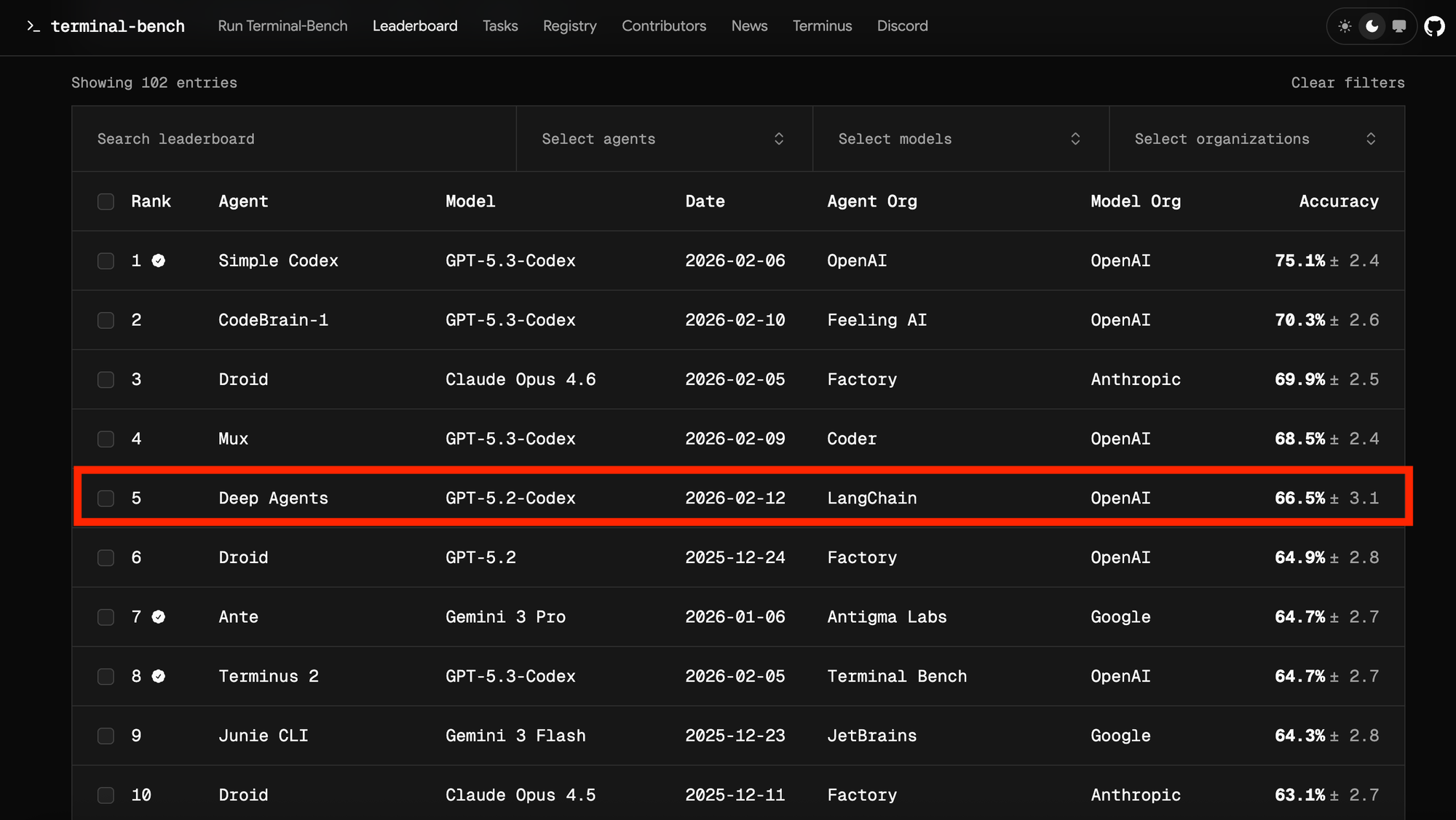
This article details how LangChain improved its coding agent's performance on Terminal Bench 2.0 by optimizing the 'harness' through techniques like self-verification, tracing, and context engineering.
What happened
LangChain's coding agent achieved a 13.7-point improvement on Terminal Bench 2.0 by refining its harness. Techniques included trace analysis, self-verification workflows, and environment context injection, while keeping the model (gpt-5.2-codex) unchanged.
Why it matters
The article provides actionable strategies for optimizing AI agents, emphasizing the importance of system-level design in achieving reliable autonomous performance. These methods are critical for developers building agentic systems in constrained environments.
- Optimize agents through system-level design, not just model upgrades.
- Self-verification and trace analysis are critical for autonomous agent reliability.
- Context engineering reduces errors in unfamiliar environments.
- Balanced reasoning budgets improve task accuracy without excessive resource use.
- Guardrails for myopic behavior (e.g., loop detection) enhance agent robustness.
The bigger picture
The approach demonstrates how system-level engineering can maximize model performance, offering a framework for improving agent reliability in real-world applications like code generation and problem-solving.
LangChain's work highlights the importance of harness engineering in AI agent development, showing that system-level optimizations can achieve significant performance gains without model changes.
Technical details
- Traces: System-level logs of agent interactions used for failure analysis.
- Self-verification: Mechanisms forcing agents to test solutions against task specifications.
- PreCompletionChecklistMiddleware: A hook ensuring agents perform verification before exiting.
- Reasoning budgeting: Strategic allocation of computational resources for planning vs. verification phases.
- LoopDetectionMiddleware: Detects repetitive edits to prompt agents to reconsider approaches.
FAQ
What is 'harness engineering' in AI agents?
Harness engineering involves designing system-level tools and workflows (e.g., prompts, middleware, context handling) to optimize agent performance on specific tasks.
How did self-verification improve the agent's performance?
Self-verification forced the agent to test solutions against task specifications, reducing errors from incomplete or incorrect implementations.
What role do traces play in agent optimization?
Traces provide detailed logs of agent behavior, enabling systematic analysis of failure modes and targeted improvements in reasoning and verification processes.
Why is context engineering important for agents?
Context engineering ensures agents understand their environment (e.g., directory structures, tools), reducing errors from misinterpretation of constraints or available resources.
How does reasoning budgeting affect agent performance?
Strategic allocation of computational resources (e.g., high vs. xhigh reasoning modes) balances thoroughness with efficiency, preventing timeouts while maintaining accuracy.
This summary and analysis were generated with AI from the original article and may contain errors. Read the original for the full story.
Read the full story
Originally published by LangChain Blog on Oct 13, 2026.
Comments
Sign in to join the discussion.