
Meta Extends Confidential Computing to AI Glasses with Private Processing
Meta has extended Private Processing to AI glasses, using confidential VMs, trusted execution environments, remote attestation, anonymous credentials, OHTTP routing, and TEE-based storage to process AI workloads and persistent user context in the cloud. By Leela Kumili
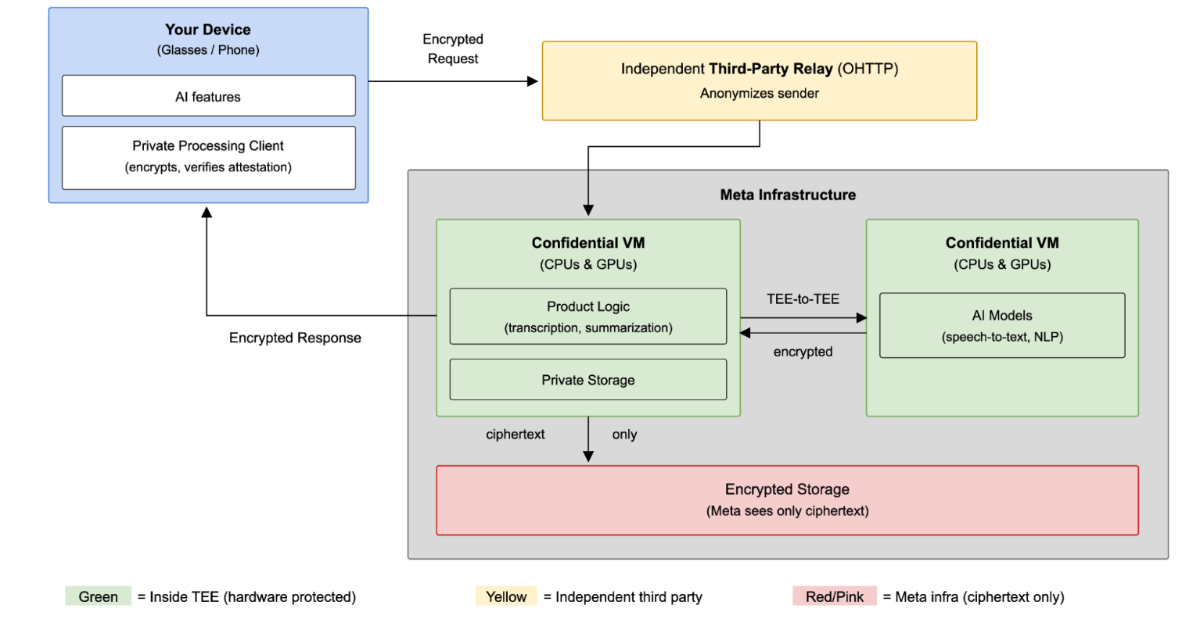
Meta has extended its Private Processing framework to AI glasses, leveraging confidential computing technologies to ensure secure processing of sensitive AI workloads and user data in the cloud.
What happened
Meta has expanded its Private Processing framework to AI glasses, enabling secure processing of AI workloads and user data in the cloud. The system uses confidential virtual machines (CVMs), trusted execution environments (TEEs), remote attestation, and encrypted storage to protect sensitive information. This approach ensures that user data remains private and secure, even as AI glasses process continuous streams of data.
Why it matters
This development is significant for AI developers and security professionals as it introduces a new level of data privacy and security for wearable AI devices. By integrating confidential computing, Meta is addressing critical privacy concerns associated with always-on AI assistants and persistent user context, which is essential for building trust in AI-driven wearable technologies.
- Confidential computing is essential for securing AI workloads in wearable devices.
- Private Processing ensures that user data remains isolated and protected within secure environments.
- Remote attestation and encrypted storage are key components of the architecture.
- Meta is working with security researchers to review and improve the system.
- The system supports advanced AI features like contextual search and long-term recall.
The bigger picture
The introduction of confidential computing in AI glasses has the potential to set a new standard for privacy and security in wearable AI. It enables more advanced AI capabilities while maintaining user trust, which is crucial for the adoption of such technologies.
Meta's extension of Private Processing to AI glasses represents a significant step in integrating confidential computing into wearable AI. By ensuring data privacy and secure processing, the system addresses critical challenges in AI-driven wearable technologies.
Technical details
- Confidential Virtual Machines (CVMs) are used to run AI workloads in isolated environments.
- Trusted Execution Environments (TEEs) provide hardware-level isolation for secure processing.
- Remote attestation ensures that the workload is running on a trusted environment.
- OHTTP routing and anonymous credentials help separate user identity from request processing.
- Encrypted storage and user-provided keys protect persistent state within the confidential boundary.
FAQ
What is Private Processing in the context of Meta's AI glasses?
Private Processing is a framework that uses confidential virtual machines (CVMs) and trusted execution environments (TEEs) to securely process AI workloads and user data in the cloud.
How does Meta ensure data privacy in AI glasses?
Meta uses remote attestation, encrypted storage, anonymous credentials, and OHTTP routing to ensure data privacy and prevent unauthorized access to user data.
What are the key components of the Private Processing architecture?
The architecture includes confidential virtual machines (CVMs), trusted execution environments (TEEs), remote attestation, encrypted storage, and anonymous credentials.
Why is confidential computing important for AI glasses?
Confidential computing is important for AI glasses to protect sensitive user data and ensure privacy, especially for always-on AI assistants that require persistent context.
When will Private Processing be available on Meta's glasses?
Private Processing is not yet available on Meta's glasses, and the company has not specified which features will initially use the system or provided a timeline for its availability.
This summary and analysis were generated with AI from the original article and may contain errors. Read the original for the full story.
Read the full story
Originally published by InfoQ - AI/ML/Data on Oct 14, 2026.
Comments
Sign in to join the discussion.