
Runaway subagent cost in coding agents: what the $78,000 Codex report shows, a test for each cause and the caps that hold
Runaway subagent bills come from nesting no cap stops and children that inherit the parent's model. Count spawn depth in the logs, then cap it in three places.
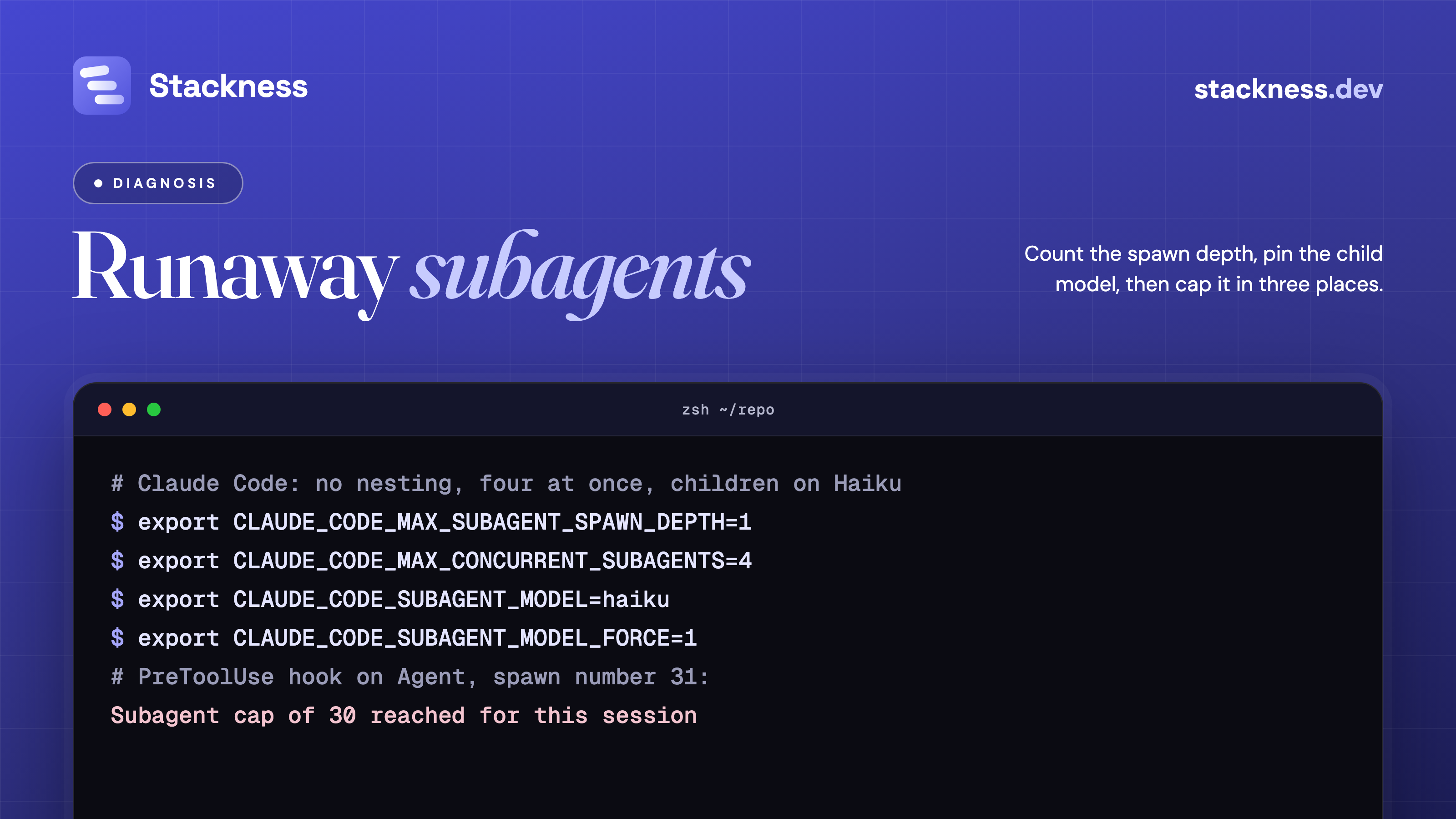
This article explores the issue of runaway subagent costs in coding agents, focusing on the $78,000 Codex report and the underlying causes of excessive subagent spawning. It provides actionable solutions to prevent such costs and offers insights into the technical and billing mechanisms involved.
What happened
The article discusses the issue of runaway subagent costs in coding agents, particularly in the context of the $78,000 Codex report. It outlines the causes of such costs, including nesting without depth limits, concurrency caps, model inheritance, and billing without hard ceilings. The article also provides technical solutions and tools to mitigate these issues.
Why it matters
Understanding and addressing runaway subagent costs is crucial for AI developers and professionals to manage expenses effectively. This is especially important in environments where AI tools are used extensively, as uncontrolled subagent spawning can lead to significant financial implications.
- Set depth caps and concurrency limits to prevent excessive subagent spawning.
- Control model inheritance to avoid costly subagent tasks.
- Use logging and monitoring tools to track subagent activity and costs.
- Implement hard billing limits to prevent uncontrolled spending.
- Ensure that subagents do not inherit forked history to avoid overcounting.
The bigger picture
The practical impact of runaway subagent costs includes significant financial strain on users and the need for robust monitoring and cost management strategies. Proper configuration and tool usage can prevent such issues and ensure efficient resource utilization.
The article emphasizes the importance of managing subagent costs in coding agents by addressing nesting, concurrency, model inheritance, and billing mechanisms. It provides actionable solutions and highlights the need for proper configuration and monitoring to prevent financial overruns.
Technical details
- Codex's V2 subagents ignore the depth setting, leading to deep nesting.
- Concurrency caps limit the number of running agents, not the total number spawned.
- Subagents inherit the parent's model and effort, increasing costs.
- Forked history causes subagents to re-read the parent's context, leading to overcounting.
- Billing without a hard ceiling can turn a bug into an invoice.
FAQ
What causes runaway subagent costs?
Runaway subagent costs are often caused by nesting without depth limits, concurrency caps, model inheritance, and billing without hard ceilings.
How can I prevent excessive subagent spawning?
Set depth caps, concurrency limits, and model inheritance controls to prevent excessive subagent spawning.
What tools can help track subagent costs?
Tools like ccusage, Langfuse, Orca, and coucou can help track subagent costs and send alerts.
How can I ensure subagents do not inherit forked history?
Spawn subagents without forked history and pass the necessary files in the task to avoid re-reading the parent's context.
What should I do if I see an unexpected invoice?
Check for automatic reload settings, enforce hard limits, and verify the provider's usage page to ensure accurate billing.
This summary and analysis were generated with AI from the original article and may contain errors. Read the original for the full story.
Read the full story
Originally published by Stackness Blog on Oct 16, 2026.
Comments
Sign in to join the discussion.