
Udhaar-Khata: Voice AI Digital Ledger for My Father Using 100% Local Open-Weights (Gemma 2 + Whisper)
This is a submission for the Hacktoberfest Weekend Challenge: Build for a Friend What I Built I built Udhaar Khata (उधार खाता) — a voice-powered, 100% local open-weights digital ledger and credit book built specifically for my father. My father manages a neighbourhood shop in India.
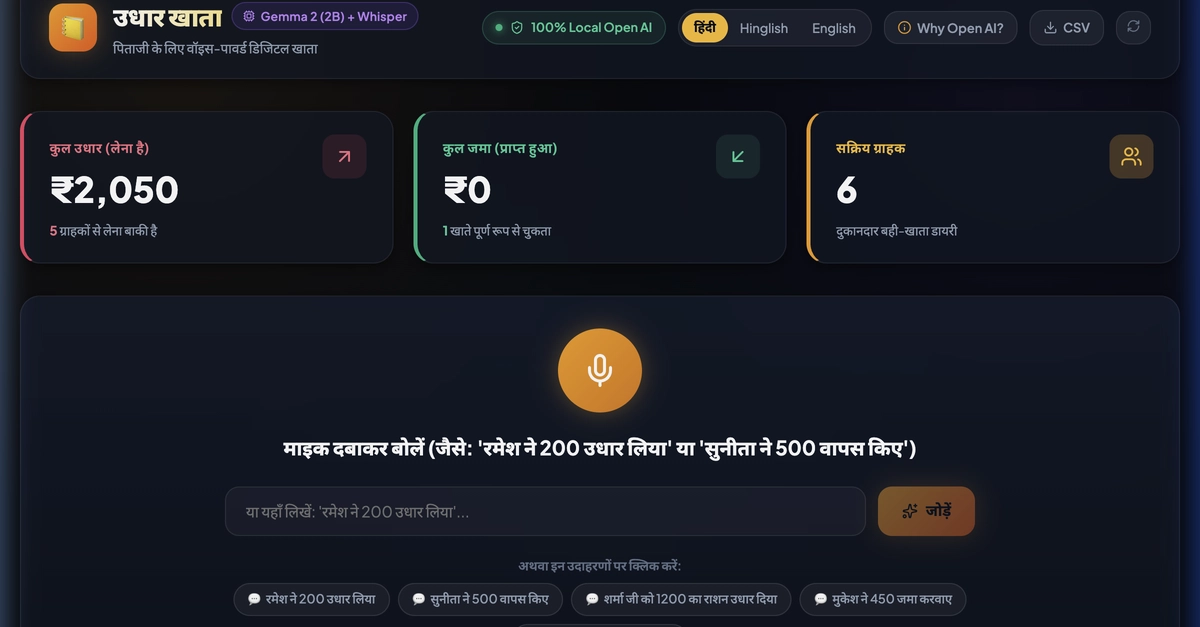
Udhaar-Khata is a voice-powered, 100% local open-weights digital ledger and credit book built for small business owners, specifically for the author's father who manages a neighborhood shop in India. It leverages AI models like Google Gemma 2 and OpenAI Whisper to enable natural language interaction and local data processing.
What happened
The author developed Udhaar-Khata, a voice-powered digital ledger for managing credit transactions in a neighborhood shop. The system uses local open-weights AI models like Google Gemma 2 and OpenAI Whisper to process natural language input, extract transaction details, and generate reminders. All data is stored locally, ensuring privacy and offline functionality.
Why it matters
Udhaar-Khata addresses the challenges faced by small business owners in managing credit transactions without relying on cloud-based systems. It provides a privacy-focused, offline solution that respects cultural norms and local language usage, making it highly relevant for AI developers and open-source contributors.
- Local open-weights AI models can provide privacy and offline functionality for small business tools.
- Natural language processing can be adapted for colloquial dialects like Hinglish.
- Cultural sensitivity is crucial for designing user-friendly financial tools in India.
- Open-source and open-weights AI can empower users without relying on cloud infrastructure.
- Privacy and data sovereignty are critical for financial applications in sensitive contexts.
The bigger picture
Udhaar-Khata offers a practical, privacy-preserving solution for small businesses, especially in areas with unreliable internet. It demonstrates the power of open-weights AI in enabling local, offline applications that respect user privacy and cultural context.
Udhaar-Khata is a compelling example of how open-weights AI can be used to create practical, privacy-focused tools for small businesses. By leveraging local processing and natural language understanding, it addresses real-world challenges in a culturally sensitive and technically sound manner.
Technical details
- Google Gemma 2 (2B) for information extraction and structured JSON output.
- OpenAI Whisper for local speech-to-text processing.
- Bilingual React interface with SQLite local storage.
- Deterministic Indic-NLP rule engine for structured data parsing.
- 1-click WhatsApp integration for culturally respectful payment reminders.
FAQ
What is Udhaar-Khata?
Udhaar-Khata is a voice-powered, 100% local open-weights digital ledger and credit book designed for small business owners, particularly for managing credit transactions in a neighborhood shop.
Which AI models does Udhaar-Khata use?
Udhaar-Khata uses Google Gemma 2 (2B) for information extraction and OpenAI Whisper for local speech-to-text processing.
How does Udhaar-Khata ensure privacy?
All customer data, contact numbers, and transaction ledgers are stored locally in a SQLite database, ensuring no data is uploaded to external cloud servers.
Can Udhaar-Khata work without internet?
Yes, Udhaar-Khata is designed to work offline, making it suitable for areas with unreliable internet connectivity.
What languages does Udhaar-Khata support?
Udhaar-Khata supports Hindi and Hinglish, allowing users to interact naturally with the system.
This summary and analysis were generated with AI from the original article and may contain errors. Read the original for the full story.
Read the full story
Originally published by Dev.to AI on Oct 4, 2026.
Comments
Sign in to join the discussion.