
Zero Trust Architecture for MCP
[Playbook] Zero Trust Architecture for MCP An engineering blueprint for implementing On-Behalf-Of OAuth 2.1 and SPIFFE workload identity. Cover visual featuring a physical Causal Interaction studio …
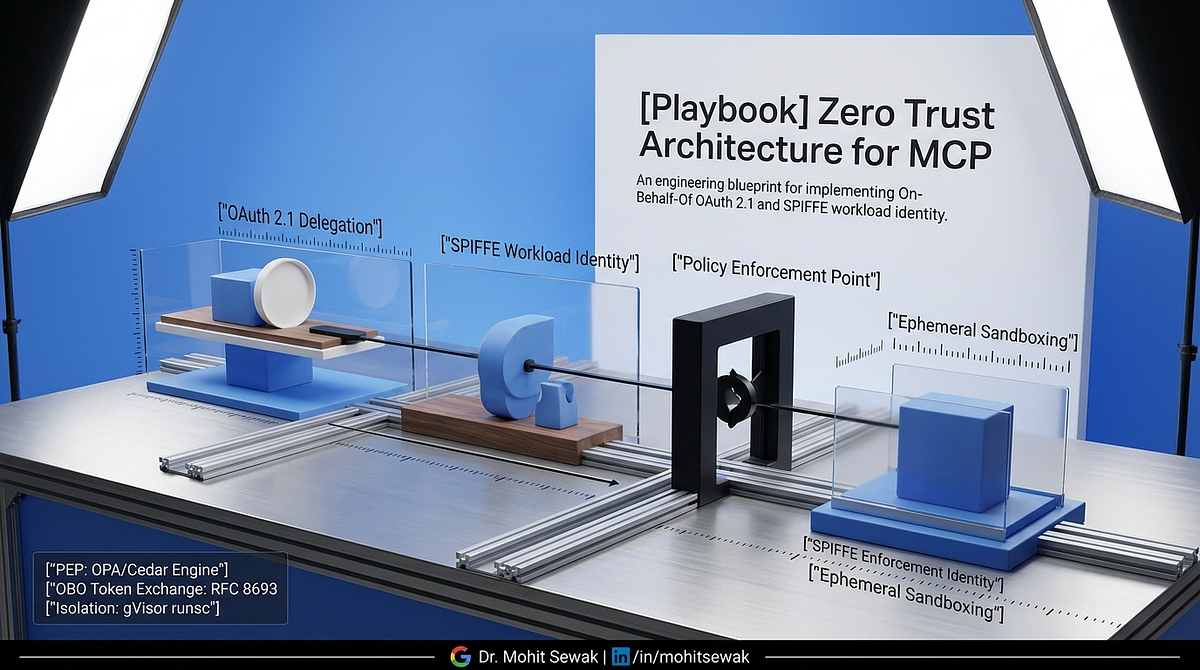
This article presents a technical blueprint for implementing Zero Trust Architecture (ZTA) in Model Context Protocol (MCP) systems, addressing critical security vulnerabilities in AI agent deployments.
What happened
The article identifies systemic security failures in MCP deployments where unauthenticated STDIO transports and ambient authority create audit loopholes. It proposes a Zero Trust architecture with semantic gateways, cryptographic token delegation, and runtime sandboxing to mitigate these risks.
Why it matters
The findings highlight critical vulnerabilities in AI agent infrastructure that could enable data exfiltration and unauthorized execution. The proposed architecture provides a framework for securing enterprise AI systems against sophisticated attacks.
- Unauthenticated STDIO transports create critical security gaps in AI systems
- Zero Trust requires decoupling identity delegation from stochastic model outputs
- Runtime sandboxing with gVisor is essential for containment
- Policy enforcement must occur outside the agent's execution context
- Security measures introduce measurable latency penalties requiring architectural trade-offs
The bigger picture
The article establishes a normative framework for securing AI agent systems, influencing enterprise security practices and protocol design. The latency trade-offs will require careful optimization in production environments.
The article provides a comprehensive technical framework for securing MCP systems through Zero Trust principles, addressing critical vulnerabilities in AI agent infrastructure while acknowledging the engineering trade-offs involved.
Technical details
- RFC 8693 On-Behalf-Of token delegation for identity downscoping
- SPIFFE/SPIRE workload identity management
- gVisor kernel-isolated sandboxes with net=none and read-only filesystems
- Open Policy Agent (OPA) policy decision points
- First-Order Computation Tree Logic (FO-CTL) for formal verification
FAQ
What percentage of MCP servers lack basic authentication?
91.8% of public MCP servers operate without basic authentication or OAuth boundaries.
What is the primary security mechanism proposed in the article?
The article proposes a Zero Trust Architecture combining RFC 8693 On-Behalf-Of token delegation, SPIFFE workload identities, and kernel-isolated sandboxing.
What latency penalties are introduced by the proposed security measures?
Token exchange and policy evaluation add 15-35ms per tool invocation, while sandboxing increases cold-boot times by 80-200ms.
How does the article address prompt-injection vulnerabilities?
By decoupling policy enforcement from the agent's execution context and using deterministic schema contracts instead of natural language instructions.
What formal verification method is mentioned?
First-Order Computation Tree Logic (FO-CTL) is used to verify system safety guarantees.
This summary and analysis were generated with AI from the original article and may contain errors. Read the original for the full story.
Read the full story
Originally published by Towards AI on Oct 10, 2026.
Comments
Sign in to join the discussion.