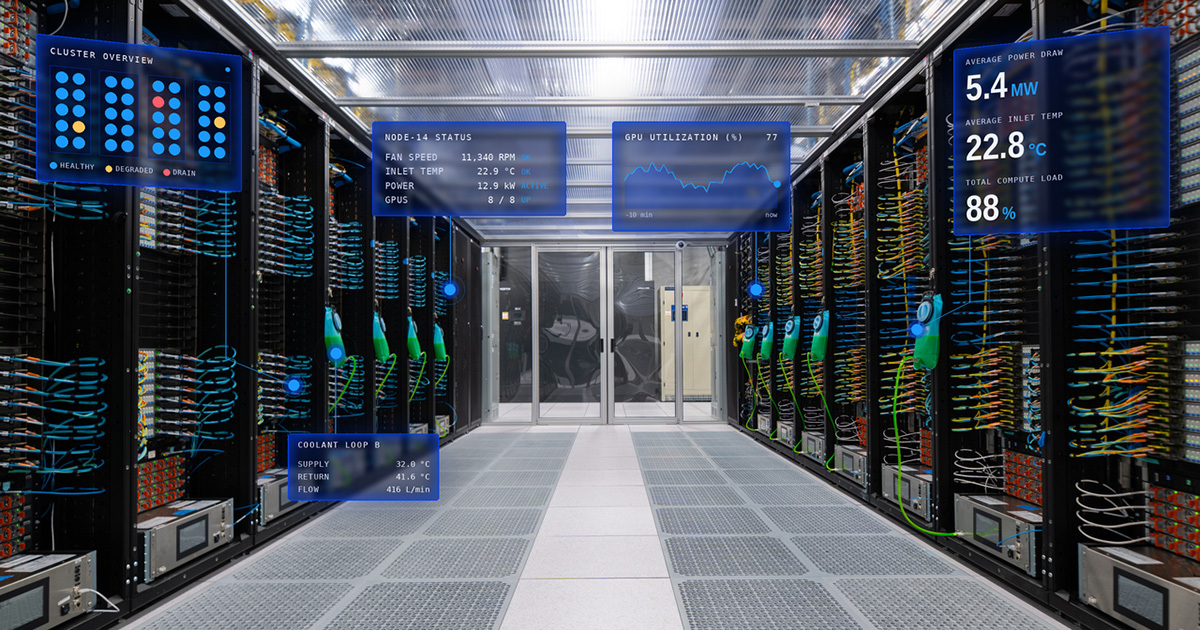
Agents on live hardware: reason where you must, engineer everywhere else
Five million signals a day, down to five alerts. How we used agents two different ways on one anomaly detection problem, and where the line moves over time.
Stay updated with the latest developments in Artificial Intelligence

Five million signals a day, down to five alerts. How we used agents two different ways on one anomaly detection problem, and where the line moves over time.
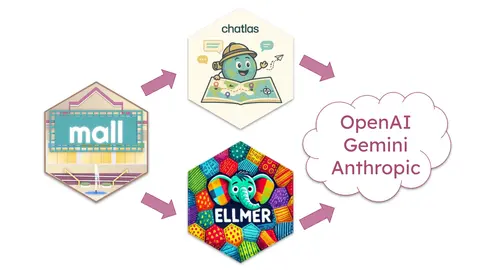
The mall 0.2.0 update for R and Python introduces support for external LLM providers like OpenAI and Gemini. This version also features parallel processing for R users, the ability to run NLP on string vectors in Python, and a brand new cheatsheet.
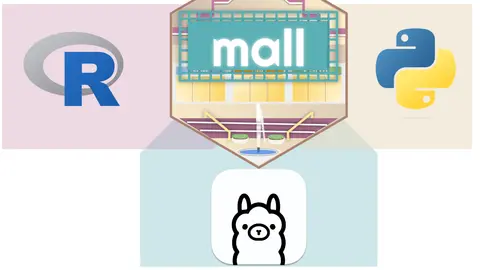
We are proud to introduce the {mall} package. With {mall}, you can use a local LLM to run NLP operations across a data frame. (sentiment, summarization, translation, etc). {mall} has been simultaneously released to CRAN and PyPi (as an extension to Polars).
We are thrilled to introduce {keras3}, the next version of the Keras R package. {keras3} is a ground-up rebuild of {keras}, maintaining the beloved features of the original while refining and simplifying the API based on valuable insights gathered over the past few years.
Highlights to the most recent updates to `sparklyr` and friends
Interact with Github Copilot and OpenAI's GPT (ChatGPT) models directly in RStudio. The `chattr` Shiny add-in makes it easy for you to interact with these and other Large Language Models (LLMs).
Hugging Face rapidly became a very popular platform to build, share and collaborate on deep learning applications. We have worked on integrating the torch for R ecosystem with Hugging Face tools, allowing users to load and execute language models from their platform.
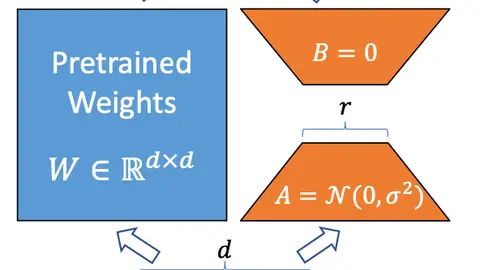
LoRA (Low Rank Adaptation) is a new technique for fine-tuning deep learning models that works by reducing the number of trainable parameters and enables efficient task switching. In this blog post we will talk about the key ideas behind LoRA in a very minimal torch example.
Implementing a language model from scratch is, arguably, the best way to develop an accurate idea of how its engine works. Here, we use torch to code GPT-2, the immediate successor to the original GPT.
This is a high-level, introductory article about Large Language Models (LLMs), the core technology that enables the much-en-vogue chatbots as well as other Natural Language Processing (NLP) applications.
Announcing safetensors, a new R package allowing for reading and writing files in the safetensors format.
torch v0.11.0 is now on CRAN. This release features much-enhanced support for executing JIT operations. We also amended loading of model parameters, and added a few quality-of-life improvements, like support for temporarily modifying the default torch device, support for specifying data types as…
Implementation and walk-through of LLaMA, a Large Language Model, in R, with TensorFlow and Keras.
Escnn, built on PyTorch, is a library that, in the spirit of Geometric Deep Learning, provides a high-level interface to designing and training group-equivariant neural networks. This post introduces important mathematical concepts, the library's key actors, and essential library use.
luz v0.4.0 is now on CRAN. This release adds support for training models on ARM Mac GPUs, reduces the overhead of using luz, and makes it easier to checkpoint and resume failed runs.
torch v0.10.0 is now on CRAN. This version upgraded the underlying LibTorch to 1.13.1, and added support for Automatic Mixed Precision. As an experimental feature, we now also support pre-built binaries, so you can install torch without having to deal with the CUDA installation.
Currently, in generative deep learning, no other approach seems to outperform the family of diffusion models. Would you like to try for yourself? If so, our torch implementation of de-noising diffusion provides an easy-to-use, easy-to-configure interface.
Please allow us to introduce Deep Learning and Scientific Computing with R torch. Released in e-book format today, and available freely online, this book starts out by introducing torch basics. From there, it moves on to various deep-learning use cases.
We code up a simple group-equivariant convolutional neural network (GCNN) that is equivariant to rotation. The world may be upside down, but the network will know.
Showing 18 of 30 stories
Load more storiesGet the top AI news and tools straight to your inbox every week.
Weekly · AI news from RStudio AI Blog
Join 15,000+ AI enthusiasts