

v0.7.0
LLM inference in C/C++. Contribute to ggml-org/llama.cpp development by creating an account on GitHub.
llama.cpp11 min read
Stay updated with the latest developments in Artificial Intelligence
LLM inference in C/C++. Contribute to ggml-org/llama.cpp development by creating an account on GitHub.


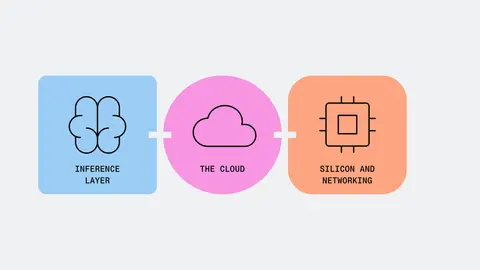
Enterprises can now run open models at production scale on a dedicated B300 inference cluster, built by Together AI, IBM Cloud, and NVIDIA
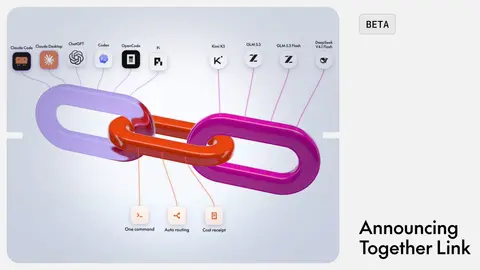
Together Link brings frontier open models like GLM 5.3 and Kimi K3 into the coding agent your team already uses, cutting model spend by over 50%.
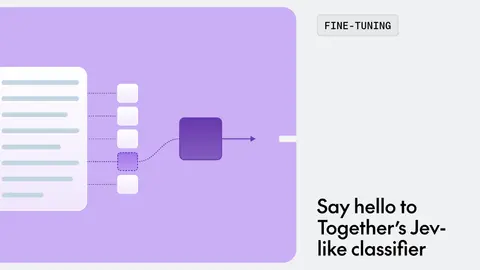
We just launched our own Jev-like classifier, together/Tev1-4B-experimental, on top of Qwen3.5 4B on Together’s serverless platform. In this blog post we’ll show you how to fine-tune your own version!
A hard model swap exposes every user at once, and rolling back means cold-starting the old deployment under pressure. Here's how staged traffic ramps, metric gates, and automatic rollback work on dedicated inference.

Inside a global bank's shift to self-serve dedicated inference: how Together's DMI gave engineering teams direct control over scaling, models, and testing.
Moving from closed to open source models can take weeks, not years. A five-stage playbook: discover, evaluate, adapt, decide, and production.
Together Fine-Tuning adds the latest open-weight models, live experiment tracking, Expert LoRA, early stopping, tokenized dataset previews, pre-flight validation, and lower training prices on selected models.
We ported ThunderKittens to NVIDIA's Vera Rubin NVL72 and rebuilt our NVFP4 GEMM around the new hardware, taking it from 42% of roofline to over 22 PFLOPS — competitive with cuBLAS and CuTe DSL. Here is what changed in the ISA and how we used it.
Together GPU Clusters now supports preemptible compute: the same GPU capacity at a flat 50% of the on-demand rate, with a five-minute drain window.
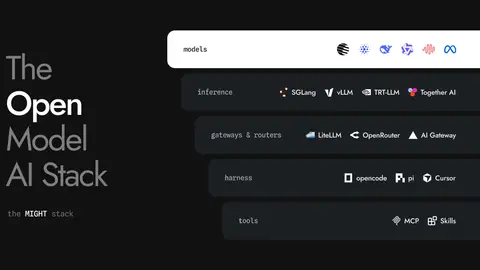
A deep dive into the open model AI stack — model, inference, gateways and routers, harness, and tools — and how keeping each layer independent lets you swap in a new open model in minutes instead of rebuilding your workflow.
We ran 900 DeepSWE rollouts on GLM-5.3 and GLM-5.3 Flash. Flash gives up 5.6 points of pass@1 at 17x lower cost, and only 2.6 points at pass@4.
We ran 904 DeepSWE rollouts on GLM-5.3 and Claude Fable 5. A tie on pass@1, but GLM-5.3 wins pass@4 and costs 5.4x less: \$3.99 per rollout vs. \$21.63.
We ran 904 DeepSWE rollouts on GLM-5.3 and GPT-5.6 Sol. Sol leads pass@1 by 3.7 points; GLM-5.3 wins pass@4 at half the cost, and a GLM-first cascade hits 85.9%.
We ran 904 DeepSWE rollouts on DeepSeek V4 Pro 0813 and GPT-5.6 Sol. Sol leads pass@1 by 10 points at 35x the cost; Pro wins pass@4, and a Pro-first cascade hits 83.0%.
We ran 904 DeepSWE rollouts on DeepSeek V4 Pro 0813 and Claude Fable 5. Fable leads pass@1 at 90x the cost; Pro wins pass@4, and a Pro-first cascade hits 82.7%.
Shadow traffic proves a candidate is operationally sound. It can't tell you if users like it better. Run the split at the endpoint instead of in your app code.
We ran 900 DeepSWE rollouts on DeepSeek-V4 Flash and GPT-5.6 Luna. Luna leads pass@1 by 14 points; DeepSeek delivers 4.8x the solves per dollar.
Kimi K3 is the first open 3T-class model. See how it benchmarks, what it costs, and how to call it on the Together AI API, with copy-paste code examples.
Showing 18 of 32 stories
Load more storiesGet the top AI news and tools straight to your inbox every week.
Weekly · AI news from Together AI Blog
Join 15,000+ AI enthusiasts