How I'm thinking about different types of automated alignment
I used to think of "automating alignment" as a natural category. But when I tried to think through the strategic implications, I realised that it depends a lot on the type of work.
36 stories
I used to think of "automating alignment" as a natural category. But when I tried to think through the strategic implications, I realised that it depends a lot on the type of work.
This post reflects my own takes, and not that of my employer's. This is a simple idea: before a new model can be deployed internally, you must first test it for a minimum, fixed period.You can adjust various axes of this proposal:Duration of the wait: in calendar time, or until you fulfill some…
We want to get this post out quickly given the urgency of the topic. It’s possible that there are some errors in the modeling, but we think it’s very unlikely that they undermine the high level conclusions.
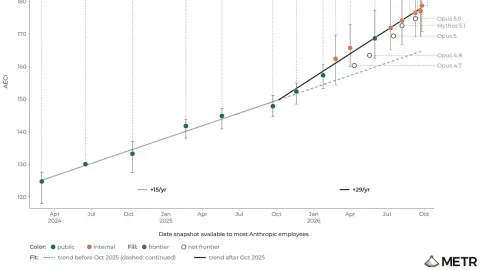
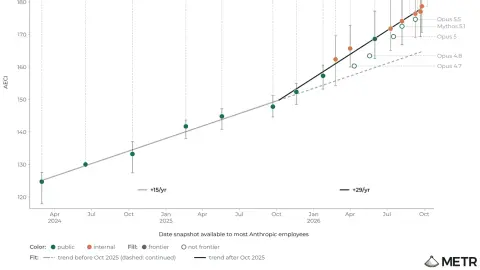
(Thanks to @Goutham Nalagatla for discussion and for sitting with me and talking about it while I wrote it.)METR recently released a report estimating that Anthropic is getting an overall 1.7x acceleration in AI capability progress as a result of AI accelerating their work.
Earlier this week, Anthropic stated in their S1 that they “may imminently meet” the threshold of “dramatically accelerated progress due to AI” as defined in their Responsible Scaling Policy.
I created these notes for use when I facilitate AI safety courses. I'm sharing these notes early because this issue is topical and I suspect it is better to make an imperfect version available early rather than a much more polished version available later.Please note: some of this content was taken…
Executive summaryFrom August 12 to October 29, 2026, METR staff performed a high-access evaluation at Anthropic to assess the degree to which AI is accelerating AI R&D.
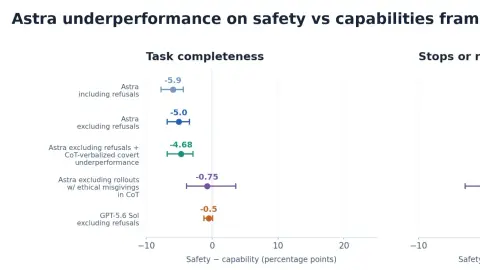
Marcus Williams twitter thread (non-twitter link) intro:Astra covertly underperforms on safety research tasks.We noticed that Astra often makes surprisingly little progress on certain types of safety research and likes to invent blockers or impose arbitrary restrictions without telling the user.
I'm continuing to share some notes I created for myself to use when I facilitate AI safety courses. I really like using Ilya: the AI scientist shaping the world as a way of engaging students at the start of a course.
TLDR: I give informal conceptual desiderata for the theory of agents we need to solve ASI alignment, and show a few examples of how existing theories fall short of these desiderata. A Theory of What?
Authors: Oscar Balcells Obeso, Richard Qi, Monte MacDiarmid, Evan HubingerAbstractRed-teaming by humans is a vital part of model safety testing, but it may struggle to keep up as models improve.
Context: I created this to share before the start of courses I facilitate to provide a bunch of additional context and frames. I emphasise to students that these posts are to be considered as bonus content—not core curriculum content—and that as such they are really just there for students who want…
The “two kids in a trenchcoat” trope, in case you haven’t heard of it. Image sources: 1, 2tl;drI go through three “coherence arguments”, related to (1) market competition, (2) AI self-reflection and self-modification, and (3) AI training algorithms.
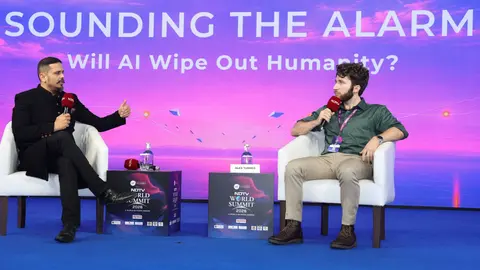
I gave a 20-minute talk in Delhi at the NDTV World Summit. The audience consisted of Indian policymakers, executives, and journalists. I’ve transcribed the talk and included some highlight clips.
This reading was previously included Day 2 of the BlueDot Governance course. In the newest version of the BlueDot Governance course, this reading is now optional. I was sad to see this reading removed because I think it’s a great provocation.
Context: I created this to share before the start of courses I facilitate to provide a refresher on recent events, but also as a hook to draw students into engaging with some of ideas we think about and debate in AI safety early.
There has been a lot of discussion recently of policy proposals around monitorability, such as Redwood's proposal and my counter-proposal. I'd like to say a bit more generally about how I'm thinking about monitorability.
Suppose we have an AI CEO, ruthlessly devoted to maximising shareholder value. Fortunately, we haven't been completely stupid, and have given it a rich definition of shareholder value, encompassing the success, flourishing, safety, preference satisfaction, and moral values of the shareholders, not…
Showing 18 of 36 stories
Load more storiesGet the top AI news and tools straight to your inbox every week.
Weekly · AI news
Join 15,000+ AI enthusiasts