Know a great AI tool or AI news source? Submit it to AiByts

cryptography

25 stories

Stories

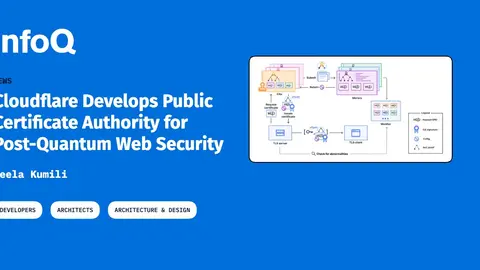
  • Cloudflare Develops Public Certificate Authority for Post-Quantum Web Security

    Cloudflare is developing a public certificate authority for Merkle Tree Certificates (MTCs) to reduce the bandwidth overhead of post-quantum cryptography. A Chrome experiment served billions of MTCs to 50% of Chrome Beta 146 for selected domains, reporting 9% faster median performance.

    InfoQ - AI/ML/Data3 min read
  • The post-quantum future of web privacy

    Cryptographic protocols like Privacy Pass help keep web sites safe from abuse while keeping their users private. This post looks at the quantum threat to these protocols, and some new post-quantum cryptography that may help close the gap.

    Moltworker Blog20 min read
  • A history of backdoors (2015)

    The past several months have seen an almost eerie re-awakening of the 'exceptional access' debate -- also known as 'Crypto Wars'. For those just joining the debate, theTL;DR is that law enforcement wants software manufacturers to build wiretapping mechanisms into modern encrypted messaging systems.

    Lobsters8 min read
  • Your Cryptography Conspiracy Theory Is Wrong

    This conversation plays out hundreds of times a day, but (thankfully) only a handful of those involve me: Person: "I have [problem]." Cryptography nerd: "Oh, you probably want to use [sensible recommendation]." Person: "Ah, well, can I really trust that? The NSA probably backdoored it 30 years ago.

    Lobsters17 min read
  • 4 real? Tracking exploitation and patching of eMudhra’s weak keys

    Four, just four: that’s the key to break into any unpatched connection on the Internet that is using eMudhra certificates. Here’s how we quickly patched Cloudflare, what evidence we can see of attempted exploitation, and how much of the rest of the Internet remains exposed.

    Moltworker Blog7 min read
  • The case of the 9 bit AES key

    Several PDF implementations advertise AES-256, but generate the 256-bit key from either a very small state space, or from insecure random sources.

    Lobsters6 min read
  • Keyless Entry: Hacking SwitchBot Smart Locks

    We've identified multiple vulnerabilities in devices of the popular SwitchBot Lock Pro smart lock series. The most critical, a cryptographic flaw in their bluetooth communication, allows everyone to silently open smart locks in a software-only attack.

    Lobsters10 min read
  • 8 eMudhra certificates are compromised. Here's what you need to know

    Following the discovery that eight eMudhra intermediate certificates use weak keys, Cloudflare is deploying mitigations and releasing client updates. We explain the impact, our response, and what customers and developers should do next.

    Moltworker Blog5 min read
  • The NIST Elliptic Curves Seeds Bounty Has Been Claimed

    We now know how the seeds of the NIST elliptic curves were generated: they’re not the hash of some saucy sentence, but the output of drand48() seeded with the time, which was indeed in 1997–98.

    Lobsters6 min read
  • The Future of AI Cryptanalysis

    Matthew Green has been writing a rather pessimistic series of posts about the potential for AI systems to vastly outperform humans in cryptanalysis of both symmetric and public-key ciphers. I am more optimistic than he is.

    Bruce Schneier4 min read
  • (Post-Quantum) Cryptographic Right Answers

    In the tradition started by Colin Percival and Thomas Ptacek, a set of “Cryptographic Right Answers” updated for the accelerated post-quantum transition timeline.

    Lobsters18 min read
  • Quoting Matthew Green

    Everyone is very concerned about being respectable, so I’m going to be the goofball who raises worst-case possibilities. I think there is a 1% chance we live in Minicrypt, and a 15% chance we functionally lose confidence in our existing public-key encryption algorithms.

    Simon Willison1 min read
  • The keys to the Internet change on October 11. Are you ready?

    On October 11, 2026, the DNS root switches to a new key-signing key (KSK-2024). Learn what this means for you, and how RFC 8509 trust anchor sentinels allow you to test whether your DNS resolver is ready for the rollover.

    Moltworker Blog8 min read

Showing 18 of 25 stories

Load more stories
AiByts Weekly Brief

Get the top AI news and tools straight to your inbox every week.

Weekly · AI news

Join 15,000+ AI enthusiasts