
AOSP Source Releases Are So Late Developers Disassemble Libraries to Report Bugs
Article URL: https://github.com/android/ndk/issues/2260 Comments URL: https://news.ycombinator.com/item?id=50083130 Points: 424 # Comments: 204
Hacker News4 min read
65 stories
Article URL: https://github.com/android/ndk/issues/2260 Comments URL: https://news.ycombinator.com/item?id=50083130 Points: 424 # Comments: 204
Building RAG from Scratch: No Frameworks Needed Understand Retrieval-Augmented Generation by building it yourself — pure Python, zero dependencies. Introduction LangChain, LlamaIndex, Haystack — great tools, but they hide how RAG actually works.

Services at a citizens’ office can benefit a lot from AI assistance. Starting from a simple chatbot that answers questions about building permits, parking fines and childcare benefits to more advanced applications where AI assists filing an application, reviewing such applications, and booking…
⭐️ Highlight ⚡️ Faster SentenceWindowRetriever SentenceWindowRetriever now queries the Document Store once per run or run_async call instead of once per retrieved document.
⭐️ Highlights 🧠 SummarizationCompactor: Compact Agent Context Without Losing It The experimental SummarizationCompactor is a new compaction strategy for CompactionHook. It replaces older turns and Agent steps with LLM-generated summaries.
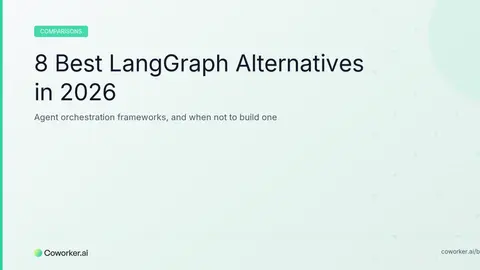
Coworker AI compares 8 LangGraph alternatives for agent orchestration: CrewAI, AutoGen, Semantic Kernel, Temporal and more, with honest trade-offs.

Simple RAG example on the Oscars using Llama 3.1 open models and the Haystack LLM framework. Installation ! pip install transformers-haystack sentence-transformers-haystack bitsandbytes Authorization you need an Hugging Face account you need to accept Meta conditions here:…
In this notebook, we will build a Haystack Retrieval Augmented Generation (RAG) Pipeline using self-hosted AI models with NVIDIA Inference Microservices or NIMs. The notebook is associated with a technical blog demonstrating the steps to deploy NVIDIA NIMs with Haystack into production.
Notebook by Stefano Fiorucci In this experiment, we will use Large Language Models to perform Information Extraction from textual data. 🎯 Goal: create an application that, given a URL and a specific structure provided by the user, extracts information from the source.
Evaluating the responses of Language Models and LLM-based applications often involves using model-based metrics that do not require ground truth labels.
Notebook by Sara Zanzottera and Bilge Yucel Amazon Sagemaker is a comprehensive, fully managed machine learning service that allows data scientists and developers to build, train, and deploy ML models efficiently.
Notebook by Bilge Yucel In this notebook, we will use Ollama, Gemma2 and Haystack to build a self-reflecting agent that can leverage web resources to augment its self-reflection and decision-making capabilities.
Notebook by Bilge Yucel Amazon Bedrock is a fully managed service that provides high-performing foundation models from leading AI startups and Amazon through a single API. You can choose from various foundation models to find the one best suited for your use case.
by Tuana Celik ( LI, Twitter) This is part one of the Advanced Use Cases series: 1️⃣ Extract Metadata from Queries to Improve Retrieval cookbook & full article 2️⃣ Query Expansion cookbook & full article 3️⃣ Query Decomposition cookbook & the full article 4️⃣ Automated Metadata Enrichment In this…
by Tuana Celik ( LI, Twitter) This is part one of the Advanced Use Cases series: 1️⃣ Extract Metadata from Queries to Improve Retrieval cookbook & full article 2️⃣ Query Expansion cookbook & full article 3️⃣ Query Decomposition & the full article 4️⃣ Automated Metadata Enrichment Query…
Notebook by Bilge Yucel Multilingual Generative QA Using Cohere and Haystack In this notebook, we’ll delve into the details of multilingual retrieval and multilingual generation, and demonstrate how to build a Retrieval Augmented Generation (RAG) pipeline to generate answers from multilingual hotel…
Notebook by Stefano Fiorucci In this experiment, we will use Large Language Models to perform Information Extraction from textual data. 🎯 Goal: create an application that, given a text (or URL) and a specific structure provided by the user, extracts information from the source.
When building applications with LLMs, writing effective prompts is a long process of trial and error. Often, if you switch models, you also have to change the prompt. What if you could automate this process?
Showing 18 of 65 stories
Load more storiesGet the top AI news and tools straight to your inbox every week.
Weekly · AI news
Join 15,000+ AI enthusiasts