

How to Check the Assumptions Behind Stakeholder Views
Find dependencies in stakeholder proposals without inventing what people believe. Prepare an assumption-check brief with evidence gaps and focused questions.
Hemory Blog5 min read
77 stories
Find dependencies in stakeholder proposals without inventing what people believe. Prepare an assumption-check brief with evidence gaps and focused questions.

Handle a conversation recorded partway through. Separate captured speech, later restatement, and recollection, then recover the explanation needed for work.

Trace a project risk from early clues to explicit warnings, test results, and mitigation. Record what was known and the response still needing an outcome.
Learn what a decision record captures, how it differs from meeting notes and a decision log, and when a separate entry helps. Includes a concise example.

Carry dependencies across meetings without confusing prepared, shared, accessible, and completed. Keep accepted conditions and the next needed input clear.
Trace a recurring work question through past conversations. Recover partial answers, follow referenced sources, and ask only for the information still missing.
Use voice-note templates for a reminder or developed idea. Preserve real conditions and reasoning, and track time-sensitive actions in your reminder system.
Keep estimates, secondhand reports, and confirmed plans distinct in meeting notes. See how to preserve uncertainty without making the whole update tentative.

Turn a concern that surfaced after a meeting into a follow-up question. Check what was discussed, separate your idea, and ask without assuming a solution.
Pair a sketch with a voice note to preserve a visual idea and its reasoning. Use clear labels, matching versions, and a source reference for later work.
Choose a quote, paraphrase, or summary for a work brief. Compare all three using one interview and preserve the meaning your reader needs.
Keep assumptions, reported approvals, and accepted choices distinct. Preserve valid delegation and ask only about the missing information that affects the work.
Build a project name map that distinguishes codenames, customer shorthand, phases, and unrelated names. Keep the right decisions attached to the right scope.
Bring ideas, customer needs, and decisions from real-world conversations into your AI workflow, with less note-taking, summarizing, and copying by hand.
Choose an AI note taker for your meetings and follow-up work. Compare capture, accuracy, search, integrations, privacy, and the manual work still required.
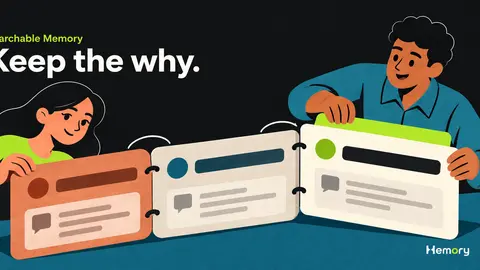
Copy a decision log template with essential fields, a completed example, and a simple way to track changes and find the reasoning behind past decisions.
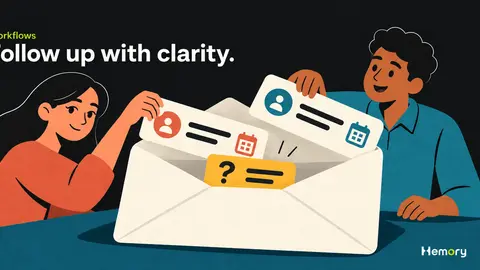
Write a meeting follow-up email with templates for teams, clients, and unresolved decisions, plus subject lines and an example grounded in a discussion.
Turn real-world conversations into searchable memory with Hemory. Revisit details, connect discussions, and use past context to answer new questions.
Showing 72 of 77 stories
Load more storiesGet the top AI news and tools straight to your inbox every week.
Weekly · AI news
Join 15,000+ AI enthusiasts