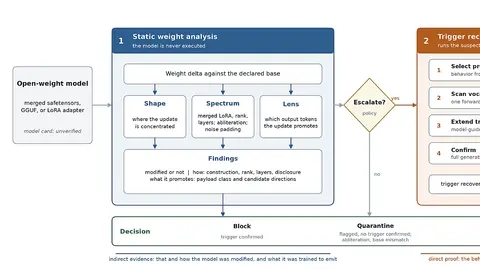
Hidden in the Weights: Supply Chain Risk from Backdoored LoRA Models
CrowdStrike researchers developed a two-stage approach to protect model supply chains by detecting LoRA backdoored models before deployment.
22 stories
CrowdStrike researchers developed a two-stage approach to protect model supply chains by detecting LoRA backdoored models before deployment.
We’re on a journey to advance and democratize artificial intelligence through open source and open science.
LoRA offers a parameter-efficient adaptation strategy, supporting multi-user workloads via customized adapters on a shared backbone. However, serving concurrent requests with different adapters introduces substantial computation and memory-management overhead.
I'm doing an MSc project on BrickNet (kulits/BrickNet on GitHub, CVPR 2026). It writes LEGO models as plain text and fine-tunes Qwen3 (I'm using 0.6B) with LoRA: a PT adapter that learns the text format, and an SFT adapter that conditions on a caption.
Multi-image reference for video is the turning point this episode is about: LTX-2.3 MSR takes several references, keeps them consistent over a long render, and does it through an IC-LoRA-based route with three-stage rendering.
Ascend says it validated LoRA fine-tuning of the 2.8-trillion-parameter Kimi K3.1 Pro on a 128-card Atlas 950 SuperPoD, citing a 15% average gain from Swap Core caching.
🔔 Join our next Applied AI cohort, taught by me and an OpenAI lead. Use YT25 for 25% off: https://maven.com/aishwarya-kiriti/genai-system-design?promoCode=YT25 Is fine-tuning dead?
Low-Rank Adaptation (LoRA) has become a key mechanism for efficiently specializing foundation models into many task- and user-specific variants. Serving many LoRA adapters under a shared resource budget turns post-hoc compression into a two-level allocation problem: rank must be distributed across…
Hey! We published a set of 6-step LoRAs, one without the upsampling step: https://huggingface.co/PrunaAI/P-Q-Image-2.1
Low-rank adaptation (LoRA) is usually tied to the pretrained backbone on which it is learned. We ask whether LoRAs trained independently for the same task on different pretrained backbones can be summed and applied unchanged to all contributing backbones.
Tongyan Lingzhi, incubated by the Beijing Institute for General Artificial Intelligence, is building personal AI that stores user and team skills in lightweight LoRA weights updated over time.
A typed decision maps evidence, a question and a fixed set of options to a probability for every option, computed in one forward pass, by reading a language model's logits or a small head over its hidden states, instead of generating and parsing text.
We’re on a journey to advance and democratize artificial intelligence through open source and open science.
Low-rank adaptation (LoRA) applies every rank-one component of its update to every token, and mixture-of-experts variants replace this with a learned router that activates a fixed number of components.
A practical guide to fine-tuning EmbeddingGemma with LoRA for custom retrieval, covering training pairs, negative sampling, and pitfalls.
Personalizing text-to-image diffusion models from a few reference images requires preserving subject identity while following prompts that describe new contexts.
We propose a fine-tuning method for flow-matching diffusion models aimed at realistic artificial light modeling without the need for a large training dataset.
Despite the widespread use of Low-Rank Adaptation (LoRA), little is known about its dynamics in continual learning and the mechanisms by which low-rank updates affect catastrophic forgetting.
Showing 18 of 22 stories
Load more storiesGet the top AI news and tools straight to your inbox every week.
Weekly · AI news
Join 15,000+ AI enthusiasts