NeurIPS 2026 Paris complimentary registration already full. Did any Top Reviewers get a spot? [D]
I was selected as a NeurIPS 2026 Top Reviewer and awarded complimentary registration.
Reddit - r/ML1 min read
359 stories
I was selected as a NeurIPS 2026 Top Reviewer and awarded complimentary registration.
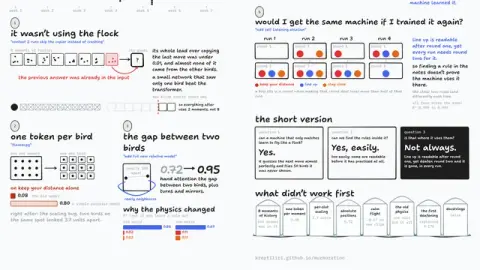
I wrote a small boid simulator (12 birds), recorded it flying, and trained a transformer to predict each bird's next move without it knowing about any boid rules.
I've been building open models that treat a decision as a closed-set scoring problem rather than text generation. The input is structured context plus a typed question with a fixed set of options.
OrcaRouter released OrcaCyber Zero 1.5, a gated cybersecurity model with a 1M-token context window. It reports 100% on Cybench and 95.8% on an evaluable CVE-Bench subset, priced at $3.00 / $7.50 per 1M tokens.
This is my first time ARR submission. I have a paper from the ARR 2026 August cycle with completed reviews and I understand the reviews remain valid for 6 months.
I have working programmatic control over a system, I can send inputs reliably and capture the screen as visual feedback. The control/feedback loop is already done.
I feel like I am unable to digest most machine learning research these days. The primary reason is because I feel like they have gotten tremendously wordy. I find it not uncommon to find research papers consisting of 20+, 30+, 40+ pages of pure texts.
ALHR- Adaptive learnable Hierarchical Routing is a static binary tree based system that uses learnable functions to REDUCE the amount of keys used. It takes less memory and SCALES much better VRAM with tokens submitted by /u/Alarming-Emotion-894 [link] [comments]
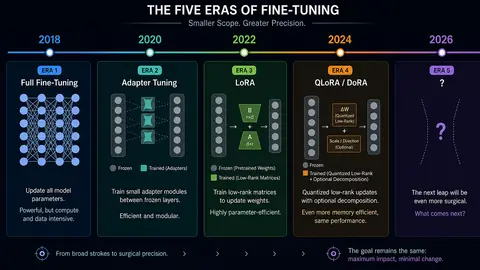
Last month I had a model, a dataset, and a GPU already warm. The old reflex said fine-tune. I didn’t. I sat there and asked whether…Continue reading on Towards AI »
I am a data scientist who started working in the industry before the LLM revolution. Back then, Jupyter Notebooks were a perfect fit for the classical DS pipeline: EDA -> data prep -> fit -> eval -> tune -> save model artefact and notebook.
Microsoft has released Microsoft-Decision-1, a decision model for routing, classification, verification and agent control. Microsoft-Decision-1 is a decision-scoring model that returns a calibrated probability for each fixed answer option instead of generated text.
OpenAI’s Decisions API is now in public beta on GPT-6 Luna. It returns typed probabilities, choices and scores about 10x faster than the Responses API, billing $0.10 per 1M input tokens with no output charges.
Talus generates 64x64 heightmaps (4 km, up to 1,200 m) conditioned on a terrain type and any subset of five measured properties: mean elevation, relief, mean slope, water fraction and spectral slope. I trained it from scratch on one RTX 5060 (8 GB), about 4.5 hours in total across versions.
We are expanding the Clef decision model family with Clef-omni, natively processing audio, video, images, and text in a single pipeline. We’ve also lowered Clef-flash pricing and boosted Clef inference speeds by up to 2.0x.
How a decision-first model can catch risky tool calls before they turn into real-world actions The post Can TypeSafe's Jev Make AI Agents Safer Without Another LLM? appeared first on Towards Data Science.
Should I address the reviewer comments/suggestions (minor things) in this version already or wait for camera ready if accepted?
ALHR - Adaptive Learnable Hierarchical Routing, uses static binary trees and learnable functions to minimize the amount of keys to be read.
Showing 72 of 359 stories
Load more storiesGet the top AI news and tools straight to your inbox every week.
Weekly · AI news
Join 15,000+ AI enthusiasts