

GPT-6 Cyber Security Evaluation: CodeRabbit’s Results
Across 33 benchmark cases, CodeRabbit’s ensemble with GPT-6 Cyber caught 22 known issues versus 19 without it and reported 66% more high- and medium-severity findings.
CodeRabbit Blog5 min read
15 stories
Across 33 benchmark cases, CodeRabbit’s ensemble with GPT-6 Cyber caught 22 known issues versus 19 without it and reported 66% more high- and medium-severity findings.

Bad synthetic data trains bad models. Before you feed it into your pipeline, you need objective quality signals. Here’s how to measure them.
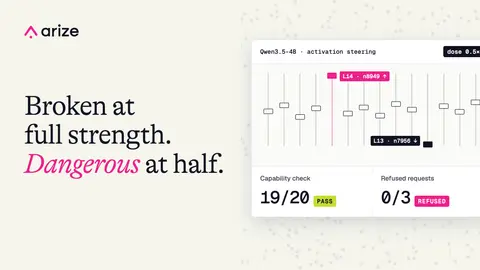
A one-neuron push turns Qwen3.5-4B hostile. At half strength it still does the sums and writes code, and it stops refusing. SBOMs and model signing tell you what you shipped. Only behavioral evals tell you what it does.

Understanding the architectural decisions behind ConvNeXt, advantages and disadvantages over Vision Transformers and older CNNs.Continue reading on Towards AI »

Decision models return a probability for each option in a fixed list. We tested whether image-capable decision models can play Tic-tac-toe, Minesweeper, and Flappy Bird from screenshots, and compared them with LLMs. The post Can decision models play games from screenshots?

Ten quantization guides, and not one threshold-dependent metric between them — what that gap hides, and the two numbers that close it. The post The Number Your Quantization Gate Doesn't Have appeared first on Towards Data Science.
Agents need labeled interaction data to improve. Synthetic data creates that data at scale while keeping real user data private. Learn how the data flywheel works and why it matters for training and evaluating AI.

METR will publish its own assessments of Anthropic’s risks, incidents, and practices, and the frontier AI model maker has given up the right to block them.
Self-improving agents need fresh, labeled data. Synthetic data lets teams scale evaluation and training loops faster than real data alone.
Real datasets miss the rare stuff that breaks your model. Synthetic data fills the gaps, lets you test safely, and cuts labeling cost. Here is how.

Here’s how to solve it exactly. The post Building Fair Evaluation Sets Is a Combinatorial Problem appeared first on Towards Data Science.

We test GPT-6 Astra on object detection, segmentation, counting, visual reasoning, and video, with examples, benchmark results, and cost comparisons.

GPT-6 Astra can return polygon outlines for any object you describe. They are not pixel masks, so we benchmarked them against SAM 3 and show how to combine the two.
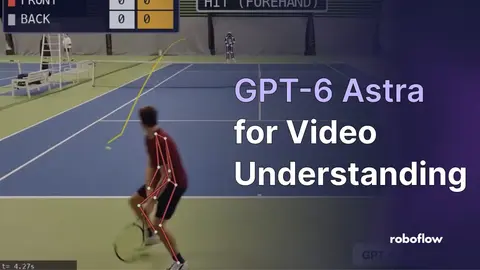
GPT-6 Astra has no video input, but a sequence of timestamped frames in one request gets you a timeline of events. Three demos: sports analytics, process monitoring and truck turnaround time.
See CodeRabbit’s GPT-6 Astra evaluation: cross-file bug detection, review findings, customer data protection, and the trade-offs in API cost.
Showing 15 of 15 stories
You're all caught up.
Get the top AI news and tools straight to your inbox every week.
Weekly · AI news
Join 15,000+ AI enthusiasts