

Gemini 4 Argon: Built to solve your hardest problems
We’re giving developers, enterprises, scientists, and consumers access to Gemini 4 Argon, our latest frontier model.
Google Official Blog13 min read
429 stories
We’re giving developers, enterprises, scientists, and consumers access to Gemini 4 Argon, our latest frontier model.
What Satya Nadella’s recent essay and research on agent failures reveal about building trustworthy AI architecture
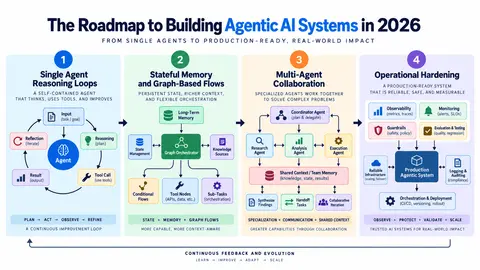
A four-level technical roadmap for building agentic AI systems, from single cognitive loops and stateful memory through multi-agent swarms and production observability.
A four level roadmap lays out how to move agentic AI from demo to production, starting with single agent cognitive loops and ending with observability for full multi agent systems.

Real repositories, seeded agent decisions: what 50,400 runs show about wasted turns, patch churn, and which harness rules help The post Coding Agents Can Solve the Task — But How Much Work Did They Waste? appeared first on Towards Data Science.
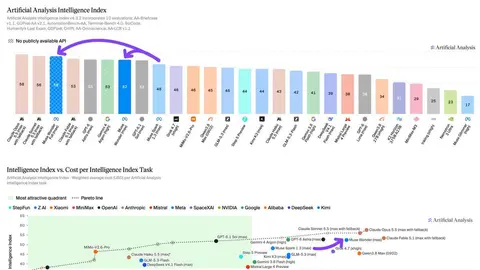
We have been coveringe MSL’s 14 month journey to becoming a frontier lab, but only today did the final ball drop: Meta’s Muse Wonder to match Spark and Glimmer, the way that OpenAI has Sol/Terra/Luna and Anthropic has Opus/Sonnet/Haiku.
Four architectures, one ladder. What each rung adds, what it really costs, how it fails, and how to pick the lowest rung that solves your problem well.
Agentic workflows sit between fixed automations and fully autonomous agents. Learn what they are, the patterns behind them, real examples, and a 5-question checklist for when to use one.
The future of local AI is agentic and requires multiple agents to share one machine: one agent summarising your emails overnight, one watching your health data and one doing the shopping, while you are still able to chat and ask questions in between.
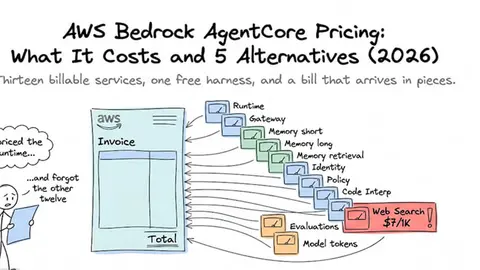
AgentCore pricing re-checked Oct 13, 2026: 12 meters, Runtime v1 at $0.0895 and v2 at $0.1276 per vCPU-hour, per-GB short-term memory, and 5 alternatives.
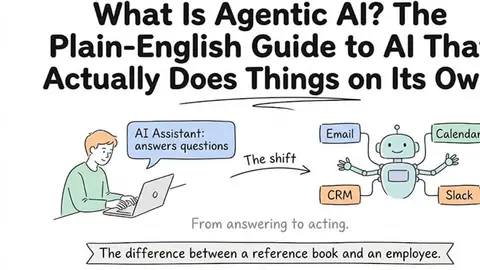
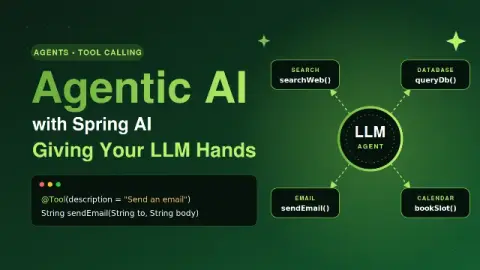
Agentic AI plans and acts toward a goal on its own. Plain definition, 2026 examples like OpenAI Dots and Meta Muse, and agentic AI vs AI agents vs assistants.
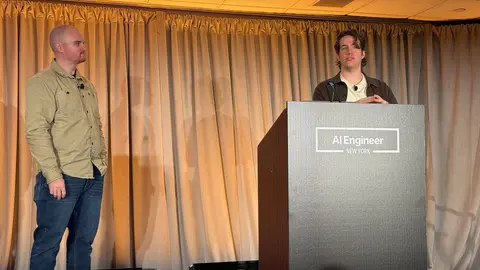
At AI Engineer New York, Anthropic drew on lessons from Unix and Linux to explain how agents can tackle bigger projects without overwhelming developers.
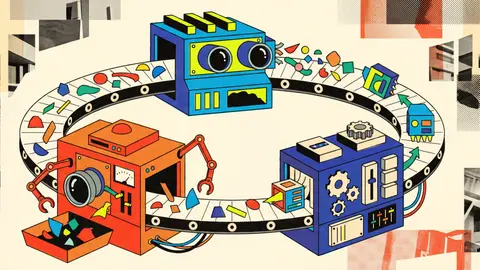
Sakana AI's MASS method lets one language model improve itself by solving tasks, judging results, and refining workflows, reaching a win rate of nearly 70 percent against the base model after two rounds.

By Alex Turner, Amber Scorah, and Karl Koch. Op-ed written for Fortune.Giving independent evaluators “employee-like access” is “a great idea”, OpenAI CEO Sam Altman said on September 12th.

Sakana AI's MASS framework lets a 27B model self-improve by learning from its own multi-agent teams, boosting research benchmark efficiency by up to 1.6x. The post Sakana AI Unveils MASS: A Self-Improving AI Loop Built On Its Own Collective Intelligence appeared first on Metaverse Post.
Large language models (LLMs) excel across diverse tasks, benefiting from knowledge priors, in-context reasoning, and test-time computation. Despite these strengths, single-model reasoning remains vulnerable to error propagation, as later steps depend on the model's earlier outputs, leaving…
Multi-agent systems are increasingly used to solve coding tasks by coordinating agents that share code and plans. These agents are often optimized with reinforcement learning (RL) using automated evaluators, but bypassing evaluation can earn reward without producing a genuine solution.
The continued improvement of large language models increasingly depends on synthetic experience, yet effective data synthesis for interactive agents requires not only executable and verifiable trajectories, but also interactions that provide learning value for the current task agent.
Showing 36 of 429 stories
Load more storiesGet the top AI news and tools straight to your inbox every week.
Weekly · AI news
Join 15,000+ AI enthusiasts