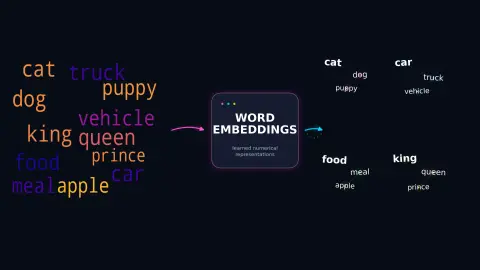
How Do Word Embeddings Capture Relationships Between Words?
Understanding how words become related in a learned vector space The post How Do Word Embeddings Capture Relationships Between Words? appeared first on Towards Data Science.
20 stories
Understanding how words become related in a learned vector space The post How Do Word Embeddings Capture Relationships Between Words? appeared first on Towards Data Science.
A practical guide to strengthening churn, CLV, and other traditional models with text The post How to Leverage NLP for Product Data Science appeared first on Towards Data Science.
We're rapidly transitioning to a computing landscape defined by highly general, increasingly autonomous agents. Driven by large language models (LLMs) that can dynamically generate plans and invoke external tools, these systems offer the potential for AI to seamlessly handle complex, multi-step…
Keyword search matches exact words, not concepts. Learn why traditional Boolean search fails modern tax practice and how natural language AI eliminates research bottlenecks.
AI agents have shown great potential in automating real-world tasks, such as conducting a Google Search, reading local computer files, or executing generated Python scripts. To achieve such agentic workflows, LLMs need to learn how to use tools correctly and efficiently.
Factuality is essential for making Large Language Models (LLMs) reliable. When a model answers a factual question incorrectly, is it because the fact was never encoded, or because the fact is encoded but not accessible?
Large language models (LLMs) are increasingly being deployed not just as coding assistants but as autonomous agents capable of conducting end-to-end scientific research workflows.
A large proportion of clinical diagnoses can be derived from language-based interviews alone. These diagnostic interviews are typically conducted by clinicians through doctor-patient interactions during in-person or remote visits.
Having powerful Large Language Models (LLMs) right in your pocket is now a reality with on-device models like Gemini Nano and Gemma. This technology enables everyday features on your phone — such as instantly summarizing a flurry of notifications or proofreading an important text message — all…
It is well-established that allowing large language models (LLMs) to generate step-by-step reasoning traces, commonly known as chain-of-thought (CoT), enhances performance on complex tasks.
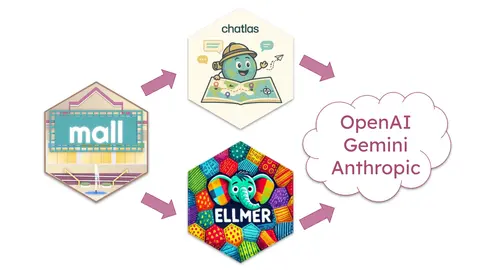
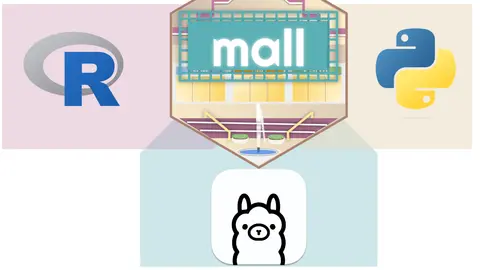
The mall 0.2.0 update for R and Python introduces support for external LLM providers like OpenAI and Gemini. This version also features parallel processing for R users, the ability to run NLP on string vectors in Python, and a brand new cheatsheet.
What is Qwen AI Artificial intelligence is evolving fast; models are becoming faster and better. It is no news that Artificial intelligence is here to stay. Qwen AI has gained a lot of attention recently, but what exactly is Qwen AI, and why is it a revolution in artificial intelligence?
We are proud to introduce the {mall} package. With {mall}, you can use a local LLM to run NLP operations across a data frame. (sentiment, summarization, translation, etc). {mall} has been simultaneously released to CRAN and PyPi (as an extension to Polars).
Large language model (LLM) advancements have led to a new paradigm that unifies various natural language processing (NLP) tasks within an instruction-following framework. This paradigm is exemplified by recent multi-task LLMs, such as T0, FLAN, and OPT-IML.
People use tables every day to organize and interpret complex information in a structured, easily accessible format. Due to the ubiquity of such tables, reasoning over tabular data has long been a central topic in natural language processing (NLP).
Large language models (LLMs) have significantly improved the state of the art for solving tasks specified using natural language, often reaching performance close to that of people.
Implementing a language model from scratch is, arguably, the best way to develop an accurate idea of how its engine works. Here, we use torch to code GPT-2, the immediate successor to the original GPT.
This is a high-level, introductory article about Large Language Models (LLMs), the core technology that enables the much-en-vogue chatbots as well as other Natural Language Processing (NLP) applications.
Showing 18 of 20 stories
Load more storiesGet the top AI news and tools straight to your inbox every week.
Weekly · AI news
Join 15,000+ AI enthusiasts