The Dot and the Swarm
I generally think I have done a good job anticipating the direction and pace of AI over the few years I have been writing this Substack, but I think I recently got something fairly large wrong.
One Useful Thing8 min read
21 stories
I generally think I have done a good job anticipating the direction and pace of AI over the few years I have been writing this Substack, but I think I recently got something fairly large wrong.
Agency is the initiative to act. Increasingly, it is going to determine what happens next with AI, and whether that is good or bad for us. But whose agency?
Every few months, I write a guide for people who want to use AI to do stuff. This time, a lot has changed, in part because what it means to “use AI to do stuff” encompasses so much more “stuff” than it used to.
If you feel like things are accelerating in AI, you are probably right. Better AI models from the leading American AI labs have been releasing more quickly than ever (though government interventions stopped access temporarily to two of the most powerful models, Claude Fable and GPT-5.6).
I had early access to the first Mythos-class AI model being released to the public, Claude 5 Fable. Much of the discussion of Mythos has centered on its impact on software security, but I tested it on everything except that (the guardrails around Fable essentially prevent it from being used for…
It has been two years since Co-Intelligence, my book about AI, was published, and it was successful beyond what I could have hoped (it was a New York Times bestseller and has been translated into 25+ languages, with the biggest markets being the Netherlands and Korea).
If you go to your favorite social media site, you will find it full of posts that start to look suspiciously similar to each other:
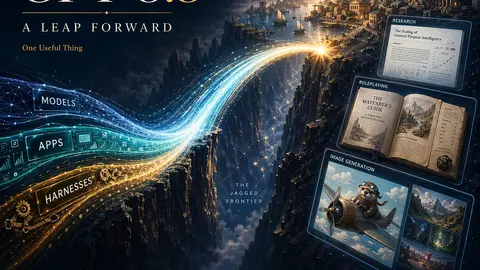
I had early access to GPT-5.51, and I think it is a big deal. It is a big deal because it indicates that we are not done with the rapid improvement in AI. It is also a big deal because it is just plain good.
We often lack the tools for the job, even if the AI is capable enough
In October of 2023, I wrote about the “Shape of the Shadow of the Thing,” speculating on the Thing that AI might turn into in the coming years. I think we can see the Thing much more clearly now, and some of the consequences that come with it.
I have written eight of these guides since ChatGPT came out, but this version represents a very large break with the past, because what it means to “use AI” has changed dramatically.
I just taught an experimental class at the University of Pennsylvania where I challenged students to create a startup from scratch in four days. Most of the people in the class were in the executive MBA program, so they were taking classes while also working as doctors, managers, or leaders in a…
I opened Claude Code and gave it the command: “Develop a web-based or software-based startup idea that will make me $1000 a month where you do all the work by generating the idea and implementing it. i shouldn’t have to do anything at all except run some program you give me once.
Back in the ancient AI days of 2023, my co-authors and I invented a term to describe the weird ability of AI to do some work incredibly well and other work incredibly badly in ways that didn’t map very well to our human intuition of the difficulty of the task.
I’ve been testing Google’s new Gemini 3 model. It is very good. But rather than give you benchmark numbers, I’m going to show you how far AI has come in three years by asking the AI to demonstrate it.
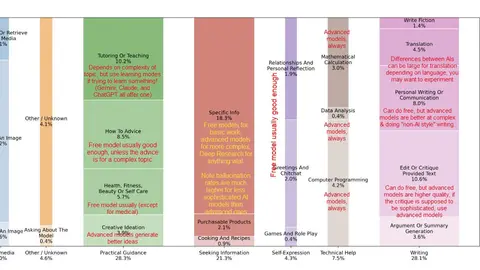
As AI advice becomes more important, we are going to need to get better at assessing it
Every few months I write an opinionated guide to how to use AI1, but now I write it in a world where about 10% of humanity uses AI weekly. The vast majority of that use involves free AI tools, which is often fine… except when it isn’t.
Showing 18 of 21 stories
Load more storiesGet the top AI news and tools straight to your inbox every week.
Weekly · AI news
Join 15,000+ AI enthusiasts