Midmarket AI is not enterprise AI at a smaller scale
Learn how midmarket companies can move AI from pilots to production with focused investments, in-house strategy, expert partners, and clear governance.
VentureBeat AI6 min read
52 stories
Learn how midmarket companies can move AI from pilots to production with focused investments, in-house strategy, expert partners, and clear governance.
Gartner predicts 40% of enterprise applications will include task-specific AI agents by the end of 2026, up from less than 5% in January. The firm named agentic AI oversight its top cybersecurity trend for 2026, flagging identity registration and policy-driven authorization for machine actors as a…
A year-old startup called Octen is expanding its search service for AI agents with a model that locates web pages in roughly 10 milliseconds, a $20 monthly subscription for unlimited web searches, and image search.Read more
Explore four questions for running open AI models in production, covering deployment, GPU capacity, serving-stack management, accelerators and benchmarking.
Decision models are hot right now: The internet is buzzing about Jev (from TypeSafe AI), Clef from Cloudflare, and the Decisions API from OpenAI. These models provide low latency by skipping verbose text generation and returning structured outputs in JSON format, along with confidence…
Orchestrator.inc takes coding agents from task to merged PR. Munder Difflin runs a team of agents for all knowledge work. Compared, checked 6 Nov 2026.
Outshift’s Vijoy Pandey explains why AI agents agree on wrong answers—and why enterprises need coordination beyond shared context and lower token costs.
In computing, whenever a cheaper, more open alternative shows up, it’s often framed as a winner-takes-all fight to the finish. We saw it with Linux and Windows, and again with Android and iOS.
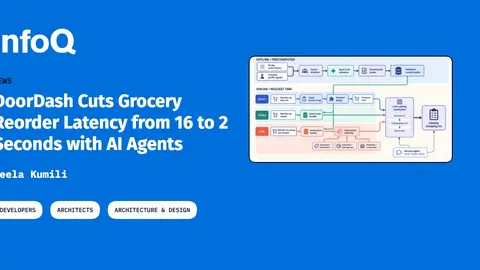
DoorDash reduced grocery reorder latency from 16 to 2 seconds by precomputing recurring purchase needs using batch LLM inference and deterministic validation. Live catalog resolution keeps product selections current, while an editable shopping interface avoids unnecessary model calls.
Microsoft subsidiary and popular code repository hosting service GitHub is rolling out a system that decides which AI models should handle a software development task — and, according to independent testing, can approach the performance of a leading coding agent for roughly half the expense.Read…
Salesforce is detailing the next phase of its Agent Fabric platform, with evaluations designed to identify malfunctioning AI agents and initiate corrective action, alongside expanded discovery capabilities and previously announced spending and governance controls.Read more
The harness surrounding an AI coding model — its system prompt, tools and context-management rules — can triple the cost of solving coding problems without producing a measurable improvement in accuracy, according to new research. AI vendors regularly advertise accuracy gains from harness updates.
Capital One’s Maureen Jules-Perez explains why effective enterprise AI should reduce prompts, interfaces and workflow friction while giving employees more room for judgment and expertise.
Accurate data isn’t enough for AI agents. SAP’s Yaad Oren explains why business context, semantics and governance are critical to reliable decisions.
AI agents are being given the ability to optimize their own components, such as prompts, context management, workflows, and code. However, current self-evolving harness optimizers usually draw on the pre-existing knowledge of the underlying models or trajectories that the agent has explored so…
Enterprises that run more than a handful of AI agents in production face risk, cost and oversight burdens that grow exponentially with every agent they add, says Felix Van de Maele, founder and CEO of data governance company Collibra.
Falling token prices have led many enterprises to assume AI costs will fall with them. Agents are breaking that assumption.Read more
Enterprise multi-agent workflows typically use rigid, pre-scripted pipelines or simple voting mechanisms to aggregate the responses of multiple agents. These approaches break down when complex problems cannot be divided into neat subtasks in advance or none of the models in the AI system has the…
Showing 18 of 52 stories
Load more storiesGet the top AI news and tools straight to your inbox every week.
Weekly · AI news
Join 15,000+ AI enthusiasts