
Welcome Muse Spark Open: open-weight frontier multimodal mixture-of-experts model from Meta
We’re on a journey to advance and democratize artificial intelligence through open source and open science.
Hugging Face Blog20 min read
49 stories
We’re on a journey to advance and democratize artificial intelligence through open source and open science.
🤗 Transformers: the model-definition framework for state-of-the-art machine learning models in text, vision, audio, and multimodal models, for both inference and training. - Release Release v5.20.0 · huggingface/transformers

You can teach an open-weight LLM to text like a specific persona: their slang, their reply length, their humor, even how they write in a roleplay scene, creative writing exercise, or chatbot customer interactions.
Parameter-efficient fine-tuning has hundreds of methods, usually compared by parameter count and benchmark score. We compare them as maps. A pretrained checkpoint is a base point in weight space, and a weight-space method is a smooth map from a small parameter space that starts at that point.
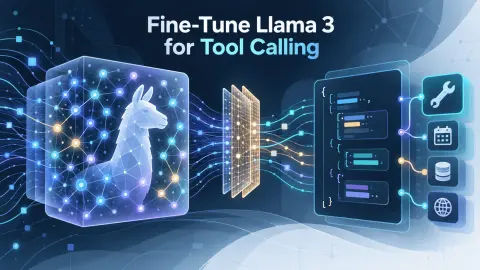
Llama 3 is a capable generalist, but that's exactly the problem when you need an agent that reliably outputs structured JSON for a specific API.
Comparing parameter-efficient fine-tuning recipes under a single, shared learning rate is a common but flawed practice: when the arms being compared have very different trainable-parameter counts, a shared rate can simultaneously depress the larger arms' means and inflate their variance,…
🤗 Transformers: the model-definition framework for state-of-the-art machine learning models in text, vision, audio, and multimodal models, for both inference and training. - Release Release v5.19.0 · huggingface/transformers
Continual parameter-efficient fine-tuning for large language models (LLMs) must balance retention of previously acquired knowledge, adaptation to new tasks, and strict parameter budgets.
Go ahead and axolotl questions. Contribute to axolotl-ai-cloud/axolotl development by creating an account on GitHub.
🤗 Transformers: the model-definition framework for state-of-the-art machine learning models in text, vision, audio, and multimodal models, for both inference and training. - Release Release 5.18.0 · huggingface/transformers
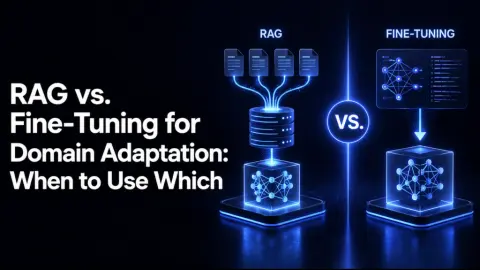
In this article, you will learn the mechanical difference between retrieval-augmented generation and fine-tuning, when each technique is the right tool, and how to decide...
We’re on a journey to advance and democratize artificial intelligence through open source and open science.
Go ahead and axolotl questions. Contribute to axolotl-ai-cloud/axolotl development by creating an account on GitHub.
TensorRT LLM provides users with an easy-to-use Python API to define Large Language Models (LLMs) and supports state-of-the-art optimizations to perform inference efficiently on NVIDIA GPUs.
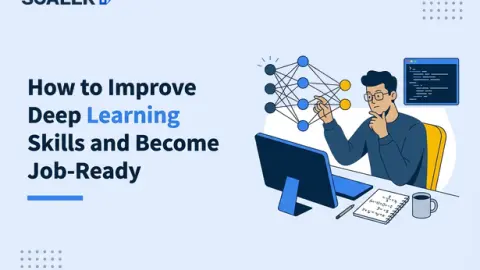
You can finish three deep learning courses, build a CNN, and still find yourself stuck when the same model stops working on your own dataset. Maybe changing a few parameters does nothing, the validation loss starts behaving strangely, or the model simply refuses to learn.
TensorRT LLM provides users with an easy-to-use Python API to define Large Language Models (LLMs) and supports state-of-the-art optimizations to perform inference efficiently on NVIDIA GPUs.
🤗 Transformers: the model-definition framework for state-of-the-art machine learning models in text, vision, audio, and multimodal models, for both inference and training. - Release Release: v5.16.0 · huggingface/transformers
🤗 Diffusers: State-of-the-art diffusion models for image, video, and audio generation in PyTorch. - Release Diffusers 0.40.0: New pipelines, tensor-parallel support, improved CLI, and more · huggingface/diffusers
Showing 36 of 49 stories
Load more storiesGet the top AI news and tools straight to your inbox every week.
Weekly · AI news
Join 15,000+ AI enthusiasts