Know a great AI tool or AI news source? Submit it to AiByts

PyTorch

203 stories

Stories

← Back to the latest stories
  • Hugging Face Integrations

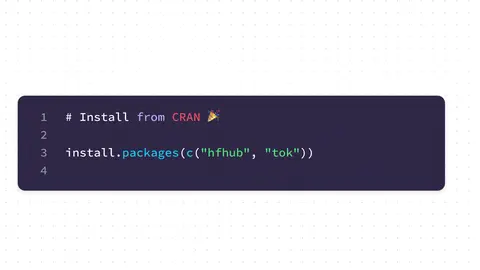
    Hugging Face rapidly became a very popular platform to build, share and collaborate on deep learning applications. We have worked on integrating the torch for R ecosystem with Hugging Face tools, allowing users to load and execute language models from their platform.

    RStudio AI Blog4 min read
  • Understanding LoRA with a minimal example

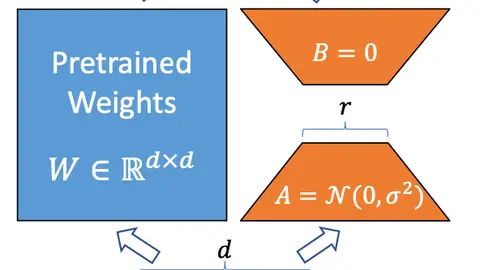
    LoRA (Low Rank Adaptation) is a new technique for fine-tuning deep learning models that works by reducing the number of trainable parameters and enables efficient task switching. In this blog post we will talk about the key ideas behind LoRA in a very minimal torch example.

    RStudio AI Blog7 min read
  • GPT-2 from scratch with torch

    Implementing a language model from scratch is, arguably, the best way to develop an accurate idea of how its engine works. Here, we use torch to code GPT-2, the immediate successor to the original GPT.

    RStudio AI Blog15 min read
  • safetensors 0.1.0

    Announcing safetensors, a new R package allowing for reading and writing files in the safetensors format.

    RStudio AI Blog4 min read

  • torch 0.11.0

    torch v0.11.0 is now on CRAN. This release features much-enhanced support for executing JIT operations. We also amended loading of model parameters, and added a few quality-of-life improvements, like support for temporarily modifying the default torch device, support for specifying data types as…

    RStudio AI Blog4 min read

  • Group-equivariant neural networks with escnn

    Escnn, built on PyTorch, is a library that, in the spirit of Geometric Deep Learning, provides a high-level interface to designing and training group-equivariant neural networks. This post introduces important mathematical concepts, the library's key actors, and essential library use.

    RStudio AI Blog16 min read
  • luz 0.4.0

    luz v0.4.0 is now on CRAN. This release adds support for training models on ARM Mac GPUs, reduces the overhead of using luz, and makes it easier to checkpoint and resume failed runs.

    RStudio AI Blog4 min read

  • torch 0.10.0

    torch v0.10.0 is now on CRAN. This version upgraded the underlying LibTorch to 1.13.1, and added support for Automatic Mixed Precision. As an experimental feature, we now also support pre-built binaries, so you can install torch without having to deal with the CUDA installation.

    RStudio AI Blog5 min read
  • De-noising Diffusion with torch

    Currently, in generative deep learning, no other approach seems to outperform the family of diffusion models. Would you like to try for yourself? If so, our torch implementation of de-noising diffusion provides an easy-to-use, easy-to-configure interface.

    RStudio AI Blog7 min read
  • Deep Learning and Scientific Computing with R torch: the book

    Please allow us to introduce Deep Learning and Scientific Computing with R torch. Released in e-book format today, and available freely online, this book starts out by introducing torch basics. From there, it moves on to various deep-learning use cases.

    RStudio AI Blog4 min read

  • AO, NAO, ENSO: A wavelet analysis example

    El Niño-Southern Oscillation (ENSO), North Atlantic Oscillation (NAO), and Arctic Oscillation (AO) are atmospheric phenomena of global impact that strongly affect people's lives.

    RStudio AI Blog19 min read
  • Wavelet Transform - with torch

    torch does not have built-in functionality to do wavelet analysis. But we can efficiently implement what we need, making use of the Fast Fourier Transform (FFT). This post is a very first introduction to wavelets, suitable for readers that have not encountered it before.

    RStudio AI Blog18 min read
  • torch 0.9.0

    torch v0.9.0 is now on CRAN. This version adds support for ARM systems running macOS, and brings significant performance improvements.

    RStudio AI Blog4 min read

  • Discrete Fourier Transform - with torch

    About the Fourier Transform, it has been said that it is one of the greatest wonders of the universe. At the same time, it can be realized in a mere half-dozen lines of code.

    RStudio AI Blog22 min read

Showing 198 of 203 stories

Load more stories
AiByts Weekly Brief

Get the top AI news and tools straight to your inbox every week.

Weekly · AI news

Join 15,000+ AI enthusiasts