miniCOIL EN-ES: Sparse Neural Retrieval Across the Language Barrier
Sparse neural retrieval finally started getting more and more attention (SPARSEUP, MILCO, sparse encoders in Sentence Transformers…). Well, amazing, we like attention!
14 stories
Sparse neural retrieval finally started getting more and more attention (SPARSEUP, MILCO, sparse encoders in Sentence Transformers…). Well, amazing, we like attention!
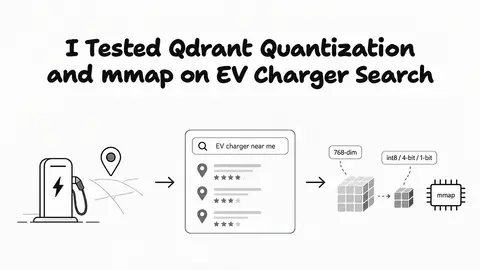
I Tested Qdrant Quantization and mmap on EV Charger Search What got smaller, what stayed accurate, and where the memory really went When I started this project, I had a question in mind: if a …
We choose embedding models, dimensions, and indexes. The geometry usually comes with the package. But why use a flat space, and what else could we choose? What Is a Manifold, and Where Do Our Vectors Live? A manifold is the space our embeddings live in.
Memory Tiers in Qdrant: What to Use and When A growing vector collection eventually outgrows the RAM it started with: Qdrant handles that by letting you assign dense vectors, the HNSW graph, quantized vectors, payloads, and payload indexes each to whichever memory tier that structure supports,…
A bulk load finishes, and the collection looks ready: every point is in, and the upload call has returned. Then the first queries land, and search takes hundreds of milliseconds, sometimes several seconds at a stretch, while Qdrant’s indexing, merge, and vacuum optimizers work through the backlog…
Hybrid Search in Qdrant A search result can look plausible and still be wrong. Dense retrieval can return a document on the right topic but miss an exact identifier copied into the query. Sparse retrieval can miss a relevant document when the query describes it with terms the corpus doesn’t use.
When Your Collection Outgrows RAM Once a collection no longer fits in RAM, the kernel evicts vector pages, and the next query waits on a disk read to get them back. Quantization buys that memory back.
When Is a Reranker Worth It? Before you tune a reranker, use the pre-tuning checks to verify index state and set a labeled baseline. Your candidate list can already contain documents your ranking never shows.
How to Tune Hybrid Search in Qdrant Before you tune fusion, use the pre-tuning checks to verify index state and set a labeled baseline. Hybrid search retrieves dense and sparse candidate lists, then fuses them into one ranking.
Candidate Depth: How Much Retrieval Is Enough? Before you tune candidate depth, use the pre-tuning checks to verify index state and set a labeled baseline. Everything below measures against that baseline. Candidate depth is the number of candidates a retrieval stage passes to a later ranking stage.
What to Check Before Tuning a Qdrant Collection Before you change a setting, decide what better retrieval means for your workload. The right document at rank one, more candidates for a reranker, lower latency, and a smaller memory footprint each favor different settings, so pick your goal first.
Filtered vector search breaks when metadata filters turn a healthy nearest-neighbor graph into scattered islands. HNSW’s m parameter controls how many links each point gets. At Qdrant’s default m=16, the one-million-point collection benchmarked below averaged about 21 links per node on layer 0.
Is RAG Dead? The Role of Vector Search in AI Efficiency When Anthropic came out with a context window of 100K tokens, they said: “Vector search is dead. LLMs are getting more accurate and won’t need RAG anymore.” Google’s Gemini 1.5 now offers a context window of 10 million tokens.
Bulk Uploading Data to Qdrant Why Bulk Uploading Matters When you start using Qdrant at scale, one of the first challenges you may run into is uploading large amounts of data efficiently. Small uploads are usually straightforward, but bulk ingestion introduces a different set of concerns.
Showing 14 of 14 stories
You're all caught up.
Get the top AI news and tools straight to your inbox every week.
Weekly · AI news
Join 15,000+ AI enthusiasts