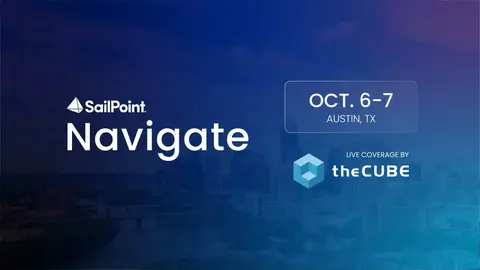
What to expect at SailPoint’s Navigate event: Join theCUBE Oct. 6–7
Agentic artificial intelligence is changing the identity security equation. Enterprises are no longer governing access only for employees and traditional machine identities.
87 stories
Agentic artificial intelligence is changing the identity security equation. Enterprises are no longer governing access only for employees and traditional machine identities.
The companies featured at the recent Bank of America Private Tech Trailblazers Conference point to where the next wave of AI growth is taking shape: specialized technology built around proprietary data, industry-specific workflows and, increasingly, purpose-built hardware.
AI-native cybersecurity requires defenses that can keep pace with attackers while protecting infrastructure that never stops running. That challenge is bringing security expertise and specialized computing closer together, with automation embedded throughout the systems enterprises use to train and…
Artificial intelligence is turning nearly every enterprise workload into a data workload, and data governance is becoming the test of whether companies can trust autonomous systems with the infrastructure underneath. The question is no longer only where data lives, but what is allowed to act on it.
Agent workload isolation is becoming a practical infrastructure challenge as research teams move beyond training models to running code and testing agents. Systems built for intensive computation must now accommodate workloads that interact with tools, storage and other services.
An enterprise AI foundation depends on more than models and agents. It also requires governed operational data and infrastructure that can carry AI into production, a foundation-first approach emerging among Brazilian companies. Technology company TOTVS S.A.
The neocloud market is moving past its origins as a stopgap for scarce graphics processing units. AI-native startups now choose their infrastructure on latency, burst capacity and openness, not just chip availability.
As open-weight models close in on the performance of proprietary frontier systems, enterprises are gaining a credible way to run generative AI on hardware they own. That shift puts the data already sitting in corporate storage at the center of the private AI conversation.
As enterprises push AI out of pilots and into production, FlexPod, the converged infrastructure franchise built by NetApp Inc. and Cisco Systems Inc., is being recast as a pretested answer to AI’s complexity. Customers want a trusted platform, not a pile of parts to integrate themselves.
Artificial intelligence has pulled data infrastructure out of the back office and into conversations with buyers who never had to think about storage before. For longtime storage providers, that shift is a rare chance to retell their story to an audience with no preconceptions. NetApp Inc.
AI agent infrastructure is evolving to support systems that move continuously among inference, feedback and training. Cognition AI Inc.’s Devin now assists throughout the software development lifecycle, from planning and writing code to reviewing it and responding to production problems.
Storage architecture is being rewritten for artificial intelligence factories. Traditional enterprise storage was designed around workloads that scaled in relatively predictable ways.
AI factory economics increasingly depend on more than access to high-performance graphics processing units. As agentic systems draw on multiple models, databases and tools, the entire data center must work as one computing system.
For enterprises, data resiliency ultimately comes down to an ability for useful work to continue. The definition sounds simple, yet making sure that data in critical systems is fully protected and accessible as rapidly as possible is a complicated task.
Token economics are becoming a defining measure of artificial intelligence infrastructure efficiency. As AI workloads move beyond training, the economics of producing useful intelligence are starting to shape infrastructure decisions.
Intelligent data infrastructure is becoming critical as enterprises move artificial intelligence from curated pilots into production. NetApp Inc. is positioning its Novus architecture for that transition.
An agent gateway moves identity security beyond deciding who gets through the front door to governing what autonomous AI agents do once inside. By sitting in the path of attempted actions, the gateway can enforce authorization decisions at runtime. Okta Inc.
Opening a Model Context Protocol server, or MCP server, to customers’ AI tools is becoming standard for fintech companies, but in payments a rogue agent does not just leak data — it moves money. That raises the bar for how agents are identified, logged and stopped.
Showing 72 of 87 stories
Load more storiesGet the top AI news and tools straight to your inbox every week.
Weekly · AI news
Join 15,000+ AI enthusiasts