How Jev Cut Our Classification Cost by 20×
We moved bounded classification decisions in Ari from general-purpose LLM calls to TypeSafe's Jev, at roughly one-twentieth the cost and 10–15× the speed.
Oats Blog6 min read
27 stories
We moved bounded classification decisions in Ari from general-purpose LLM calls to TypeSafe's Jev, at roughly one-twentieth the cost and 10–15× the speed.
oats is public, so anyone can file an issue, and most of maintaining it is toil. GitHub Actions workflows run Claude Code on a self-hosted runner. Three save the most time: auto-classification of every issue; autofix for bugs, critical review findings, and tasks, which it declines without…
At Ariso, we each review tens of pull requests a day. A GitHub Action prepares the handoff: when a draft becomes ready for review, Claude Code assesses risks, blockers, regressions, deleted behavior, and specific human checks.
A hot take sparked by a Reddit thread about AI burnout: junior engineers should still learn data structures, architecture, and system design, because none of it is tied to a specific language.
Every project management tool shipped agents this year, so "AI-powered" stopped meaning anything — most of it is a chat window bolted onto a backlog humans still maintain by hand.
Every week an engineer I respect tells me they're worried a coding agent is coming for their job. Engineers spend about 30% of their time writing code, and the more senior you get, the less you write. The agents took the typing.
I opened 80 pull requests in a two-week sprint by assigning tasks to an agent and walking away from my machine. The tool is called Ivan, it's free and open source, and it runs natively in GitHub Actions.
We mentioned a bug in a meeting on Tuesday. This morning, Claude Code suggested fixing it the moment I opened my terminal — and twenty minutes later there was a PR. Here's how ari-hooks wires Ari into Claude Code, and why we don't use a ticketing system anymore.
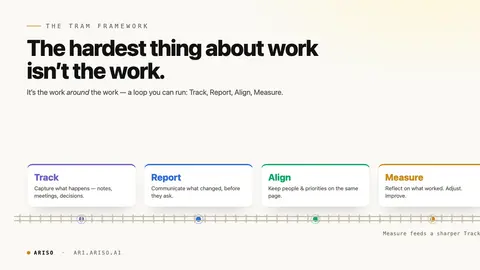
Early in my career, a mentor gave me a simple system: tell people what you're going to do, do it, then tell people you did it. From engineer to consultant to founder, I've learned that was the start of the biggest lesson of my career — the hardest thing about work isn't the work, it's the work…
A year of building together made it obvious. Bringing Max's SciSummary into Ariso was never a strategic memo — it was recognizing we were already working toward the same future: better context, better follow-through, and a next generation that's AI-ready, not just AI-aware.
Most ChatOps bots are a glorified query bar. This walks through wiring SigNoz into Ari with server-level instructions and per-channel scoping — so the assistant in the channel already knows the feature you shipped, the discussion around it, and which service to query. Three steps, about ten minutes.
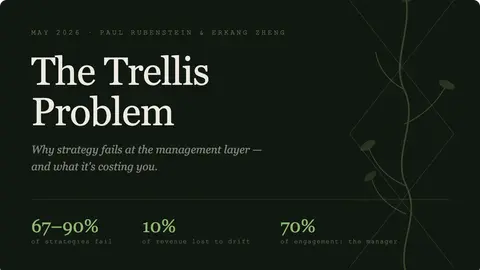
Between 67% and 90% of strategies fail — not because the strategy was wrong, but because the organization can't hold the line between intent and execution.
Every company has it. Most leaders underestimate it. And almost no one books it as a line item. Gallup measures it in trillions. Bain measures it in days per week. Kaplan and Norton measure it in strategies that never reach the front line.
You adopted the AI notetaker. Summaries land before you've closed the Zoom tab. Action items are extracted. You're moving faster. So why does Monday still feel the same? Why are follow-ups still leaking? The notes got better. The work didn't.
This isn't about autocomplete anymore, or a slightly smarter Clippy. We're talking about a bot that took a feature request from a chat message, understood the business context, scanned the entire codebase, and opened a production-ready Pull Request. It did it in 20 minutes.
Good managers generate more bandwidth than they consume. Bad managers consume more bandwidth than they generate. Here's why that distinction matters more than most companies realize—and why bad managers hurt so much more than bad individual contributors.
The real problem isn't that AI is coming for your job. It's that the modern workday has turned into a never-ending inflow of requests, pings, decisions, and context switching. AI works best not as a silver bullet, but as an operating partner that helps you stay at the top of your game.
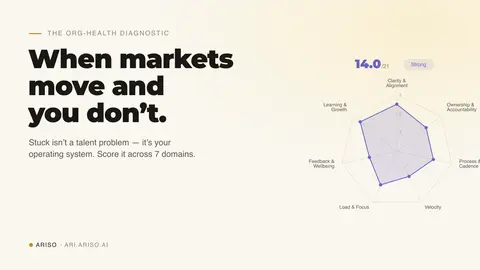
"Stuck" is rarely a skills problem; it's a system problem. Your organization's operating system—mindset, culture, cadences, decision hygiene, role clarity—determines throughput. With a broken OS, even A-players stall.
Showing 18 of 27 stories
Load more storiesGet the top AI news and tools straight to your inbox every week.
Weekly · AI news
Join 15,000+ AI enthusiasts