Mitsubishi Corp. ex-employee faces fine for insider trading
TOKYO -- A former employee of trading house Mitsubishi Corp. should pay a 1.87 million yen ($11,800) penalty for engaging in insider trading, a Japane
Nikkei Asia Tech1 min read
15 stories
TOKYO -- A former employee of trading house Mitsubishi Corp. should pay a 1.87 million yen ($11,800) penalty for engaging in insider trading, a Japane
Crypto funding rates represent the periodic payments exchanged between long and short positions in perpetual futures contracts, serving as a crucial mechanism for keeping the perpetual price tethered to the spot price.
Crypto markets never sleep, and neither should your strategy. By 2026, the barrier to entry for sophisticated algorithmic trading has shifted from owning massive GPU clusters to effectively orchestrating AI APIs.
Perpetual futures markets are dominated by funding rates, a mechanism that keeps contract prices tethered to spot prices. While many traders view funding as a nuisance or a minor income stream, sophisticated quantitative strategies treat it as a primary alpha source.
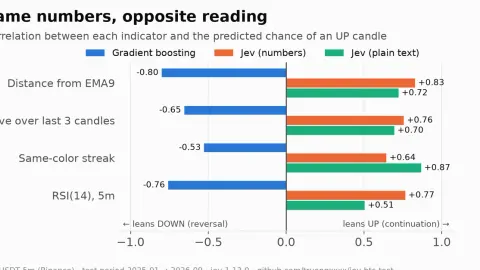
Should you trade with Jev? Not on price data, not yet. I haven't found anyone who has shown it beats a simple model at reading a market, and in my own test it read Bitcoin's indicators the wrong way round.
Crypto assets are notorious for their extreme volatility, making traditional risk management strategies often inadequate. For traders seeking an edge, AI-driven risk management offers a robust solution by processing vast datasets in real-time to predict market shifts and adjust positions…
Perpetual futures markets have created a unique yield opportunity: funding rate arbitrage. By simultaneously holding a long position in the perpetual contract and a short position in the spot market (or vice versa), traders can capture the periodic funding payments without directional exposure.
By 2026, the landscape of algorithmic trading has shifted from simple technical analysis indicators to sophisticated, LLM-driven sentiment and predictive modeling.
Maximal Extractable Value (MEV) has evolved from a niche concern for high-frequency traders into a critical security risk for all blockchain participants.
In the volatile landscape of 2026, manual trading is a relic. The market moves too fast for human reaction times, and the data volume is too vast for unaided analysis. Building a crypto signal bot powered by AI APIs is no longer just an advantage; it is the baseline requirement for serious traders.
Building a robust crypto signal bot in 2026 requires moving beyond simple technical indicators. The market has evolved; volatility is now driven by sentiment, on-chain data, and macroeconomic signals. To gain an edge, you must integrate advanced AI APIs that process unstructured data in real-time.
The landscape of algorithmic trading has shifted dramatically. By 2026, the barrier to entry for high-frequency, sentiment-aware trading strategies has lowered significantly thanks to the maturation of Large Language Models (LLMs) and specialized financial AI APIs.
By 2026, the landscape of algorithmic trading has shifted from simple technical indicator triggers to sophisticated predictive modeling. Integrating Large Language Models (LLMs) and sentiment analysis APIs into your trading stack allows you to process market noise and macro-economic data in…
In the high-stakes world of 2026 algorithmic trading, static rules are obsolete. The market has evolved into a dynamic, multi-modal environment where textual sentiment from social media, real-time news feeds, and complex price action patterns converge.
By 2026, the barrier to entry for building a crypto signal bot has shifted from writing complex technical analysis algorithms to orchestrating advanced AI agents.
Showing 15 of 15 stories
You're all caught up.
Get the top AI news and tools straight to your inbox every week.
Weekly · AI news
Join 15,000+ AI enthusiasts