Know a great AI tool or AI news source? Submit it to AiByts

Transcripts

19 stories

Stories

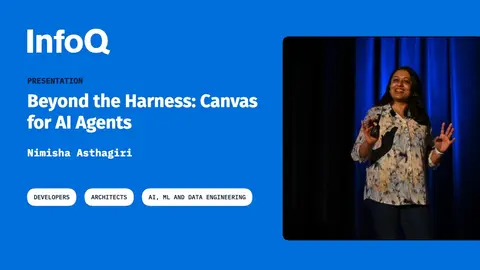
  • Presentation: Beyond the Harness: Canvas for AI Agents

    Nimisha Asthagiri shares how applying proven product engineering and architecture principles creates a bounded canvas for AI agents. She explains how this model provides agents with bounded autonomy, continuous drift detection, and decision records to scale software development resiliently.

    InfoQ - AI/ML/Data31 min read
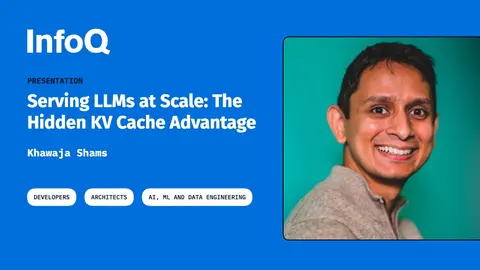
  • Presentation: Serving LLMs at Scale: The Hidden KV Cache Advantage

    Khawaja Shams shares a distributed systems perspective on scaling LLM inference stacks efficiently. He discusses practical strategies for optimizing GPU utilization, managing KV cache memory cliffs, leveraging tiered storage, reducing tail latency, and implementing disaggregated prefill and decode…

    InfoQ - AI/ML/Data33 min read
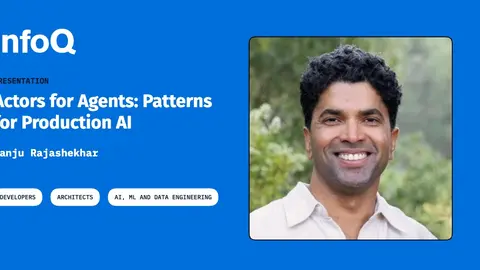
  • Presentation: Actors for Agents: Patterns for Production AI

    Manju Rajashekhar explains how the actor model solves the complex runtime challenges of production AI agents. By treating agents as distributed systems, he discusses state ownership, message passing, write-through state, and supervision boundaries to manage failures, continuations, and mutable…

    InfoQ - AI/ML/Data32 min read
  • Presentation: Exploding GPUs

    Andrew Martin discusses why AI security is fundamentally tied to Kubernetes security. He shares insights into the evolving AI threat landscape, covering non-deterministic agent behavior, GPU supply chain vulnerabilities, shared compute risks, and practical defense strategies - from prompt…

    InfoQ - AI/ML/Data34 min read
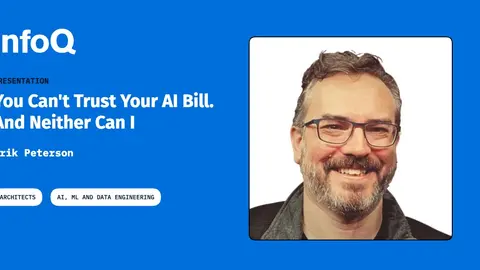
  • Presentation: You Can't Trust Your AI Bill. And Neither Can I

    Erik Peterson discusses why AI spend is eclipsing cloud bills, triggering a major software engineering cost crisis. He explains tokenmaxxing, unit economics, forced developer promotions, and why fully autonomous AI will write, deploy, and govern code by 2028. By Erik Peterson

    InfoQ - AI/ML/Data33 min read
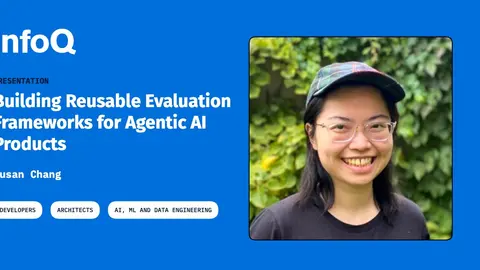
  • Presentation: Building Reusable Evaluation Frameworks for Agentic AI Products

    Susan Chang explains how Elastic transitioned from siloed, ad-hoc AI agent evaluations to a unified, production-grade framework. She discusses balancing LLM-as-a-judge with deterministic rules, bridging Python data science evals with TypeScript production code, and implementing deep tracing to…

    InfoQ - AI/ML/Data32 min read
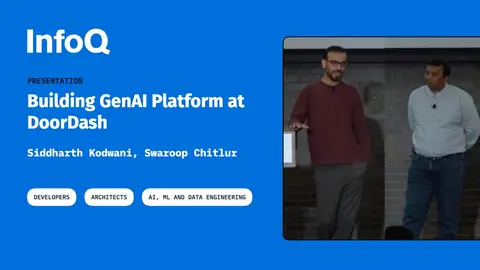
  • Presentation: Building GenAI Platform at DoorDash

    Swaroop Chitlur and Sidd Kodwani share DoorDash’s journey building an internal GenAI platform. They discuss core architectural bets, transitioning from vendor-first setups to open-weights models, navigating LLM and agent gateways, and balancing accuracy, latency, and cost for over 5,000 internal…

    InfoQ - AI/ML/Data35 min read
  • Presentation: Beyond Observability: Evolving Production Operations in the Age of AI

    The panelists discuss how production operations are evolving with AI, turning operational data into actionable insights for incident response. They explain how automation and new architectural practices help engineering teams build more understandable systems, while exploring how AI reshapes…

    InfoQ - AI/ML/Data35 min read
  • Presentation: Context Is the New Code

    Patrick Debois discusses how to manage, evaluate, distribute, and observe context using proven software engineering practices. He shares how treating context like code - complete with testing, CI/CD, package managers, and security scanning - enables engineering leaders to reliably scale AI coding…

    InfoQ - AI/ML/Data32 min read
  • Presentation: Designing Fast, Delightful UX with LLMs for Mobile Frontends

    Balakrishnan Ramdoss discusses how to architect production-grade, AI-powered conversational apps at scale. He explains how to overcome model latency, leverage server-driven UI and Backend-for-Frontend patterns to dynamically render multi-modal interfaces, optimize prompts for UI selection, and…

    InfoQ - AI/ML/Data22 min read
  • How to Edit Interviews Faster Without Losing Creative Control

    Interview editing is rarely slow because cutting a clip is difficult. It is slow because finding the right material takes time. Here is a workflow that gets you to the decisions faster without taking them away from you.

    Supacut Blog13 min read

Showing 18 of 19 stories

Load more stories
AiByts Weekly Brief

Get the top AI news and tools straight to your inbox every week.

Weekly · AI news

Join 15,000+ AI enthusiasts