b11572
LLM inference in C/C++. Contribute to ggml-org/llama.cpp development by creating an account on GitHub.
llama.cpp1 min read
239 stories
LLM inference in C/C++. Contribute to ggml-org/llama.cpp development by creating an account on GitHub.
LLM inference in C/C++. Contribute to ggml-org/llama.cpp development by creating an account on GitHub.
You can teach an open-weight LLM to text like a specific persona: their slang, their reply length, their humor, even how they write in a roleplay scene, creative writing exercise, or chatbot customer interactions.
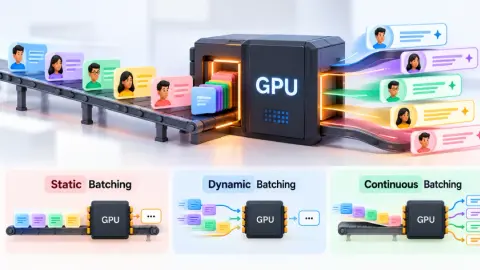
Imagine four people booking a ride to the same destination. If each person takes a separate taxi, four vehicles make the same trip. But if they travel together in a bus, everyone reaches the destination in a single trip. The bus carries more people at once and makes better use of the resources.
From demystifying the online softmax trick to hitting a 41.6x speedup on an NVIDIA RTX 4050 GPU — a beginner’s hands-on journey into hardware-aware deep learning.
Distributed inference serving is an air traffic control tower for AI traffic, and agentic workflows make it more necessary than ever.
We sponsored TreeHacks 2026 at Stanford, where teams built on Runpod across 36 hours, shipping projects ranging from GPU-accelerated cancer drug discovery.
vLLM Semantic Router released Decision 3.0, 5 Apache-2.0 multimodal decision models from 0.8B to 27B. They answer choice, yes/no and score questions about text and images in one call, without generating text. The post What is Decision 3.0?
I’m an AI research engineer based in Africa with about 3 YoEs in RL, LLMs, post-training, and systems efficiency (CUDA/vLLM). However, on a smaller scale because of compute limits. My undergrad and Master’s are both in communications engineering.
How to switch from OpenAI's API to a self-hosted LLM built on open-source models on Runpod, for teams tired of usage limits and API costs.
Learn how to deploy Meta's Llama 3.1 8B Instruct model using the vLLM inference engine on Runpod Serverless for blazing-fast performance and scalable AI.
Learn how to use GuideLLM to simulate real-world inference loads, fine-tune performance, and optimize cost for vLLM deployments on Runpod.
Learn how to reduce LLM inference costs and latency using quantization, vLLM, SGLang, and speculative decoding without upgrading your hardware.
RAG and fine-tuning are two powerful strategies for adapting large language models (LLMs) to domain-specific tasks. This post compares their use cases.
Discover how to boost your LLM inference performance and customize responses using SGLang, an innovative framework for structured LLM workflows.
Explore the trade-offs between post-training, quantization-aware training, mixed precision, and dynamic quantization. Learn how each method impacts model.
Retrieval-Augmented Generation (RAG) and fine-tuning are powerful ways to adapt large language models. Learn the key differences, trade-offs, and when to.
A one-line formula for how often an LLM's top token flips, and why identical completions fall apart after about a hundred tokens The post Why Temperature 0 Isn't Deterministic appeared first on Towards Data Science.
Showing 54 of 239 stories
Load more storiesGet the top AI news and tools straight to your inbox every week.
Weekly · AI news
Join 15,000+ AI enthusiasts