
llm-gemini 0.35
Release: llm-gemini 0.35 I added support to llm-gemini for the new Gemini 4 Argon model, made available today via the Gemini API and for customers of their $100/month subscription plan. Here are the low, medium and high pelicans.
The article discusses the release of llm-gemini 0.35, which adds support for the new Gemini 4 Argon model, including pricing details and performance comparisons.
What happened
The article announces the release of llm-gemini 0.35, which integrates the Gemini 4 Argon model. It details the model's pricing structure, performance benchmarks, and sample outputs generated using the model.
Why it matters
The pricing and performance of Gemini 4 Argon impact cost decisions for businesses and developers using AI models, particularly in comparison to competitors like OpenAI and Anthropic.
- Gemini 4 Argon offers competitive pricing compared to other large models.
- Performance benchmarks highlight its cost-efficiency for specific tasks.
- Model updates like llm-gemini 0.35 enable integration of new AI capabilities for developers.
The bigger picture
The cost-effective pricing of Gemini 4 Argon may influence adoption rates among businesses and developers seeking affordable AI solutions.
The release of llm-gemini 0.35 with Gemini 4 Argon provides developers and businesses with a cost-effective AI model option, supported by performance benchmarks and diverse output examples.
Technical details
- Gemini 4 Argon model pricing: $2/million input, $10/million output (doubling on December 1st).
- Token efficiency as a key factor in model cost-effectiveness.
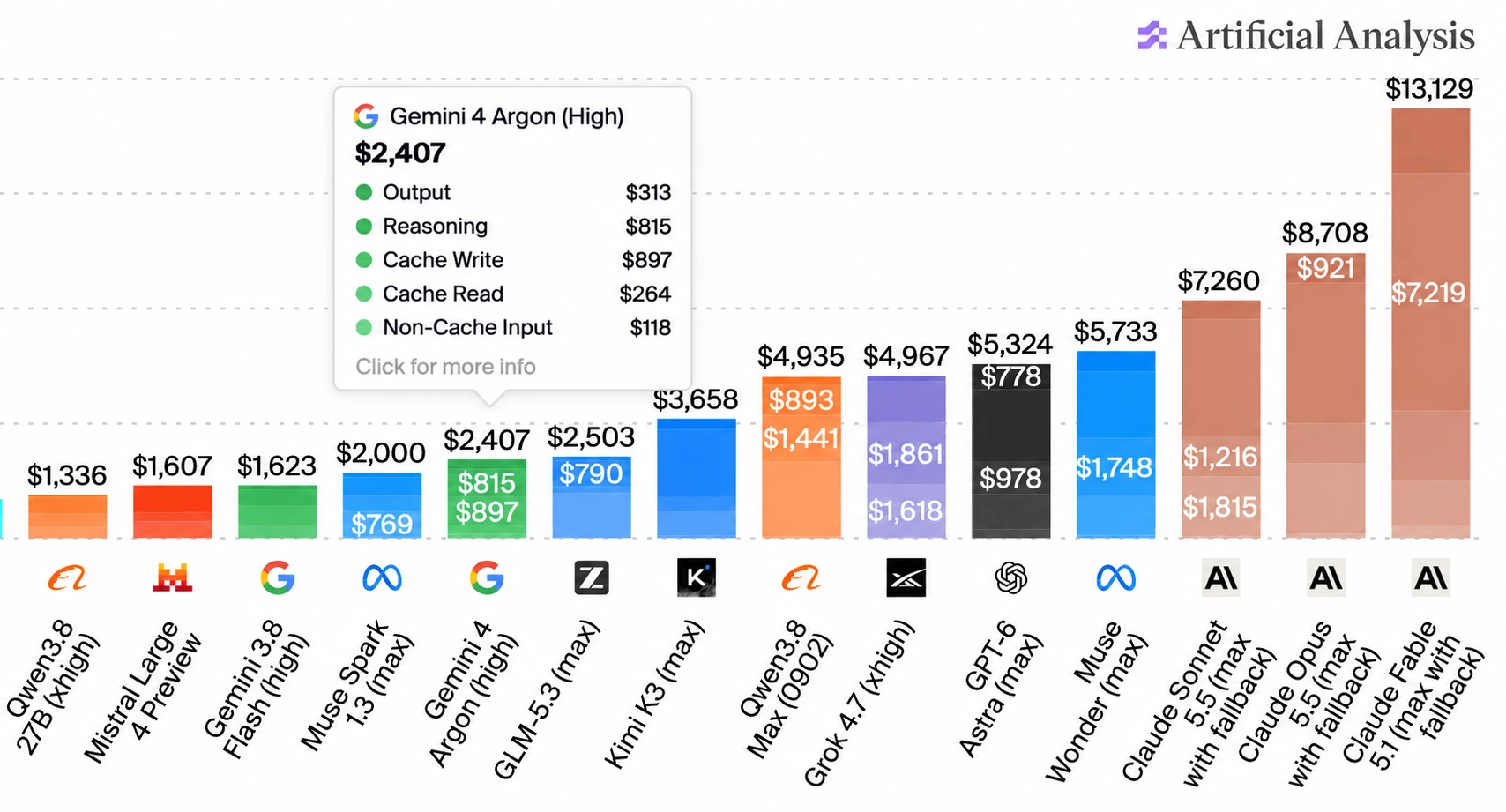
- Benchmarking data from Artificial Analysis showing Gemini 4 Argon's $2,407 cost to run a benchmark.
FAQ
What is the pricing structure for Gemini 4 Argon?
Gemini 4 Argon costs $2/million input and $10/million output, doubling on December 1st.
How does Gemini 4 Argon compare to other models?
It is cheaper than GPT-6 Astra and Claude Fable 5.1, with benchmark costs close to GLM-5.3.
What examples of outputs are mentioned?
SVGs of pelicans, a Fabergé egg generated with Blender, and a pelican riding a bike using Fourier epicycles.
This summary and analysis were generated with AI from the original article and may contain errors. Read the original for the full story.
Read the full story
Originally published by Simon Willison on Oct 13, 2026.
Comments
Sign in to join the discussion.