
Memory Anatomy: How Memory Works, in People and in AI
Four small machines show how memory works, in people and in AI chatbots. Each one follows a published model of memory and runs a short tour on its own until you tap it to try it yourself.More
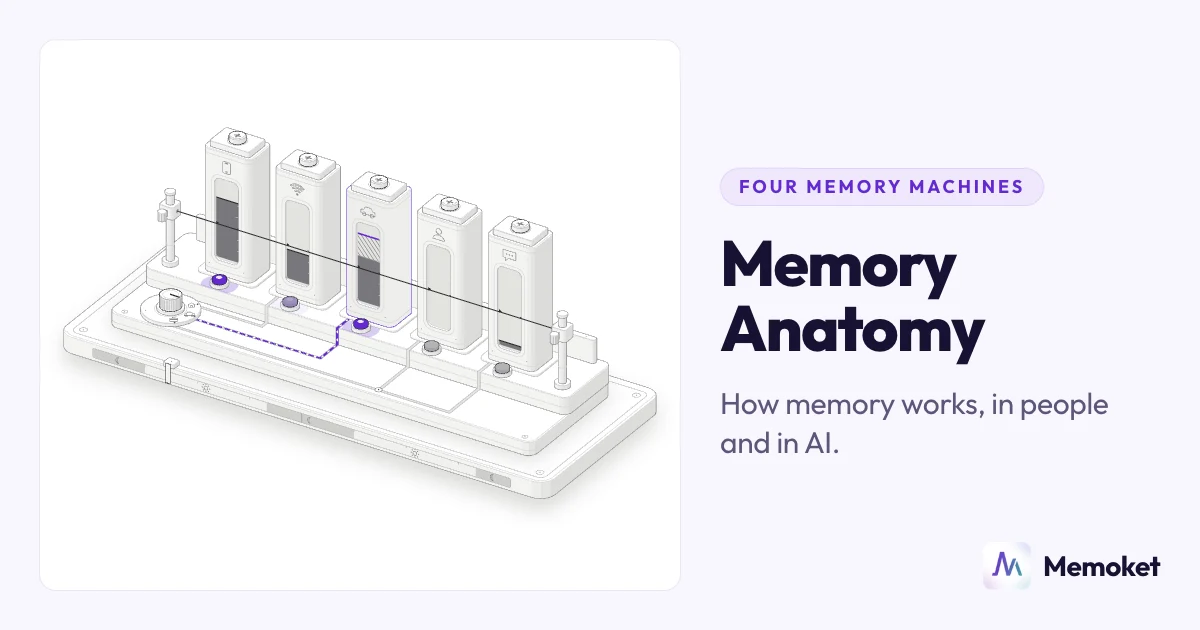
This article explores how memory functions in both humans and AI systems, using four distinct models to illustrate the mechanisms of memory retention, recall, and forgetting. It provides insights into how AI chatbots and cognitive models manage memory, offering a comparative analysis of human and artificial memory systems.
What happened
The article presents four models of memory: ACT-R, the multi-store model, complementary learning systems, and AI chat memory. Each model explains how memory functions in humans and AI, with technical details on how memories are stored, retrieved, and decayed over time. It also discusses how AI systems manage memory through context windows, summaries, and external storage.
Why it matters
Understanding memory mechanisms is crucial for AI developers and cognitive scientists. It helps in designing more efficient memory systems for AI chatbots and in understanding how human memory works, which can inform better models of learning and recall.
- Memory strength and decay are key factors in recall probability in both humans and AI systems.
- Short-term memory has limited capacity and relies on rehearsal for retention.
- Complementary learning systems help the brain learn at different speeds, which can be modeled in AI.
- AI chatbots use context windows and external storage to manage long conversations effectively.
The bigger picture
The insights from these models can improve AI memory management, enhance human-computer interaction, and contribute to cognitive science research on memory and learning.
The article provides a comprehensive overview of memory mechanisms in both humans and AI, highlighting the importance of understanding these processes for developing more efficient and intelligent systems.
Technical details
- ACT-R uses activation levels (A) and memory strength (B) to model recall probabilities.
- The multi-store model includes sensory registers, short-term memory (with a 4-slot limit), and long-term memory with fading and rehearsal.
- Complementary learning systems involve fast learning for specific facts and slow learning for general knowledge, using back-propagation and error correction.
- AI chat memory systems use context windows, summaries, and external stores to manage long conversations.
FAQ
What is the ACT-R model?
The ACT-R model is a cognitive model that explains how memory works by using activation levels and memory strength to predict recall probabilities.
How does the multi-store model work?
The multi-store model divides memory into sensory, short-term, and long-term stores, with mechanisms for rehearsal and fading to retain information.
What are complementary learning systems?
Complementary learning systems describe how the brain learns at two speeds: fast for specific facts and slow for general knowledge, using back-propagation and error correction.
How do AI chatbots manage memory?
AI chatbots use context windows, summaries, and external stores to manage long conversations, ensuring efficient memory retrieval and storage.
This summary and analysis were generated with AI from the original article and may contain errors. Read the original for the full story.
Read the full story
Originally published by Memoket Gem Blog on Oct 16, 2026.
Comments
Sign in to join the discussion.