

Agnost AI
Monitors AI agents for silent failures and user issues.


What is Agnost AI?
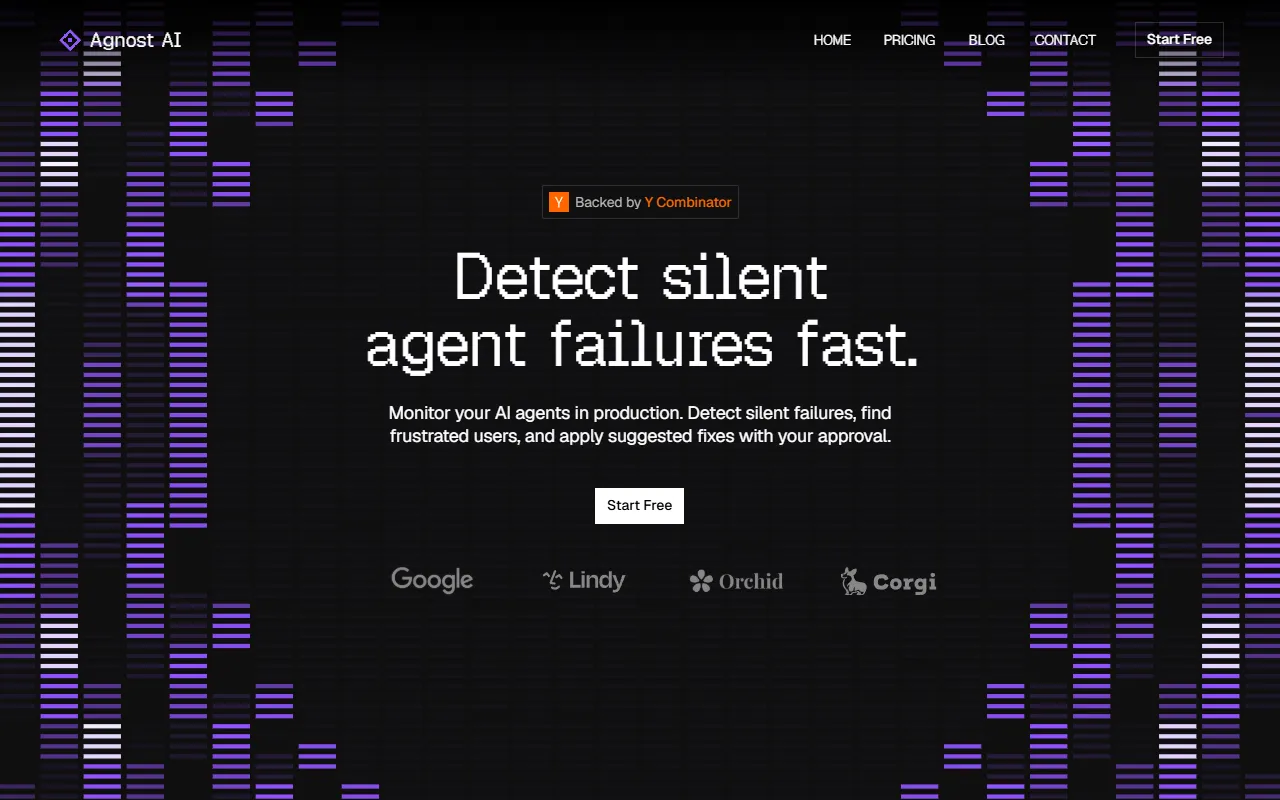
Agnost AI is an AI Agents tool that monitors AI agents for silent failures and user issues. It is available on Web App. It is aimed at developers and data analysts.
Aids in detecting silent failures, understanding user frustration, and approving suggested fixes for AI agents in production. It analyzes conversations between users and agents to identify issues like behavior drift, hallucinations, and hidden feature requests.
Built for developers and data analysts.
Key capabilities
Features
Events / month
Data retention
Incorrect downgrade guidance
From production signal to shipped fix
Find recurring problems
Follow the failure to its source
Approve the suggested fix
Run this prompt
Catch churn before it happens
Use cases
- Detect silent failures in AI agents
- Identify user frustration through conversation analysis
- Approve suggested fixes for agent issues
Who it's for
Pros & cons
Pros
- Public API available
- Secure by design
Cons
No documented limitations yet.
Developer & API
Public SDK API available
- SDKs
- Python, TypeScript
Security & compliance
- SOC 2
As stated on Agnost AI's website — not independently verified by AiByts.
FAQ
What is Agnost AI?
Agnost AI is an AI Agents tool that monitors AI agents for silent failures and user issues. Aids in detecting silent failures, understanding user frustration, and approving suggested fixes for AI agents in production. It analyzes conversations between users and agents to identify issues like behavior drift, hallucinations, and hidden feature requests.
Does Agnost AI have an API?
Yes, Agnost AI offers a public SDK API for building custom integrations.
What platforms does Agnost AI support?
Agnost AI is available on Web App.
Who should use Agnost AI?
Agnost AI is built for developers and data analysts. Common uses: detect silent failures in AI agents, identify user frustration through conversation analysis and approve suggested fixes for agent issues.
What are the best alternatives to Agnost AI?
Similar tools on AiByts include ModelCap, ChatGLM, Plurai, Yasmine Works and Groas.
Agnost AI news & updates
Best Online Evaluation Tools for AI Agents (2026)
The best online evaluation tools for AI agents in 2026 are Agnost AI, LangSmith, Langfuse, Arize AX, Braintrust, Datadog, Opik, and PostHog. Compare how each judges production traffic (span, trace, or conversation), sampling, alerts, pricing, and what happens after a failure.
Agnost AI Blog14 min readWhat LLM-as-a-Judge Costs in Production, and How to Cut It
Online evals with an LLM judge cost judge tokens plus platform fees, and both scale with traffic. Here is the formula, a worked example, and the levers that cut cost without hiding failures: filtering, sampling, smaller judges, batching, and code checks.
Agnost AI Blog5 min readHow to Set Up Online Evals for AI Agents in Production
A practical setup for online evals: capture the right evidence, pick the unit, write narrow judge rubrics, choose sampling, calibrate against human labels, and route results to alerts and fixes. Includes a rubric template and defaults.
Agnost AI Blog7 min readOnline Evals vs Guardrails vs Monitoring: Which One Catches What
Guardrails run inline and block bad output before users see it. Online evals judge production traffic afterwards to find quality failures. Monitoring tracks system health. Here is what each catches, what each costs, and how to combine them for an AI agent.
Agnost AI Blog5 min readConversation-Level vs Trace-Level Online Evals: Which Failures Each Can See
Span and trace evals judge one model call or one request. Conversation-level evals judge the whole multi-turn session. Here is which agent failures each unit can and cannot see, and how to run both without double-counting.
Agnost AI Blog5 min readWhat Are Online Evals? Online vs Offline Evaluation for AI Agents
Online evals score an AI agent's real production traffic after it happens, using LLM judges, code checks, or user signals. Offline evals score a fixed test set before release. Here is how they differ, what each catches, and how to run both.
Agnost AI Blog8 min readYour Online Eval Failed. Now What? From Flag to Verified Fix
An online eval flag is the start of the work, not the end. Here is the path from a failing production eval to a confirmed root cause, a reviewed fix, a regression test, and a measured before-and-after, with the mistakes that break each step.
Agnost AI Blog6 min readHow to catch wrong answers from your AI agent that don't show up as errors in traces
A wrong answer that raises no error is a mismatch between what the agent said and something you can check: a tool result, a retrieved source, a system of record, or what the user did next.
Agnost AI Blog10 min readHow does Agnost AI compare to Langfuse or Arize for catching agent quality failures?
All three can flag a bad agent run. They differ in what they judge and what happens next. Langfuse runs LLM judges on individual observations and alerts on scores; building the fix is up to you.
Agnost AI Blog9 min readIntent Analysis Tools for AI Conversations: A Buyer Guide
Evaluate intent analysis software for AI conversations by changing goals, clustering, feature requests, multilingual accuracy, validation, and cost.
Agnost AI Blog6 min readBest conversation analytics tools for AI agents (2026)
The best conversation analytics tools for AI agents in 2026 are Agnost AI, Amplitude Agent Analytics, PostHog, Braintrust, and LangSmith. Each groups production conversations by what users wanted and flags failures and frustration, instead of only tracing model calls.
Agnost AI Blog11 min readBest tools to detect user frustration in chatbots and AI agents (2026)
The best tools to detect user frustration in chatbots and AI agents in 2026 are Agnost AI, Amplitude Agent Analytics, PostHog, Arize Phoenix, and Opik. They catch repeated requests, corrections, and abandonment, not only negative tone.
Agnost AI Blog13 min readHow to Investigate AI Agent Failures From Slack
Use Slack as the investigation surface for production agent failures: receive grounded summaries, inspect evidence, ask follow-ups, and route fixes without losing context.
Agnost AI Blog5 min readLangfuse alternatives for understanding users, not just traces
To see what users are trying to do and where they give up, most teams keep Langfuse for open-source tracing, evals, and prompts and add a conversation analytics layer: Agnost AI, Amplitude Agent Analytics, PostHog, Braintrust Topics, or LangSmith Insights.
Agnost AI Blog13 min readBraintrust alternatives for conversation analytics (2026)
The main Braintrust alternatives for conversation analytics are Agnost AI, Amplitude Agent Analytics, PostHog, LangSmith, Trodo, Datadog, and Langfuse. Braintrust Topics does classify production traffic by task, sentiment, and issues, so eval-driven teams should keep it.
Agnost AI Blog13 min readAI Agent Monitoring: How to Catch Bad Answers in Production
A practical guide to monitoring production AI agents for wrong answers, silent failures, bad tool use, and unresolved user goals—not just exceptions and latency.
Agnost AI Blog7 min readBest tools to measure AI agent task completion and success rate (2026)
The best tools to measure AI agent task completion in 2026 are Amplitude Agent Analytics, Datadog, Splunk Agent Observability (formerly Galileo), PostHog, and Opik, which ship built-in completion signals or judges.
Agnost AI Blog12 min readCustomer Sentiment Analysis Tools: A Product Team Guide
Choose sentiment analysis software for short messages, recurring complaints, churn risk, product behavior, multilingual data, and AI conversations.
Agnost AI Blog6 min read
Details are compiled from Agnost AI's website and public sources, last verified Oct 5, 2026. Features and pricing change — confirm on the official site before you buy.
Try Agnost AI
Visit the official website
Comments
Sign in to join the discussion.