
Kiro
Helps developers and teams turn prompts into executable specs and validate code correctness.
What is Kiro?
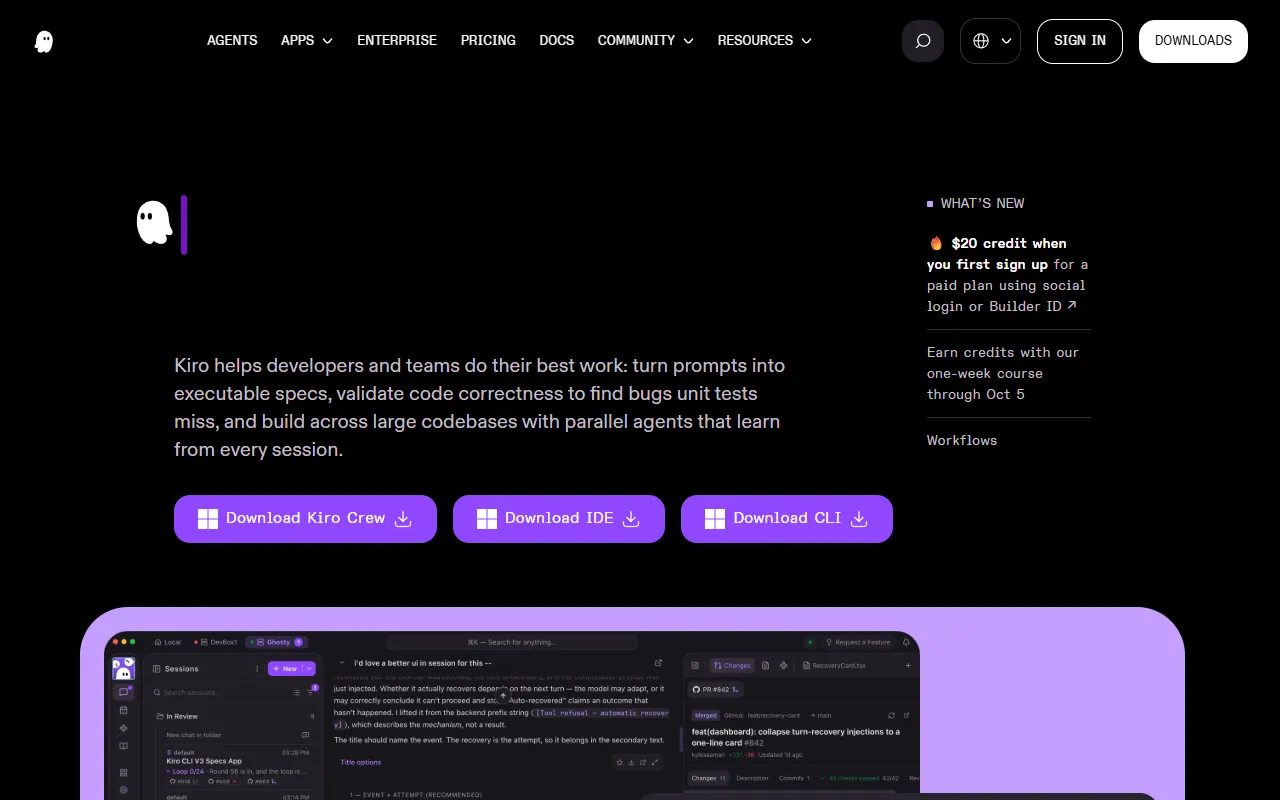
Kiro is an AI App Builder tool that helps developers and teams turn prompts into executable specs and validate code correctness. Kiro is freemium: it has a free plan plus paid upgrades. A free trial is available. It is available on Windows, macOS and Linux. It is aimed at developers, teams and enterprise users.
Kiro helps developers and teams turn prompts into executable specifications, validate code correctness to identify issues missed by unit tests, and build across large codebases using parallel agents that learn from each session. It supports spec-driven development, agent hooks for automation, and conversational coding with full project context understanding.
Built for developers, teams and enterprise users.
Key capabilities
Features
Spec-Driven Development
Supports writing specs and auto-generating tasks for implementation.
Agent Hooks for Automation
Conversational Coding
Allows coding through conversation with full project context understanding.
Full Project Context Understanding
Multi-File Operations
Natural Language Code Generation
Code Correctness Check
Validates code correctness to catch issues missed by unit tests.
Parallel Agents
Uses parallel agents that learn from each session for large codebase development.
Model Integration
Supports integration with various models like OpenAI, Anthropic, and open weight models.
Enterprise Features
Includes enterprise-ready features like IAM and SSO authentication, cost management, and governance controls.
Open Standards
Use cases
- Validate code correctness to catch issues missed by unit tests
- Implement spec-driven development by writing specs and auto-generating tasks
- Use parallel agents to build across large codebases with learning from each session
- Generate code from natural language prompts using conversational coding
- Integrate with various models including OpenAI, Anthropic, and open weight models
Popular use cases
Who it's for
Pros & cons
Pros
- Supports integration with various models including OpenAI, Anthropic, and open weight models
- Offers a free plan with usage-based pricing and credit system
- Includes enterprise-ready features like IAM and SSO authentication, cost management, and governance controls
Cons
No documented limitations yet.
Pricing
Freemium. Free trial available.
| Plan | Price |
|---|---|
| Kiro Free | Free |
| Kiro Pro | $20 |
| Kiro Pro+ | $40 |
| Kiro Pro Max | $100 |
| Kiro Power | $200 |
Integrations
AI models
- GPT 5
- Claude Sonnet 4.5
- Qwen 3
Security & compliance
- HIPAA
- SSO
- SAML
As stated on Kiro's website — not independently verified by AiByts.
FAQ
What is Kiro?
Kiro is an AI App Builder tool that helps developers and teams turn prompts into executable specs and validate code correctness. Kiro helps developers and teams turn prompts into executable specifications, validate code correctness to identify issues missed by unit tests, and build across large codebases using parallel agents that learn from each session. It supports spec-driven development, agent hooks for automation, and conversational coding with full project context understanding.
Is Kiro free?
Kiro has a free plan; advanced features require a paid plan.
How much does Kiro cost?
Kiro offers 5 plans: Kiro Free (Free), Kiro Pro ($20), Kiro Pro+ ($40), Kiro Pro Max ($100) and Kiro Power ($200).
What platforms does Kiro support?
Kiro is available on Windows, macOS and Linux.
Who should use Kiro?
Kiro is built for developers, teams and enterprise users. Common uses: validate code correctness to catch issues missed by unit tests, implement spec-driven development by writing specs and auto-generating tasks, use parallel agents to build across large codebases with learning from each session and generate code from natural language prompts using conversational coding.
What does Kiro integrate with?
Kiro integrates with VS Code.
What are the best alternatives to Kiro?
Similar tools on AiByts include BASE44, MindPal, Replit, Softr AI and PlugThis.
Kiro news & updates
Introducing improved enterprise sign-in controls
Until now, there was no way to control how enterprise users sign in to Kiro on managed devices. Even if your organization requires IAM Identity Center, users can still sign in to Kiro with a personal account (Google, GitHub, or Builder ID).
Kiro Blog2 min read
Kiro CLI V3 is rolling out as the default experience
Kiro CLI V3 brings the same agent harness that powers Kiro IDE and Kiro Web to your terminal. With V3, you can give Kiro a task that needs planning, implementation, and review, and keep working while workflow agents handle the steps in the background.
Kiro Blog7 min read
Claude Sonnet 5.5 is now available in Kiro
Claude Sonnet 5.5 is available today across Kiro IDE, CLI, Crew, and Web. It is Anthropic’s fastest Sonnet model to date and a clear upgrade over Claude Sonnet 5. In our internal benchmarking, Sonnet 5.5 performed better than Sonnet 5, while being more efficient in both token usage and speed.
Kiro Blog2 min read
Introducing Kiro workflows
Today, we’re introducing Kiro workflows, allowing you to carry out complex tasks from start to finish with multiple agents and less supervision. We’ve been building Kiro itself with workflows, including the new cloud configuration, cloud sessions, and most of the workflow experience.
Kiro Blog7 min read
Claude Opus 5.5 is now available in Kiro
Claude Opus 5.5 is available today across Kiro IDE, CLI, Crew, and Web. It is Anthropic’s most capable Opus model yet, delivering Fable 5.1-level performance on most work at 40% lower cost than Opus 5.
Kiro Blog2 min read
How we built a software factory with Kiro Crew to merge 1,000 PRs in a week
Last week, the three of us building Kiro Crew full time merged 1,000 pull requests in seven days. Over 120 a day, every one went through CI and review. Kiro Crew is mainly built by those three full-time engineers, with nearly 500 enthusiastic community contributors.
Kiro Blog8 min read
Claude Fable 5.1 is now available in Kiro
Claude Fable 5.1 is available today to Kiro enterprise customers. For long-running, context-heavy agentic sessions, Fable 5.1 sets a new bar. It traces problems to their root causes in the code rather than surfacing symptoms, and it holds context and intent across the full arc of complex tasks.
Kiro Blog3 min read
Tackling technical debt at scale with autonomous mode in Kiro Web
Every software development team has experienced the tension between maintenance and building new features: time spent on one is time not spent on the other. For open-source maintainers, this challenge is even more acute with smaller teams, larger user bases, and a backlog that never stops growing.
Kiro Blog9 min read
GPT‑5.6 models now support 1 million token context windows in Kiro
Starting today, GPT‑5.6 Sol, Terra, and Luna support 1 million token context windows in Kiro, across the IDE, CLI, and Web. You can now use GPT‑5.6 models to process entire codebases, long-form documents, and extended multi-turn agent histories in a single request, without chunking, summarization,…
Kiro Blog2 min read
Kiro adds ISO/IEC 27001:2022 coverage
We’re happy to share that procurement, security, and vendor-risk teams now have independently verified evidence to support decisions about adopting Kiro. Kiro is included in the defined scope of AWS’s ISO/IEC 27001:2022 certification.
Kiro Blog2 min read
A free year of Kiro, now for students around the world
When we launched the Kiro Students tier in March, we started with 11 universities. Demand outran that list almost immediately. Students at schools we had not reached yet kept asking us the same thing: when is my school next?
Kiro Blog5 min read
Agentic engineering in the cloud
Kiro Web and cloud sessions are generally available with cloud configuration
Kiro Blog5 min read
Are AI coding agents actually getting better?
When Kiro IDE's coding agents write or modify code, the diagnostics tool runs static analyzers to check the output. These are the same checks a developer sees underlined in their editor.
Kiro Blog11 min read
Continuous Prompt Evaluation: How We Use LLM Judges and Live Signals to Improve Kiro Agent Quality
Prompt behavior is difficult to validate exhaustively. A system prompt operates across combinations of models, tools, codebases, tasks, and users that no test suite can fully cover.
Kiro Blog6 min read
How We Learned to Trust an AI Agent to Triage Production Incidents
At 2:33 AM PDT on a Sunday, an availability alarm fired for a frontier model. Production responses were stalling mid-stream, and monitoring opened a ticket automatically.
Kiro Blog7 min read
Close the laptop, keep the agent: building with cloud sessions
Kiro just shipped cloud sessions (preview), and it fixes the one thing that always bugged me about running an AI agent on my own machine: the machine. With cloud sessions, your agent runs in a cloud sandbox instead of on your laptop.
Kiro Blog5 min read
Which Kiro app should I pick?
Kiro is not one thing anymore. In July 2025, we launched Kiro as an AI IDE. Since then, it has become much more. Kiro is a software engineering agent available as an IDE, a CLI, a web app, a mobile app, and Kiro Crew.
Kiro Blog11 min read
Kiro powers now support Agent Plugins
You built something good. A skill that encodes how your team actually deploys, plus an MCP server that talks to your internal service. It works. So you package it for the client your team uses, and then you package it again for the client the team next door uses, and again for the one your open…
Kiro Blog5 min read
Details are compiled from Kiro's website and public sources, last verified Oct 3, 2026. Features and pricing change — confirm on the official site before you buy.
Try Kiro
Freemium
Tags
- Spec-Driven Development
- Conversational Coding
- Parallel Agents
Comments
Sign in to join the discussion.