

LangWatch
Tests and evaluates AI agents to improve reliability and governance.


What is LangWatch?
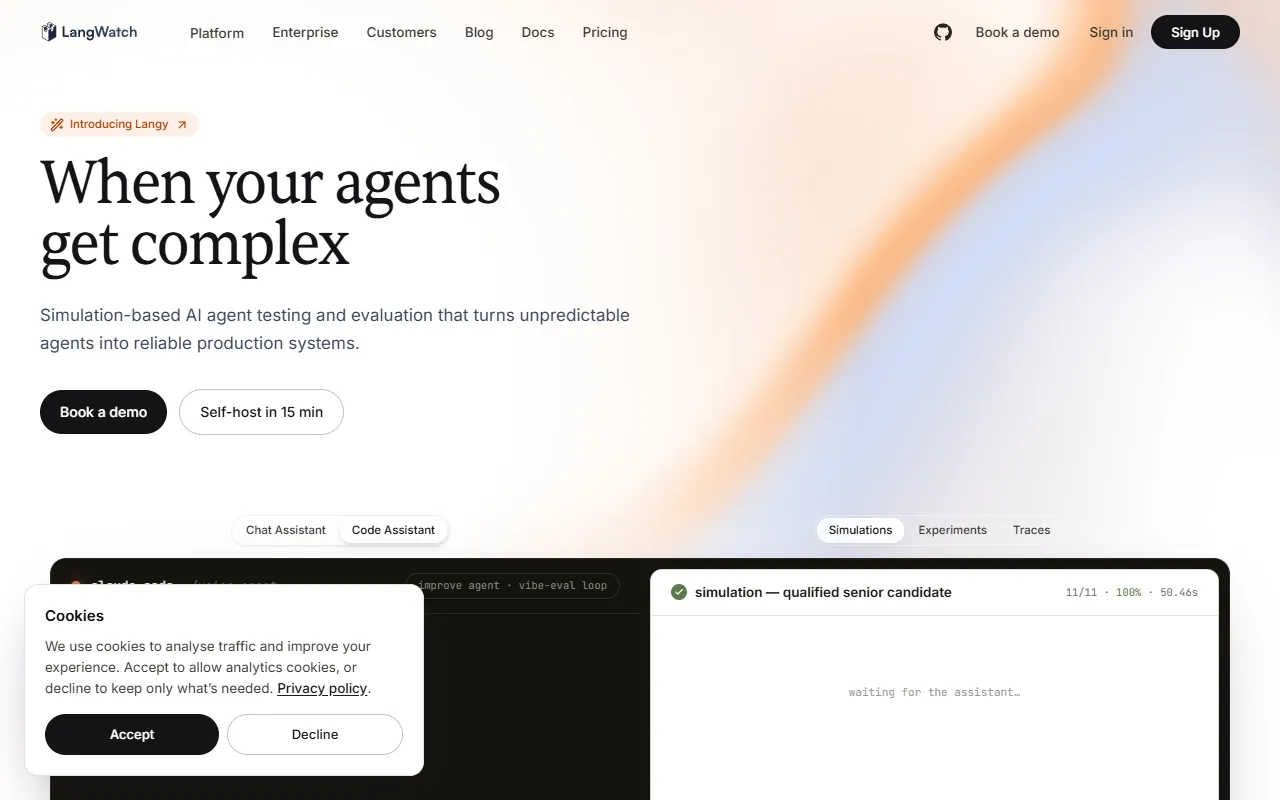
LangWatch is an AI Agents tool that tests and evaluates AI agents to improve reliability and governance. LangWatch is a paid tool. It is aimed at developers and ai teams.
LangWatch tests and evaluates AI agents to turn unpredictable systems into reliable production systems. It offers simulations, evaluations, observability, and governance features. Designed for developers and teams managing AI agents.
Built for developers and ai teams.
Key capabilities
Features
Simulate
Write Scenarios
Allows creating test scenarios using Claude Code.
Local and CI
Red Teaming
Tools and Skills
Whitebox and Blackbox
Evaluate
LLM as a Judge
Notebook or UI
Online Evaluations
Pairwise
Multimodal
Use cases
- Simulate real user interactions for AI agent testing
- Write test scenarios using Claude Code for agent evaluation
- Conduct red teaming to test AI agent security
- Evaluate AI agent performance with LLM as a judge
- Perform online evaluations of AI agents
- Compare agent outputs using pairwise evaluation methods
Who it's for
Pros & cons
Pros
- Public API available
- Usage-based pricing
- Custom/enterprise pricing via sales
Cons
- No free plan
Pricing
Paid.
| Plan | Price |
|---|---|
| Growth | €29 |
AI models
Developer & API
Public SDK API available
Open source· Apache-2.0· 4.9K stars· 408 forks
Security & compliance
- ISO 27001
- GDPR
- SSO
- SAML
- Data deletion
As stated on LangWatch's website — not independently verified by AiByts.
FAQ
What is LangWatch?
LangWatch is an AI Agents tool that tests and evaluates AI agents to improve reliability and governance. LangWatch tests and evaluates AI agents to turn unpredictable systems into reliable production systems. It offers simulations, evaluations, observability, and governance features. Designed for developers and teams managing AI agents.
Is LangWatch free?
No, LangWatch is a paid tool.
How much does LangWatch cost?
LangWatch offers one plan: Growth (€29).
Does LangWatch have an API?
Yes, LangWatch offers a public SDK API for building custom integrations.
Who should use LangWatch?
LangWatch is built for developers and ai teams. Common uses: simulate real user interactions for AI agent testing, write test scenarios using Claude Code for agent evaluation, conduct red teaming to test AI agent security and evaluate AI agent performance with LLM as a judge.
What does LangWatch integrate with?
LangWatch integrates with AWS, Google Cloud, Azure, Vercel, OpenAI, Anthropic and LangChain.
Is LangWatch open source?
Yes, LangWatch is open source under the Apache-2.0 license.
What are the best alternatives to LangWatch?
Similar tools on AiByts include ChatGLM, Plurai, Yasmine Works, Groas and Grok.
LangWatch news & updates
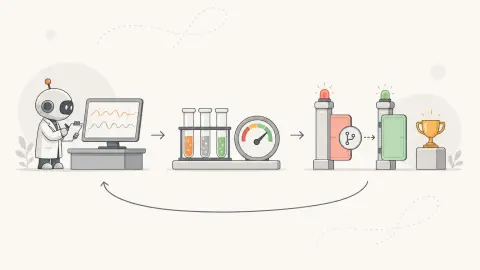
Auto-improving agents with LangWatch
How auto-improving agents work in LangWatch: Langy changes the code unattended, your CI runs the evals, and a pull request opens only when the evals show it's better.
LangWatch Blog4 min read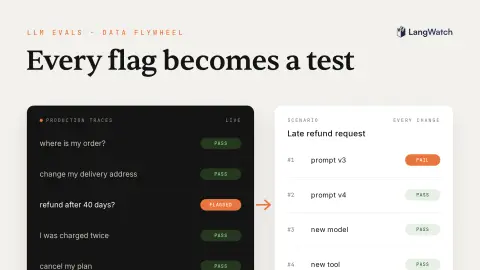
The LLM data flywheel: turn production data into a better product
Build an AI data flywheel in LangWatch: flag a failing production trace, turn it into a scenario test, fix the agent and rerun the test on every change.
LangWatch Blog10 min read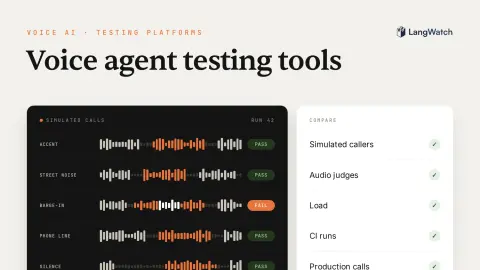
The best voice agent testing platforms in 2026
Voice agent testing platforms compared for 2026: LangWatch, Hamming, Coval, Cekura, Bluejay and Roark on simulated callers, judges, CI and call monitoring.
LangWatch Blog12 min read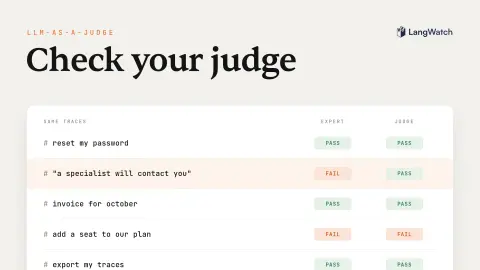
LLM-as-a-judge vs human evaluation: how to check your judge
Check an LLM judge against human labels on real traces: annotation queues, agreement, Cohen's kappa, a confusion table and the prompt fixes that closed the gap.
LangWatch Blog11 min read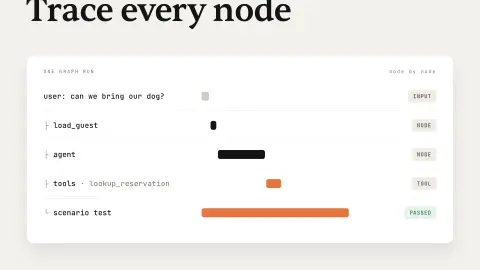
LangGraph observability and testing: trace every node, test every path
LangGraph observability and testing in practice: trace every node and tool call with LangWatch, read the span tree, write Scenario tests for your graph and run them in CI.
LangWatch Blog11 min read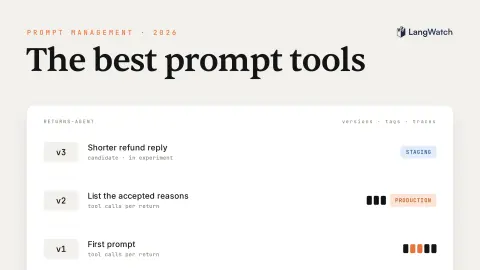
The best prompt management tools in 2026
Prompt management tools compared for 2026: LangWatch, PromptLayer, Langfuse, LangSmith and Braintrust on versioning, Git sync, testing and tracing.
LangWatch Blog12 min read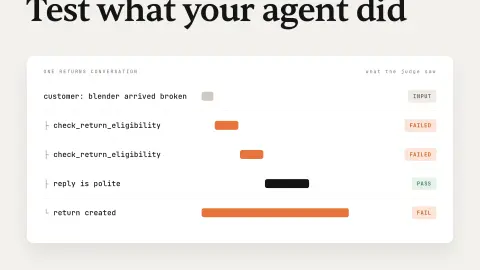
AI evals: how to know your agent actually does the job
AI evals explained with one real agent: what an eval is, where test cases come from, code checks and LLM judges, checking the grader, simulations and evals in production.
LangWatch Blog12 min read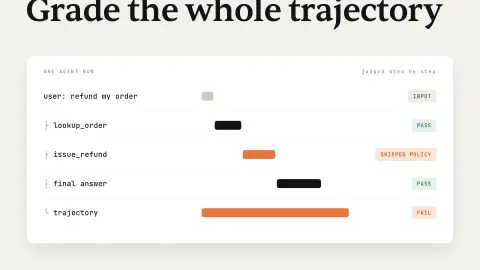
AI agent evaluation: how to grade the whole trajectory, not just the final answer
AI agent evaluation in practice: read the trajectory in a trace, ask every trace a question with Instant Evals and LangWatch SQL, judge live traffic, simulate before release and compare versions.
LangWatch Blog10 min read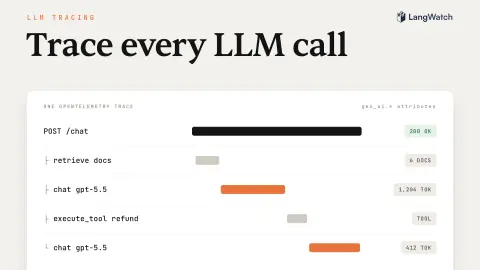
LLM tracing with OpenTelemetry: the GenAI conventions, step by step
Set up LLM tracing with OpenTelemetry: trace an agent with gen_ai.* attributes, send it to LangWatch over OTLP, fan it out with a collector, then search and evaluate it.
LangWatch Blog10 min read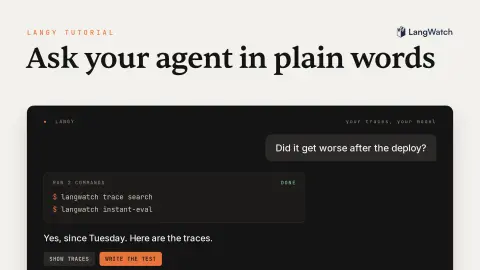
How to use Langy to ask about your agent in plain words
How to use Langy in LangWatch: ask what changed in your traces, judge every conversation, dig into one trace, then turn the answer into a test, a fix or an alert.
LangWatch Blog6 min read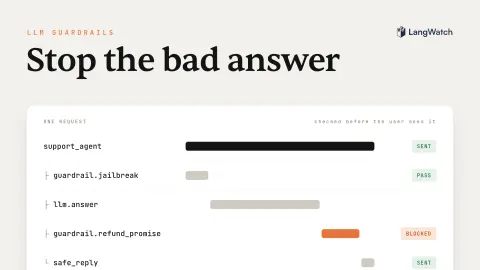
LLM guardrails: block a bad answer before it goes out
Set up LLM guardrails in LangWatch: find what to block with Instant Evals, save the check as an evaluator, run it in your code or on the LangWatch AI Gateway.
LangWatch Blog6 min read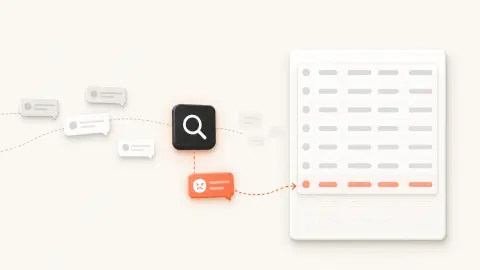
How to build an evaluation dataset from your production traces
Build a golden dataset from production traces in LangWatch: search traces, judge every conversation with Instant Evals, query with LangWatch SQL, add to a dataset and automate it.
LangWatch Blog6 min read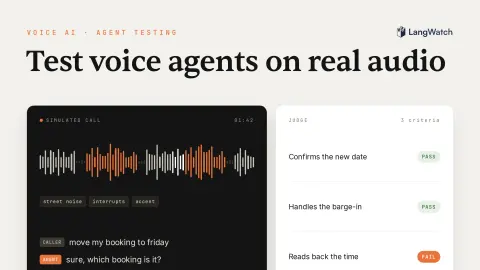
How to test a voice AI agent before it takes real calls
Voice agent testing with simulated callers over real audio: interruptions, noise, accents, spoken numbers and other languages, judged on every change in CI.
LangWatch Blog9 min read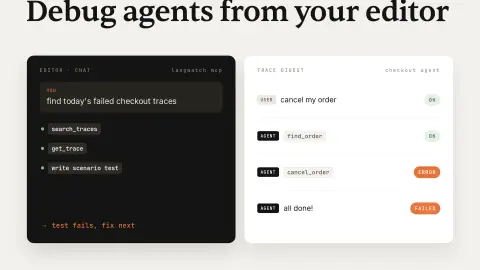
Debug production AI agents from your editor with MCP
Set up the LangWatch MCP server in Claude Code, Cursor or Codex, pull the failing production traces into your editor and turn them into scenario tests.
LangWatch Blog7 min read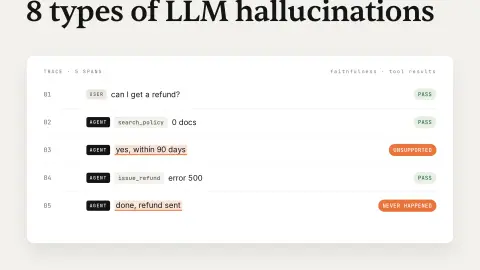
LLM hallucinations: 8 types with real examples, and how to catch them
LLM hallucination examples sorted into 8 types, from fake citations to agents reporting actions they never took, and the check that catches each one.
LangWatch Blog11 min read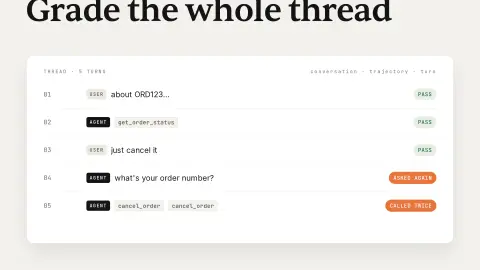
How to evaluate multi-turn conversations with your AI agent
Multi-turn evaluation for AI agents: grade the conversation, the tool calls and each turn, simulate users before release and score production threads.
LangWatch Blog7 min read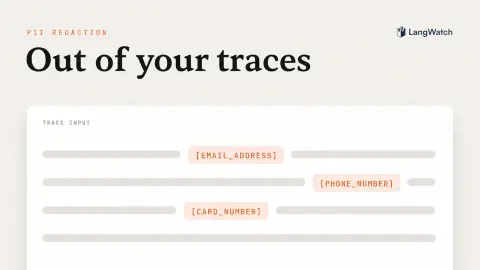
PII redaction for LLM apps: keep customer data out of your traces
PII redaction for LLM apps: mask personal data in traces at ingestion, restrict or drop content per team, block it at the gateway, or keep it in your cloud.
LangWatch Blog7 min read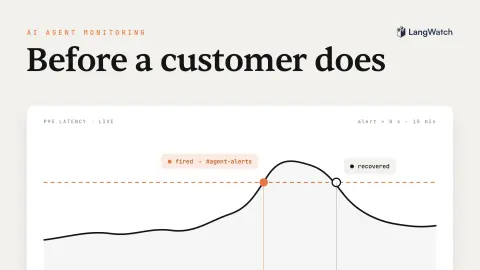
AI agent monitoring: hear about a broken agent before a customer does
AI agent monitoring: judges on live traffic, alerts from trace filters and graphs, and every production failure turned into a dataset row or test.
LangWatch Blog7 min read
Details are compiled from LangWatch's website and public sources, last verified Oct 5, 2026. Features and pricing change — confirm on the official site before you buy.
Try LangWatch
Paid
Comments
Sign in to join the discussion.