

LLMagnet
Tracks AI bot visits to measure and optimize website content visibility.


What is LLMagnet?
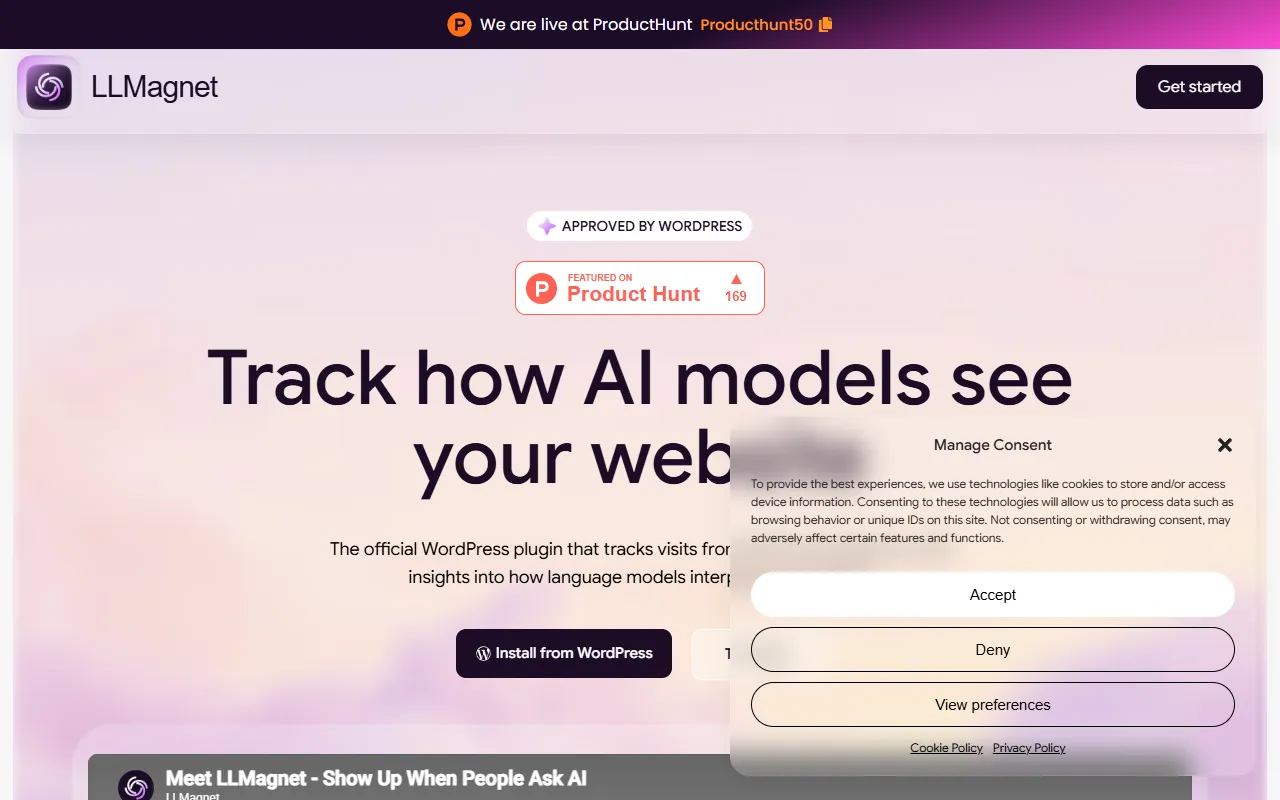
LLMagnet is an AI Website Builder tool that tracks AI bot visits to measure and optimize website content visibility. LLMagnet is free to use. It is aimed at marketers and seo professionals.
LLMagnet is a WordPress plugin that tracks AI bot visits to provide insights into how language models interpret website content. It helps users build, measure, and optimize their AI footprint. The tool integrates with WordPress and offers features for SEO and marketing.
Built for marketers and seo professionals.
Key capabilities
Features
AI Visibility Features
AI Bot Visits Tracking
Tracks AI bot visits to measure website content visibility.
SEO and Marketing Tools
Use cases
- Measure how AI models interpret website content
- Optimize website content for AI visibility
- Track AI bot visits to analyze content performance
Popular use cases
Who it's for
Pros & cons
Pros
- Free plan available
- Fully GDPR-compliant with data export and erasure tools
Cons
No documented limitations yet.
Pricing
Free.
Integrations
Security & compliance
- GDPR
- Data deletion
As stated on LLMagnet's website — not independently verified by AiByts.
FAQ
What is LLMagnet?
LLMagnet is an AI Website Builder tool that tracks AI bot visits to measure and optimize website content visibility. LLMagnet is a WordPress plugin that tracks AI bot visits to provide insights into how language models interpret website content. It helps users build, measure, and optimize their AI footprint. The tool integrates with WordPress and offers features for SEO and marketing.
Is LLMagnet free?
Yes, LLMagnet is free to use.
How much does LLMagnet cost?
LLMagnet is free to use.
Who should use LLMagnet?
LLMagnet is built for marketers and seo professionals. Common uses: measure how AI models interpret website content, optimize website content for AI visibility and track AI bot visits to analyze content performance.
What does LLMagnet integrate with?
LLMagnet integrates with WooCommerce, WordPress and Anthropic.
What are the best alternatives to LLMagnet?
Similar tools on AiByts include Kimi Chat, Capacity, Divi, Bitrise and Embedful.
LLMagnet news & updates

ChatGPT Business Hub: How to Claim Your Profile and Read the Data
How to claim your ChatGPT Business Hub profile, fix a failed DNS check, and read Mentions and Website Clicks. What verification does and doesn’t change.
LLMagnet Blog10 min read
Which GEO Tactics Have Evidence? A Scorecard of 12 Claims
We graded 12 common GEO claims by the strength of their evidence. What held up in tests, what only correlates, and what to do first.
LLMagnet Blog12 min read/.well-known/mcp.json: How to Declare What AI Agents Can Do on Your Site — and Why Under 15 of the Top 200,000 Sites Have Done It
The Model Context Protocol SDK has been downloaded 97 million times per month as of March 2026, up from approximately 2 million at launch in November 2024 (Digital Applied, 2026). More than 10,000 MCP servers are deployed in production. 41% of software organizations are running MCP in some form.
LLMagnet Blog7 min readEntity Authority: The Signal That Predicts AI Citation Rate 3x Better Than Backlinks — and How to Build It in 2026
Wikipedia accounts for 47.9% of all top citations in ChatGPT Search responses (Semrush, 2026). Brands with third-party trust signals across the web are cited in 75% of AI answers; brands without them are cited in 1% (Seer Interactive, 2026).
LLMagnet Blog7 min readGPTBot Is a Training Crawler. OAI-SearchBot Is How ChatGPT Cites You. Most Sites Are Blocking the Wrong Bots.
When site owners block AI crawlers in robots.txt, they almost always block GPTBot. On the top 1,000 websites, GPTBot appears in 633 DISALLOW rules — the most-blocked AI crawler in Q3 2026 (TechnologyChecker.io).
LLMagnet Blog7 min readPages With Tables Get Cited 4.2x More Often by AI. The Six Content Formats That Drive AI Citation in 2026.
Most AI visibility advice focuses on what to write — topic authority, keyword coverage, entity presence. The format of that content gets far less attention, despite having a larger measurable effect.
LLMagnet Blog9 min readThe Evidence Is In: llms.txt Has No Measurable Effect on AI Citations. What 300,000 Domains Show — and What to Prioritize Instead.
llms.txt was proposed in September 2024 as a plain-text file that tells AI systems what to index on a site — a robots.txt equivalent for large language models. By mid-2026, 10.13% of crawled domains had implemented one (SE Ranking, 2026).
LLMagnet Blog7 min read
61.7% of AI Citations Never Mention Your Brand Name. The Ghost Citation Problem — and How to Convert Anonymous Traffic Into Attributed Visibility.
When AI systems cite your content, they don’t necessarily credit your brand. A June 2026 Semrush study with Kevin Indig analyzed 3,981 domain appearances across 115 prompts, 14 countries, and 4 AI engines — ChatGPT, Gemini, Google AI Overviews, and Google AI Mode — and found that 61.7% of all AI…
LLMagnet Blog6 min readNLWeb: The /ask Endpoint That Makes Your Site Queryable by AI Agents — and Where Adoption Actually Stands in 2026
When an AI agent needs information from your website, it has two options. It can scrape and parse your HTML — slow (2–4 seconds), error-prone (60–70% accuracy on dynamic content), and increasingly blocked by anti-scraping defenses.
LLMagnet Blog7 min readChatGPT Cites Your Brand 46x Less Often Than Perplexity. The 11% Platform Overlap Problem — and What to Do About It.
The most common AI visibility strategy in 2026 is platform-agnostic: write structured content, earn backlinks, add schema markup, and assume that visibility on one AI platform translates to visibility on others. The data from Q3 2026 contradicts this assumption directly.
LLMagnet Blog7 min read83% of Branded Searches Now Show an AI Overview Before Your Website. Here’s What It Says About You — and How to Shape It.
When someone searches your brand name on Google today, the first thing they see 83% of the time is not your website. It’s an AI Overview — a generated summary of who you are, what you do, and whether you’re worth clicking on.
LLMagnet Blog6 min readGPTBot Is a Training Crawler, Not a Citation Bot. 23% of Top Sites Are Blocking the Wrong Thing — Here’s What the Crawl Data Actually Shows.
The most common robots.txt decision website owners are making right now — blocking GPTBot — is based on a misunderstanding of what GPTBot does. GPTBot is OpenAI’s training data crawler. It indexes your content so future versions of ChatGPT’s language model can learn from it.
LLMagnet Blog6 min read84% of AI Citations Come From Third-Party Sites, Not Brand Websites. Here’s What the Earned Media Data Says About Where AI Visibility Actually Lives.
The most counterintuitive finding in 2026 GEO research is not about schema markup or content structure — it’s about where AI systems find their sources.
LLMagnet Blog7 min readYour Agent Card Says What You Are. Your mcp.json Says What You Do. Most Sites Have Neither — Here’s How to Write Both.
Fewer than 15 of the 200,000 most-visited websites expose the files AI agents check before deciding whether to interact with a site directly — or fall back to scraping.
LLMagnet Blog7 min readWord Count Has Near-Zero Correlation With AI Citations. Here’s What Actually Determines Whether Your Content Gets Cited.
Word count shows near-zero correlation with AI citation rates — 53% of AI Overview citations go to pages under 1,000 words. Here's the content structure data: fact density, table formatting, heading hierarchy, and the 1:80 rule. The post Word Count Has Near-Zero Correlation With AI Citations.
LLMagnet Blog8 min readMicrosoft’s NLWeb Protocol Turns Any Website Into an AI-Queryable Service. Here’s the Implementation Guide.
Microsoft's NLWeb protocol adds /ask and /mcp endpoints to any website, turning it into a directly queryable service for AI agents. Here's what it is, how it works, and how to implement it. The post Microsoft’s NLWeb Protocol Turns Any Website Into an AI-Queryable Service.
LLMagnet Blog7 min readA Page Ranked #7 With a Named Author Gets Cited by AI More Than the #1 Result Without One. Here’s the E-E-A-T Data Behind It.
Search ranking and AI citation are not the same optimization target. The clearest evidence for this comes from author attribution data: a page sitting at position 7 in Google search results, with a named expert author, proper author schema, and a resolvable entity graph, is being cited by AI…
LLMagnet Blog8 min readCloudflare Analyzed 200,000 Websites for AI Agent Readiness. Fewer Than 15 Had the Discovery File Agents Actually Check First.
When an AI agent is given a task — “find me a hotel in Rome with a pool and book it,” “compare these three vendors and schedule a demo with the best one” — it doesn’t start by visiting your homepage. It starts by checking whether you’ve told it what you can do.
LLMagnet Blog8 min read
Details are compiled from LLMagnet's website and public sources, last verified Oct 4, 2026. Features and pricing change — confirm on the official site before you buy.
Try LLMagnet
Free
Comments
Sign in to join the discussion.