

MindStudio
Design, build, and deploy AI agents without coding.
- Freemium· from $20/month
- Web
- API Available
- Open Source
What is MindStudio?
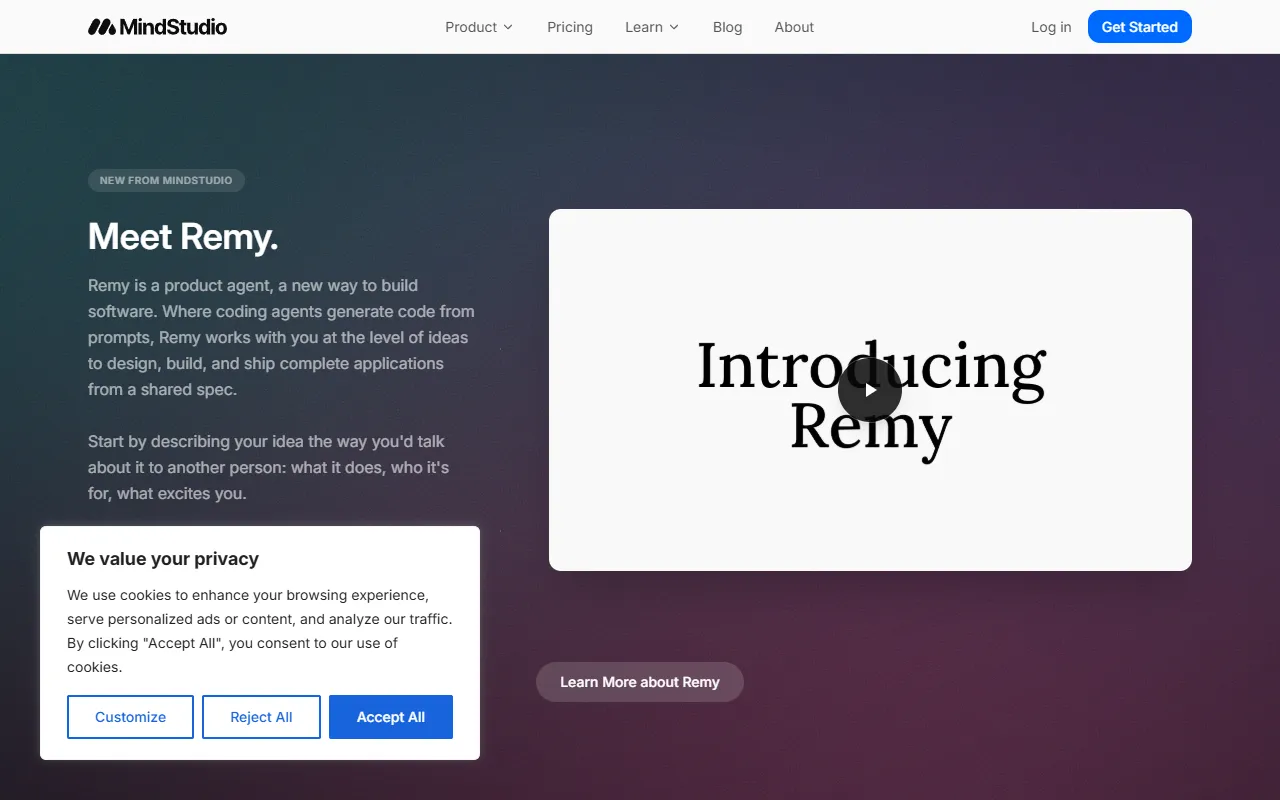
MindStudio is an Agent Builders tool. Design, build, and deploy AI agents without coding. MindStudio is freemium: it has a free plan, and paid plans start at $20/month. It is available on Web App. It is aimed at developers, enterprise teams and productivity enthusiasts.
MindStudio allows users to design, build, and deploy AI agents without coding. It offers a visual builder with 200+ models, 1,000+ integrations, and deployment options for web apps, automations, and custom workflows. No API keys are required.
Built for developers, enterprise teams, productivity enthusiasts and ai researchers.
Key capabilities
Features
Workflow Logic
User Input
Run Function
Chat
Jump
Menu
Router
Run Workflow
Checkpoint
Build User Context
Set Run Title
Set Variable
Use cases
- Design AI agents for enterprise use cases
- Build custom workflows for team collaboration
- Deploy AI agents for automation tasks
- Create web apps using AI agents
- Integrate with Google Drive and Gmail for data management
- Utilize 200+ AI models for various tasks
Popular use cases
Who it's for
- Developers
- Enterprise Teams
- Productivity Enthusiasts
- AI Researchers
- Marketing Teams
- Automation Professionals
Pros & cons
Pros
- Free plan available
- Public API available
- SOC 2 Type II compliance
- SOC II & GDPR compliance
- Single sign-on (SSO) and SAML support
Cons
No documented limitations yet.
Pricing
Freemium — paid plans start at $20/month.
| Plan | Price |
|---|---|
| Free | Free |
| IndividualPopular | $20 / month |
| Custom Code | $20 / month |
| Launch your first agent today | Custom |
Integrations
Developer & API
Public webhook API available
- Webhooks
- Supported
Open source· 33 stars· 15 forks
Security & compliance
- SOC 2
- GDPR
- SSO
- SAML
- Data deletion
As stated on MindStudio's website — not independently verified by AiByts.
FAQ
What is MindStudio?
MindStudio is an Agent Builders tool. Design, build, and deploy AI agents without coding. MindStudio allows users to design, build, and deploy AI agents without coding. It offers a visual builder with 200+ models, 1,000+ integrations, and deployment options for web apps, automations, and custom workflows. No API keys are required.
Is MindStudio free?
MindStudio has a free plan; advanced features require a paid plan.
How much does MindStudio cost?
MindStudio offers 4 plans: Free (Free), Individual ($20 / month), Custom Code ($20 / month) and Launch your first agent today (Custom).
Does MindStudio have an API?
Yes, MindStudio offers a public webhook API with webhooks for building custom integrations.
What platforms does MindStudio support?
MindStudio is available on Web App.
Who should use MindStudio?
MindStudio is built for developers, enterprise teams, productivity enthusiasts, ai researchers and marketing teams. Common uses: design AI agents for enterprise use cases, build custom workflows for team collaboration, deploy AI agents for automation tasks and create web apps using AI agents.
What does MindStudio integrate with?
MindStudio integrates with Google Drive, Gmail, HubSpot, Salesforce, LinkedIn and Chrome.
Is MindStudio open source?
Yes, MindStudio is open source.
What are the best alternatives to MindStudio?
Similar tools on AiByts include Rival, Hermes Agent, AskLi, Future AGI and BetterClaw.
MindStudio news & updates

How to Run LFM2.5-24B-A2B Locally for On-Device Agents
A practical guide to running Liquid AI's LFM2.5-24B-A2B mixture-of-experts model locally via Transformers, llama.cpp, MLX, and vLLM.
MindStudio Blog7 min read
OpenAI's 700 Math Papers: What Narrow Superintelligence Really Means
OpenAI's unreleased model wrote 700+ math papers from single prompts. Here's why that breakthrough hasn't transferred to coding or business judgment.
MindStudio Blog8 min read
LFM2.5-24B-A2B Benchmarks: How It Beats Bigger MoE Models
LFM2.5-24B-A2B edges out larger MoE rivals on agentic and tool-use benchmarks while using far fewer active parameters per token.
MindStudio Blog8 min read
Gemini 4 Argon: What's New in Google's Flagship Model
Gemini 4 Argon brings a 1M-token output ceiling, top coding benchmarks, and agentic tasks. Here's what changed in Google's new flagship model.
MindStudio Blog9 min read
LMCache vs vLLM Caching: What Actually Speeds Up Coding Agents?
LMCache and vLLM's built-in KV caching both cut agent latency, but they solve different problems. Here's when each one actually matters.
MindStudio Blog8 min read
Gemini 4 Argon for Game Dev and 3D Coding: What Testers Found
Gemini 4 Argon tested on vibe-coded games, 3D worlds, and Excel clones versus Opus, Astra, and Muse Wonder. Here's how it actually performs.
MindStudio Blog7 min read
Run MiniCPM-V 4.7 1B Locally: Ollama and llama.cpp Setup Guide
Install OpenBMB's MiniCPM-V 4.7 1B vision model locally with Ollama or llama.cpp. See VRAM usage, setup commands, and real test results.
MindStudio Blog8 min read
How to Automate Your Business Workflow Using Claude Code
A step-by-step method for auditing your work, building evals, and turning repeatable tasks into automated Claude Code skills.
MindStudio Blog9 min read
Reverse Engineer Anything: The GitHub Repo That Clones App Features With AI
How the viral Reverse Engineer Anything (REA) repo uses a five-stage framework to help AI agents decompile and rebuild app features.
MindStudio Blog7 min read
Muse Wonder Full vs Standard Wonder: What KingBench 4 Actually Found
Meta's Muse Wonder Full tested against standard Wonder on six coding builds via KingBench 4, with scores, failures, and fixes checked.
MindStudio Blog8 min read
What Is KV Cache? Why It Makes AI Coding Agents Dramatically Faster
KV cache explained: how key-value caching stops LLMs rereading old prompts, and why the speedup multiplies as agent conversations grow longer.
MindStudio Blog8 min read
MiniCPM-V 4.7 1B Tested: Can a Tiny Vision Model Actually Read?
Hands-on tests of MiniCPM-V 4.7 1B on clocks, OCR, handwriting, math, and coding reveal where this tiny vision model holds up and where it breaks.
MindStudio Blog7 min read
Muse Wonder Full Pricing: What You Actually Pay to Use It
Muse Wonder Full costs $50 or $200 a month through Meta's subscription tiers, with no published pay-as-you-go API rate yet.
MindStudio Blog7 min read
Gemini 4 Argon: Pricing, Access, and Where It Actually Ships
Gemini 4 Argon's intro API pricing, where it rolls out across Google's apps, and how it stacks up against Opus 5.5 and GPT-6.1 Sol.
MindStudio Blog7 min read
Gemini 4 Argon vs GPT 6.1 and Claude Opus 5.5: Who Wins the Benchmarks?
Gemini 4 Argon takes on GPT 6.1, Claude Opus 5.5, and Muse Wonder across Deep Sweep, Terminal Bench, and Artificial Analysis scores.
MindStudio Blog7 min read
MiniCPM-V 4.7 35B-A3B: Local Testing Results for OCR, SQL and Physics
Hands-on local test of MiniCPM-V 4.7, an Apache 2.0 vision MoE model, covering OCR, SQL debugging, physics reasoning and multilingual translation.
MindStudio Blog7 min read
MiniCPM-V 4.7 vs Qwen 3.6: Who Wins Which Benchmarks?
MiniCPM-V 4.7's benchmark results against Qwen 3.6 and Gemma, showing where the Apache 2.0 vision MoE model wins, ties, and falls short.
MindStudio Blog8 min read
Is a Major AI Breach Inevitable? What Lab Leaders Are Saying
AI executives at OpenAI and Anthropic increasingly describe a catastrophic AI breach as likely, not hypothetical. Here's why containment is slipping.
MindStudio Blog9 min read
Details are compiled from MindStudio's website and public sources, last verified Oct 3, 2026. Features and pricing change — confirm on the official site before you buy.
Try MindStudio
Freemium · from $20/month
Tags
- AI Agents
- Workflow Automation
- No Code
- AI Integration
- Custom Workflows
Comments
Sign in to join the discussion.