
Prediction Guard
Enforces NIST and OWASP policies for AI models and agents within security boundaries.
What is Prediction Guard?
Prediction Guard is an AI Security tool that enforces NIST and OWASP policies for AI models and agents within security boundaries. It is aimed at platform engineers, software vendors and partners.
Prediction Guard is a self-hosted AI security and governance platform that enforces NIST and OWASP policies on every model and agent inside your security boundary. It allows for controlled and compliant AI operations, ensuring that all AI activities adhere to strict security standards.
Built for platform engineers, software vendors and partners.
Key capabilities
Features
Agent Control
Zero Trust Foundation
Sovereign Deployments
Supports deployments in challenging environments.
Compliant AI Operations
Ensures AI operations adhere to security standards.
Use cases
- Enforce NIST and OWASP policies on AI models and agents
- Control AI agent activities within security boundaries
- Ensure compliance with security standards during AI operations
Who it's for
- Platform Engineers
- Software Vendors
- Partners
Pros & cons
Pros
- Enforces NIST and OWASP policies for AI models and agents
- Supports sovereign deployments in challenging environments
Cons
No documented limitations yet.
Security & compliance
- Data deletion
As stated on Prediction Guard's website — not independently verified by AiByts.
FAQ
What is Prediction Guard?
Prediction Guard is an AI Security tool that enforces NIST and OWASP policies for AI models and agents within security boundaries. Prediction Guard is a self-hosted AI security and governance platform that enforces NIST and OWASP policies on every model and agent inside your security boundary. It allows for controlled and compliant AI operations, ensuring that all AI activities adhere to strict security standards.
Who should use Prediction Guard?
Prediction Guard is built for platform engineers, software vendors and partners. Common uses: enforce NIST and OWASP policies on AI models and agents, control AI agent activities within security boundaries and ensure compliance with security standards during AI operations.
What does Prediction Guard integrate with?
Prediction Guard integrates with OpenAI and Anthropic.
What are the best alternatives to Prediction Guard?
Similar tools on AiByts include Snyk Code, Harden, iDox.ai Guardrail, AuditOne and LochBot.
Prediction Guard news & updates
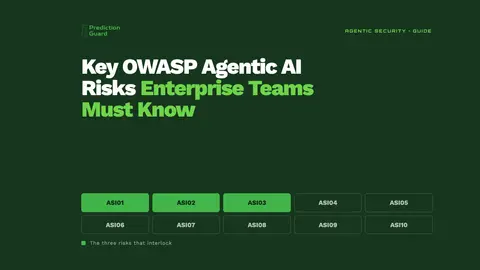
Key OWASP Agentic AI Risks Enterprise Teams Must Know
TL;DR: The OWASP Top 10 for Agentic Applications is a list of the ten most critical security risks facing autonomous AI agents, published in December 2025. It is a taxonomy to assess exposure against, not a compliance mandate.
Prediction Guard Blog10 min read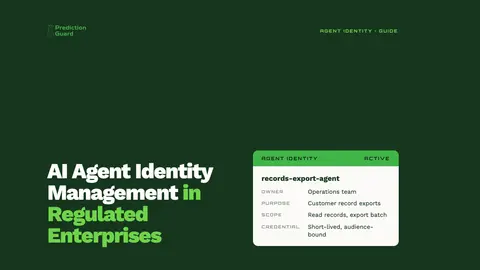
AI Agent Identity Management in Regulated Enterprises
TL;DR: AI agent identity management replaces shared service accounts with agent-specific identities, scopes authorization to each task, and produces access records an auditor can follow from request to outcome.
Prediction Guard Blog10 min read
AI Agent Orchestration for Production in 2026
TL;DR: AI agent orchestration is the coordination of multiple agents, tools, models, and shared state, and in production it only works when operational controls run inside every agent, tool call, and handoff. Each orchestration pattern fails in its own way, so each needs its own controls.
Prediction Guard Blog10 min read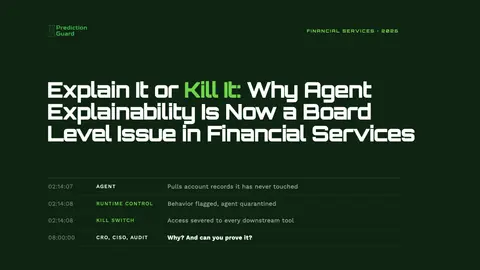
Explain It or Kill It: Why Agent Explainability Is Now a Board Level Issue in Financial Services
It is 2:14 in the morning. A payments reconciliation agent at a large bank starts pulling customer account records it has never touched before. Within seconds, a runtime control flags the behavior, the agent is quarantined, and a kill switch severs its access to every downstream tool.
Prediction Guard Blog9 min read
AI Gateway vs AI Control Plane for SIEM Logging
TL;DR: The real test in the AI gateway vs AI control plane for SIEM logging question is what lands in your SIEM. A gateway's delivery telemetry tells a SOC that a request moved: which provider, whether it succeeded.
Prediction Guard Blog9 min read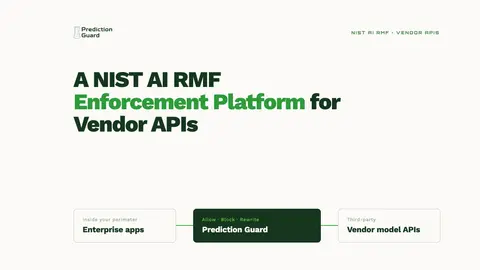
NIST AI RMF Enforcement Platform for Vendor APIs
Most enterprise AI runs on models nobody in the building controls. A team calls OpenAI, Anthropic, or Google's API, and the actual inference happens on infrastructure the organization has a contract with, not infrastructure it operates. That arrangement is normal and often the right call.
Prediction Guard Blog8 min read
What Is AI Response Filtering for PII Leakage?
Most conversations about protecting sensitive data in AI systems start with the prompt: what a user typed, what got pasted in, what a retrieval step pulled into context. That's the front door, and it matters. But a completely clean prompt doesn't guarantee a clean response.
Prediction Guard Blog9 min read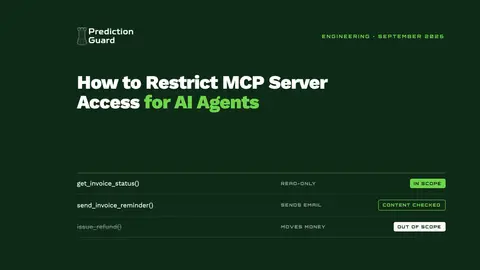
How to Restrict MCP Server Access for AI Agents
MCP has become the default way AI agents connect to real systems: internal databases, business APIs, file systems, third-party services. Introduced in late 2024, it's since been adopted across OpenAI, Google DeepMind, Microsoft, and thousands of engineering teams, with SDK downloads now in the tens…
Prediction Guard Blog6 min read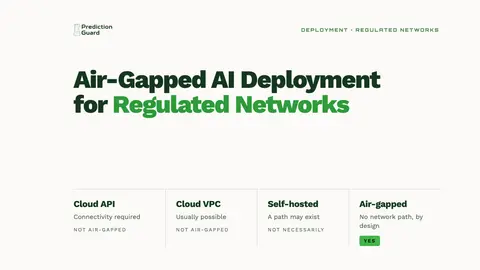
Air-Gapped AI Deployment for Regulated Networks
Plenty of platforms describe themselves as "private" or "on-premises" and still phone home. A license check, a telemetry ping, a background update call, a DNS lookup that reaches out before failing silently, any one of these is a live network path, and any outbound network capability at all means a…
Prediction Guard Blog8 min read
Understanding AI Agent Tool Poisoning
Most conversations about prompt injection assume the attacker's instruction arrives through content: a message a user typed, a webpage an agent scraped, a document it summarized. Tool poisoning breaks that assumption.
Prediction Guard Blog5 min read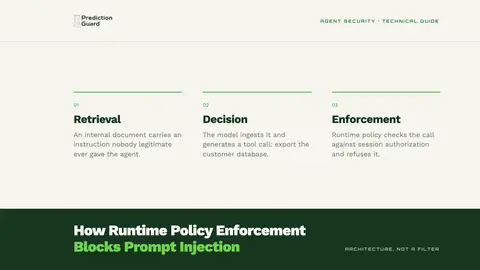
How Runtime Policy Enforcement Blocks Prompt Injection
Prompt injection sits at the top of OWASP's LLM Top 10, the most current ranking of risks facing production AI systems. Yet plenty of security teams still treat it like a chatbot novelty, something that makes a bot say something embarrassing rather than a real production security problem.
Prediction Guard Blog7 min read
You Cannot Govern an Actor
Gartner published its first Magic Quadrant for AI Governance Platforms in June and a Hype Cycle for AI Governance Technologies in August. Both are rigorous. Both answer the question they set out to answer. Our argument is with the title, "AI Governance," not the research under it.
Prediction Guard Blog11 min read
The Complete Guide to AI Governance Metrics in 2026
Ask an enterprise AI governance team whether they have a program in place, and the answer is almost always yes. Ask them to prove, with numbers, that the program is actually working, and the conversation slows down.
Prediction Guard Blog9 min read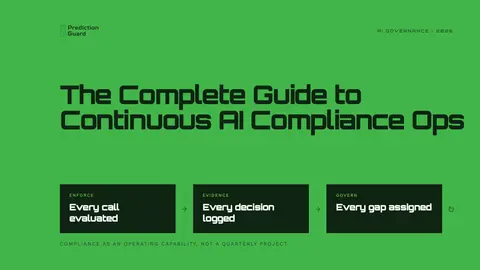
The Complete Guide to Continuous AI Compliance Ops
If your compliance program only checks in on your AI systems once a quarter, you are not governing them for the other eighty-nine days.
Prediction Guard Blog12 min read
Details are compiled from Prediction Guard's website and public sources, last verified Oct 3, 2026. Features and pricing change — confirm on the official site before you buy.
Try Prediction Guard
Visit the official website
Comments
Sign in to join the discussion.