

PydanticAI
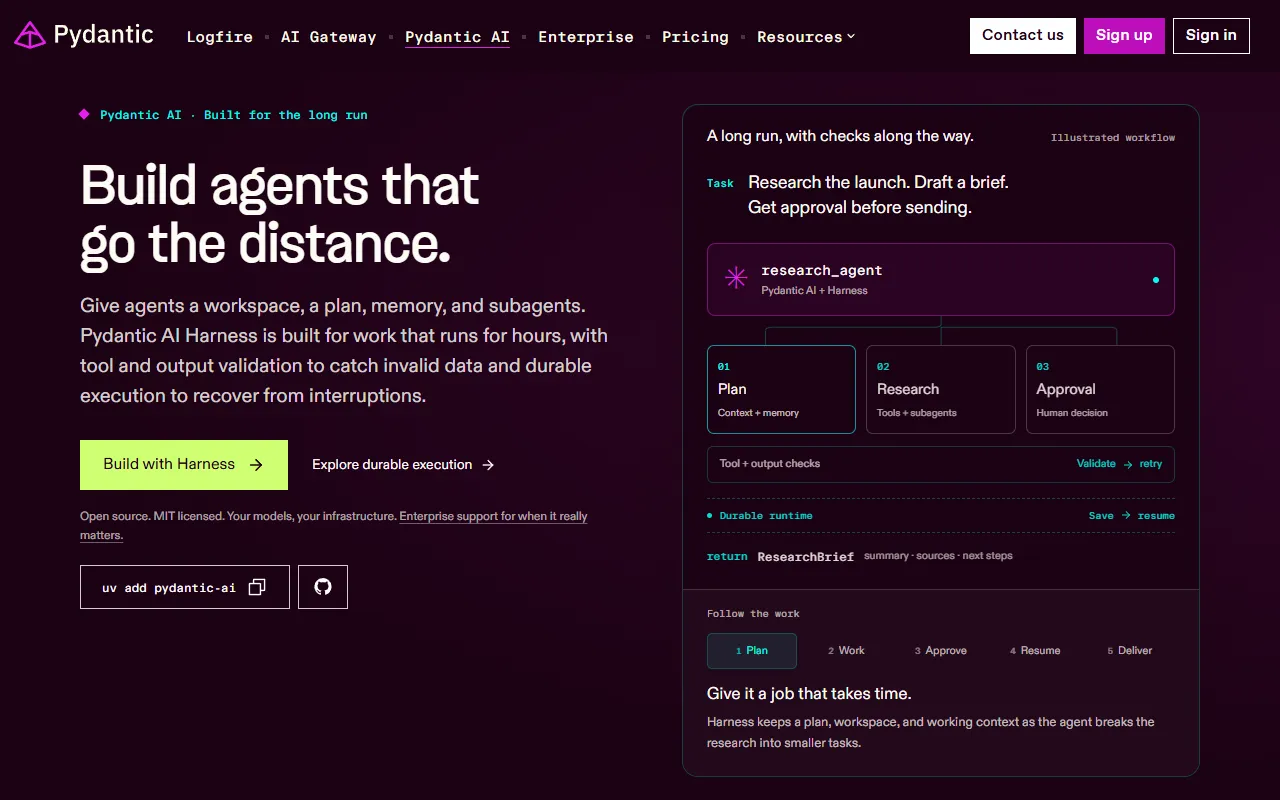
A framework for building AI agents with type-safe, production-ready code.


What is PydanticAI?
PydanticAI is a Coding Agent tool. A framework for building AI agents with type-safe, production-ready code. PydanticAI is free to use. It is aimed at developers, ai engineers and data scientists.
PydanticAI is a framework for building AI agents, offering type-safe and production-ready code. It supports agents, real-time voice, image generation, and embeddings. Designed for developers, it ensures every model and interface is typed end to end.
Built for developers, ai engineers and data scientists.
Key capabilities
Features
Realtime Voice
Image Generation
Data Extraction
Durable Workflow
Agent Framework
Provides a framework for building AI agents.
Logfire Integration
Pydantic Stack
Use cases
- Build AI agents with type-safe and production-ready code
- Process real-time voice interactions using AI
- Generate images using AI models
- Extract data from multiple sources for analysis
- Create durable workflows for reliable execution
Popular use cases
Who it's for
Pros & cons
Pros
- Free (open source)
- Part of the Pydantic Stack
Cons
No documented limitations yet.
Pricing
Free.
Developer & API
Open source· MIT· 20.3K stars· 2.8K forks
Security & compliance
- SOC 2
- GDPR
- HIPAA
- Two-factor authentication
- Encryption
As stated on PydanticAI's website — not independently verified by AiByts.
FAQ
What is PydanticAI?
PydanticAI is a Coding Agent tool. A framework for building AI agents with type-safe, production-ready code. PydanticAI is a framework for building AI agents, offering type-safe and production-ready code. It supports agents, real-time voice, image generation, and embeddings. Designed for developers, it ensures every model and interface is typed end to end.
Is PydanticAI free?
Yes, PydanticAI is free to use.
How much does PydanticAI cost?
PydanticAI is free to use.
Who should use PydanticAI?
PydanticAI is built for developers, ai engineers and data scientists. Common uses: build AI agents with type-safe and production-ready code, process real-time voice interactions using AI, generate images using AI models and extract data from multiple sources for analysis.
Is PydanticAI open source?
Yes, PydanticAI is open source under the MIT license.
What are the best alternatives to PydanticAI?
Similar tools on AiByts include GitHub Copilot, Openbase and Robert Brunhage.
PydanticAI news & updates
Durable Pydantic AI agents with Azure Durable Task
AzureDurableTaskDurability runs a Pydantic AI agent's model requests, and by default its tool calls, as Durable Task activities. A worker that dies mid-run hands the orchestration to the next worker, which replays the finished steps from history and runs only the one that was interrupted.
PydanticAI Blog12 min read
Using coding agent traces to improve your workflows
How coding harness traces in Logfire show where time and tokens go, make past sessions reusable across harnesses, and turn repeated failures into tested skills.
PydanticAI Blog17 min read
What we found testing OpAMP clients against the spec
Fleet Management in Pydantic Logfire ships OpAMP clients that share one protocol core, written once in Rust and run in six languages. How we check it against the spec, and the bugs that checking found in the upstream OpenTelemetry clients.
PydanticAI Blog5 min read
Turn down OpenTelemetry noise without a redeploy
Connect a Python service and a host to Fleet Management in Pydantic Logfire, then change the service's log level, redaction and sampling, and the host's Collector, while both keep running.
PydanticAI Blog7 min read
Code mode is not a sandbox
Code mode changes how a model calls your tools. A sandbox changes where code runs. How the two differ, the three places a sandbox boundary can go, and how Pydantic AI workspaces and Monty fit in.
PydanticAI Blog12 min read
The best Python agent harnesses in 2026
A practical comparison of the Python agent harnesses you can build on: which models each runs, where its agent works, how much of it you can take apart, how runs survive a restart, and when each one is the right pick.
PydanticAI Blog24 min read
Manage your telemetry in Logfire, send it anywhere
Fleet in Pydantic Logfire changes what your OpenTelemetry Collectors and application SDKs collect, and where they send it, from one place. No config files to edit on each machine, and no redeploys.
PydanticAI Blog5 min read
Pydantic AI is now a supported agent in AgentEnv Framework
Scale AI's AgentEnv Framework now ships Pydantic AI as a supported agent. Deploy it into an environment, give it a task, and grade what it does.
PydanticAI Blog5 min read
The best Python AI agent frameworks in 2026
A practical comparison of nine Python AI agent frameworks, plus the voice-agent frameworks: which models each runs, how runs survive a crash, how agents reach users, and when each one is the right pick.
PydanticAI Blog25 min read
Pydantic Validation: Next Steps
Pydantic Validation V3 is coming without a painful migration. Here is what to expect, and what it means for V1 and V2 support.
PydanticAI Blog3 min read
Why code mode could cut your agent bill
5,276 graded agent runs on eight models, from one-line edits to 200-item jobs. On long tasks code mode cut cost 58% and wall time 51% and got 16 points more right. On tiny ones it costs more. Here is all of it.
PydanticAI Blog23 min read
I received the AAIF Outstanding Technical Contribution Award
At AGNTCon + MCPCon North America, the Agentic AI Foundation recognized my work maintaining the MCP Python SDK. A short thank you to the people who made it possible.
PydanticAI Blog3 min read
Why do you need traces if you already have logs?
Logs record that something happened. Traces also record which request it belonged to, what called it, and how long it took. A small async example shows where logs stop being enough.
PydanticAI Blog9 min read
Run Pydantic AI coding agents in E2B sandboxes
E2BSandbox is a native Pydantic AI Harness capability. The agent's shell commands and file edits run inside an isolated E2B microVM, the sandbox pauses and resumes between runs, and a Temporal worker can crash without losing the workspace.
PydanticAI Blog11 min read
Pydantic runs on RunsOn
How we moved Logfire's million-minute CI workload to RunsOn and used ARM, Spot, caching, and right-sized EC2 instances to cut our monthly CI bill by roughly two-thirds.
PydanticAI Blog4 min read
Announcement: Pydantic v2.14 Release
Pydantic v2.14 adds Python 3.15 support, with lazy imports and TypeForm, stabilizes the MISSING sentinel, and speeds up schema generation.
PydanticAI Blog7 min read
Would you deploy an agent you don't control?
Claude Agent SDK puts Claude Code inside your application. If your product is not a coding agent, that convenience comes with architectural decisions you did not make.
PydanticAI Blog7 min read
Building production agents: the observability layer
Agents are still software, but traditional monitoring can't see what they actually do. A practitioner's case for treating observability as a first-class layer, and how we do it with Logfire.
PydanticAI Blog6 min read
Details are compiled from PydanticAI's website and public sources, last verified Oct 3, 2026. Features and pricing change — confirm on the official site before you buy.
Try PydanticAI
Free
Tags
- AI Agents
- Production Ready
- Realtime Voice
- Image Generation
- Data Extraction
- Durable Workflow
Comments
Sign in to join the discussion.