
Supacut
Helps video editors find strong material in interview footage before editing
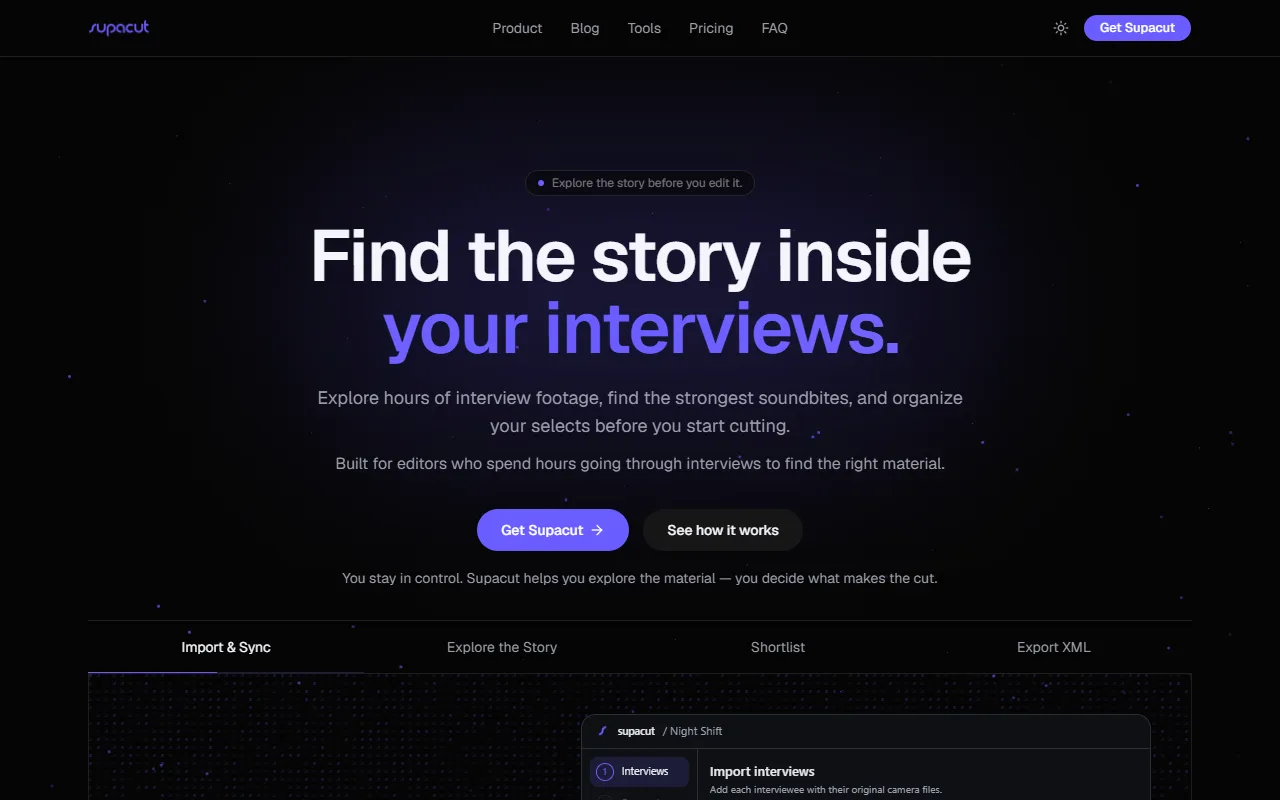
What is Supacut?
Supacut is a Video Editing tool that helps video editors find strong material in interview footage before editing. It is available on Windows and macOS. It is aimed at video editors, content creators and interviewers.
Supacut helps video editors explore, organize and find the strongest material inside hours of interview footage before the edit begins. It allows users to identify key content without making cuts, focusing on the story before the timeline. The tool emphasizes efficiency by reducing time spent searching for material.
Built for video editors, content creators and interviewers.
Features
Find the Strongest Material
Identifies key content without making cuts, focusing on the story before the timeline
Efficient Search
Reduces time spent searching for material, allowing more time for editing
User Control
Users bring their own API key and control costs without paying for tokens
Public API Access
Use cases
- Explore interview footage to find the strongest material before editing
- Identify key content without making cuts, focusing on the story before the timeline
- Reduce time spent searching for material to increase editing time
- Control costs by using own API key and avoiding token payments
- Integrate with a public API for custom workflows
Who it's for
- Video Editors
- Content Creators
- Interviewers
Pros & cons
Pros
- Public API available
- Users bring their own API key
- Control the cost without paying for tokens
Cons
No documented limitations yet.
Developer & API
Public API available
FAQ
What is Supacut?
Supacut is a Video Editing tool that helps video editors find strong material in interview footage before editing. Supacut helps video editors explore, organize and find the strongest material inside hours of interview footage before the edit begins. It allows users to identify key content without making cuts, focusing on the story before the timeline. The tool emphasizes efficiency by reducing time spent searching for material.
Does Supacut have an API?
Yes, Supacut offers a public API for building custom integrations.
What platforms does Supacut support?
Supacut is available on Windows and macOS.
Who should use Supacut?
Supacut is built for video editors, content creators and interviewers. Common uses: explore interview footage to find the strongest material before editing, identify key content without making cuts, focusing on the story before the timeline, reduce time spent searching for material to increase editing time and control costs by using own API key and avoiding token payments.
What are the best alternatives to Supacut?
Similar tools on AiByts include AutoEdit, Stanley Studio, Supra Player, OpenChatCut and Narrative.
Supacut news & updates

What Is a Paper Edit? A Guide for Video Editors
A paper edit is a way of shaping a video story before building it in the timeline — using transcripts, quotes, notes, and timecodes to test whether the story works.
Supacut Blog15 min read
Paper Edit vs. Stringout: What's the Difference?
A paper edit is about story and structure. A stringout is about selected footage in the timeline. Here is how they differ, when to use each, and how they work together.
Supacut Blog13 min read
How to Make a Paper Edit From Interview Transcripts
A transcript gives you access to everything that was said. A paper edit helps you decide what belongs in the story. Here is a practical workflow from interview transcripts to a story hypothesis.
Supacut Blog14 min read
How to Use a Paper Edit in an Interview Editing Workflow
A paper edit sits between selects and the timeline. Here is how to use one in an interview editing workflow: organize material, test structure, then let the footage challenge it.
Supacut Blog12 min read
Paper Edit vs. Highlighting: What's the Difference?
Highlighting helps you identify useful interview material. A paper edit helps you organize it into a possible story. Here is how they differ and how they work together.
Supacut Blog10 min read
How to Create a Paper Edit for a Documentary
A documentary paper edit lets you organize interview selects and test a narrative structure before committing to the timeline. Here is a practical workflow from transcripts to stringout.
Supacut Blog15 min read
Paper Edit Template: What Should It Include?
A paper edit does not need one standard format. Here is what a useful template should include for interview-based projects: speaker, source, timecode, quote, story section, and notes.
Supacut Blog12 min read
How to Find a Specific Quote in Hours of Interview Footage
You remember that someone said something important — just not who, which interview, or where. Here is how to find a specific quote in hours of interview footage without scrubbing every timeline.
Supacut Blog13 min read
How to Find the Best Moments in Interview Footage
Finding the best moments in interview footage is not the same as finding a polished quote. Here is how to recognize editorial value, keep context, and narrow selects without losing what makes those moments useful.
Supacut Blog13 min read
How to Find Themes Across Interview Transcripts
The story is rarely sitting inside one quote. Here is how to find themes across interview transcripts, group related answers, and turn scattered interviews into a clearer editorial structure.
Supacut Blog13 min read
How to Review Hours of Interview Footage Efficiently
Reviewing hours of interview footage is slow when the timeline is your search tool. Here is a progressive workflow: make the material searchable, review with editorial questions, and spend time where it matters.
Supacut Blog16 min read
How to Find Strong Quotes in an Interview Transcript
A transcript can contain dozens of usable sentences. Here is how to evaluate which quotes actually have editorial value — before you start building the edit around them.
Supacut Blog14 min read
How to Edit a Documentary With Multiple Interview Subjects
With many interview subjects, the job is not equal screen time. It is deciding what each voice contributes and how those voices work together as one documentary.
Supacut Blog14 min read
How to Edit Interviews Faster Without Losing Creative Control
Interview editing is rarely slow because cutting a clip is difficult. It is slow because finding the right material takes time. Here is a workflow that gets you to the decisions faster without taking them away from you.
Supacut Blog13 min read
How to Build a First Cut From Interview Selects
Once you have a solid set of interview selects, the question changes from what the interviews contain to what you can build. Here is how to turn those selects into a working first cut.
Supacut Blog13 min read
How to Identify the Strongest Quotes in an Interview
A long interview can contain hundreds of sentences that sound useful on their own. Only a small number will actually make the final cut. Here is how to tell the difference.
Supacut Blog15 min readHow to Build a Story Structure From Multiple Interviews
The challenge with multiple interviews is not finding the best quote from each person. It is figuring out how those voices can work together to tell one story.
Supacut Blog14 min read
How to Edit Interview Transcripts Before Opening Premiere Pro
Opening Premiere does not have to be the start of the edit. Use the transcript first to decide what material matters, which quotes are strongest, and what you want to build in the NLE.
Supacut Blog12 min read
Details are compiled from Supacut's website and public sources, last verified Oct 5, 2026. Features and pricing change — confirm on the official site before you buy.
Try Supacut
Visit the official website
Tags
- Story Finding
Comments
Sign in to join the discussion.