

v0.7.0
LLM inference in C/C++. Contribute to ggml-org/llama.cpp development by creating an account on GitHub.
llama.cpp11 min read
Stay updated with the latest developments in Artificial Intelligence
LLM inference in C/C++. Contribute to ggml-org/llama.cpp development by creating an account on GitHub.


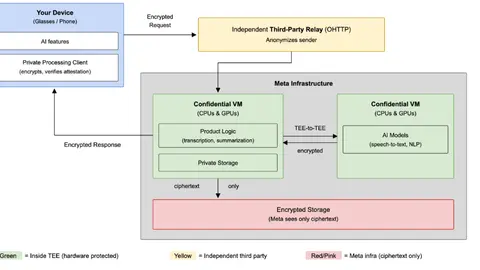
Meta has extended Private Processing to AI glasses, using confidential VMs, trusted execution environments, remote attestation, anonymous credentials, OHTTP routing, and TEE-based storage to process AI workloads and persistent user context in the cloud. By Leela Kumili

Google has introduced support for local models in the Antigravity SDK, enabling developers to build and execute agentic workflows directly on their own machines, while retaining the flexibility to mix in cloud-based models for higher-level tasks.
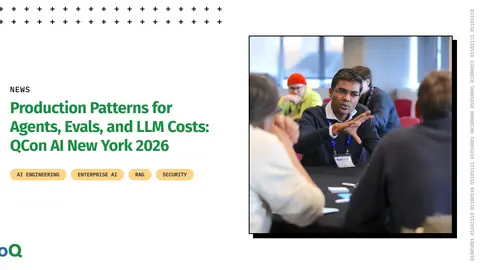
Once AI is in production, code arrives faster than it can be reviewed, token costs rise, evals have to be good enough to act on, and agents need permissions and guardrails. QCon AI New York 2026 (December 15-16) has confirmed sessions from engineers sharing how they handle these constraints.
Spotify reports that AI-assisted development more than doubled monthly merged changes, prompting a review of quality and reliability controls across its engineering organization.

Erik Peterson discusses why AI spend is eclipsing cloud bills, triggering a major software engineering cost crisis. He explains tokenmaxxing, unit economics, forced developer promotions, and why fully autonomous AI will write, deploy, and govern code by 2028. By Erik Peterson

Physical data layout is one of the most consequential decisions in lakehouse engineering. The author compares Liquid Clustering, ZOrdering, and partitioning across four workload types on Delta Lake, uncovering two undocumented failure modes that likely affect production systems today and offering a…
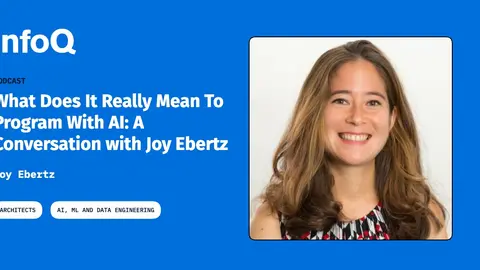
In this podcast, Michael Stiefel spoke to Joy Ebertz about how the use of artificial intelligence is changing the way architects and developers do their jobs. Focusing on the long term success of the business is one of the most neglected tasks of an architect.

Researchers from Meta, MIT, and the University of Washington introduce Context Language Models (CLMs), a new approach that enables language models to manage and edit their own context rather than relying on predefined mechanisms for summarization, compression, and information retrieval, reporting…

Google has released Android Bench 2.0, a major update to its benchmark framework for evaluating AI models and agents on Android development tasks. The update introduces long-horizon tasks (LHTs), agent-based evaluation, and continuous scoring to better assess performance on complex, multi-step…
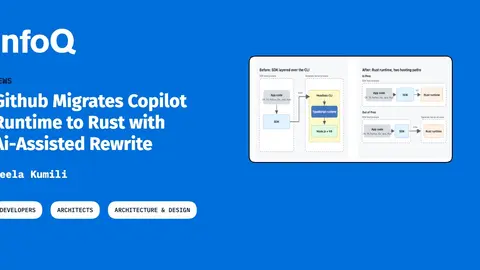
GitHub migrated more than 800,000 lines of Copilot runtime code from TypeScript and Node.js to Rust in about 14.5 weeks using AI-assisted development. The incremental migration used N-API interoperability, automated testing, human review, and 128 pull requests while continuing to ship releases.
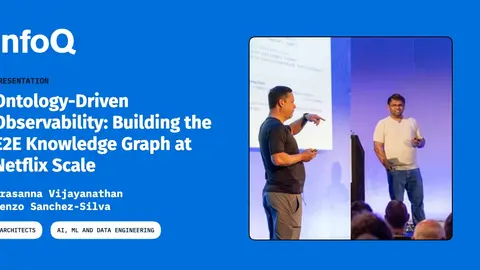
Prasanna Vijayanathan and Renzo Sanchez-Silva share how Netflix tackles observability across 38M events/sec. They discuss replacing reactive monitoring with an AI-driven operational ontology and agentic workflows using Claude and graph databases.
Pratik Rasam discusses how Spotify Ads Manager runs production-grade multi-agent systems at scale using Google ADK Java. He shares key architectural patterns, domain ownership models, deterministic guardrails, and tracing-based evaluation strategies, detailing hard-learned lessons on drawing agent…

During its recent “Birthday Week”, Cloudflare announced Clef, a set of open-weight AI models designed to choose between predefined options rather than generate text. Cloudflare released 9B- and 27B-parameter models, along with a platform for adapting them to specific decision-making tasks.

A survey conducted by independent research firm Coleman Parkes on behalf of Undo, a company focused on scaling AI-powered root-cause analysis, found that while AI coding agents have accelerated code generation, they have shifted the primary bottleneck to debugging, code comprehension, and…
On October 14, InfoQ hosts a free 60-minute panel with five practitioners on running AI in production. They'll discuss agent autonomy and human approval, how to verify AI-generated changes, sensitive-data exposure, and production RAG. Registrants can submit questions and will receive the recording.

The article describes a custom implementation that provides a session-level ordering on top of Apache Kafka partitions, supporting strict message ordering across 1000s of independent channels.

Cloudflare placed frontier AI models inside a controlled testing harness to probe its Web Application Firewall (WAF), using blocked attacks as starting points for models to generate and refine new variations. By Matt Foster

Google has made Spanner Omni generally available, running its distributed SQL database on-premises, across clouds or on a laptop. Doing so meant replacing Colossus with a Colossus-like abstraction layer and TrueTime with software-based time synchronization.
Showing 18 of 51 stories
Load more storiesGet the top AI news and tools straight to your inbox every week.
Weekly · AI news from InfoQ - AI/ML/Data
Join 15,000+ AI enthusiasts