v0.7.0
LLM inference in C/C++. Contribute to ggml-org/llama.cpp development by creating an account on GitHub.
llama.cpp11 min read
Stay updated with the latest developments in Artificial Intelligence
LLM inference in C/C++. Contribute to ggml-org/llama.cpp development by creating an account on GitHub.


Where to start with agent evals, offline vs online evals, evaluator types, LLM judges, benchmarks with Harbor, multi-turn evals, and keeping costs down.
Long-running agents degrade as context piles up. Learn how offloading, summarization, skills, subagents, and memory keep your agent's context window focused.
Learn how Orange Business used LangChain and LangSmith to build Live Intelligence, a governed AI platform for agents, evals, observability, and production scale.
Open models like GLM-5 and MiniMax M2.7 now match closed frontier models on core agent tasks — file operations, tool use, and instruction following — at a fraction of the cost and latency. Here's what our evals show and how to start using them in Deep Agents.
Stale code samples are a docs problem nobody prioritizes. Here's how we used the Deep Agents CLI to automate migrating inline code into testable, CI-ready examples
Built on Deep Agents and LangGraph, Open SWE provides the core architectural components for internal coding agents.
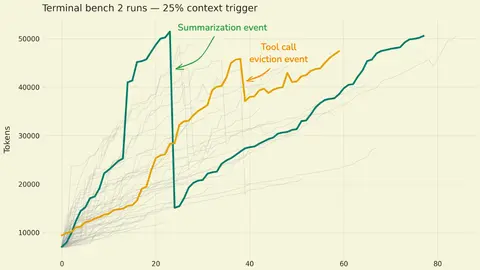
Learn how Deep Agents SDK manages context for long-running AI tasks through offloading, summarization, and filesystem abstraction to prevent context rot.
Today we’re launching Deep Agents deploy in beta. Deep Agents deploy is the fastest way to deploy a model agnostic, open source agent harness in a production ready way.
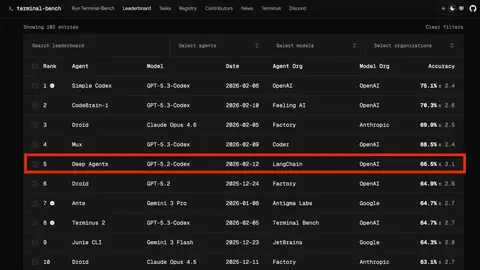
Harness engineering improved LangChain's coding agent from Top 30 to Top 5 on Terminal Bench using self-verification, tracing, and context optimization.
AI Search in LangSmith is a new way to query traces using natural language. Describe the behavior you're looking for, and LangSmith returns the traces where it happened.
Use ScaleDown's constrained decoding models with LangChain and Deep Agents to summarize history, compress tool results, and extract data faster and cheaper.
Managed Deep Agents includes a new API for managing reactions for your distributed agents, and a system to dynamically assign emoji responses with your instrument of choice. Learn more.
Discover how Snyk transformed an internal support agent into Snyk Assist, a customer-facing AI feature powered by LangChain, LangGraph, and LangSmith.
Build an agent that pays for real purchases. Restock runs in Slack on Managed Deep Agents and pays with Stripe's Link over the Machine Payments Protocol.
Deep Agents now lets you bind tools to skills, pin skills at runtime, and reload skills mid-thread, so agents with expansive skill repositories stay context-efficient and effective.
LangChain just released new capabilities in Managed Deep Agents. Agents can now schedule follow-ups, reconfigure themselves on every run, and react to Slack messages.
How we built a model router into Open SWE's harness that cut median cost per coding task by 64% with no measurable drop in quality, and how to build your own.
LangSmith Custom Apps lets you build the interface you want with your LangSmith data, publish it into your workspace, and skip the hosting, auth, and permissions work. Learn more.
Showing 18 of 47 stories
Load more storiesGet the top AI news and tools straight to your inbox every week.
Weekly · AI news from LangChain Blog
Join 15,000+ AI enthusiasts