
Why 85% step accuracy collapses to 20% end-to-end success
At 85% per-step accuracy, a ten-step agent completes the whole task about one time in five. Final-output scoring cannot see this; trajectory evaluation can.
Prefactor Blog8 min read
45 stories
At 85% per-step accuracy, a ten-step agent completes the whole task about one time in five. Final-output scoring cannot see this; trajectory evaluation can.

At 95% per-step accuracy, a 10-step agent succeeds only 59% of the time. Step-level spans show which step fails and why.
Activity schemas and validation suites let you catch policy violations and capability regressions in AI agents before they reach production.
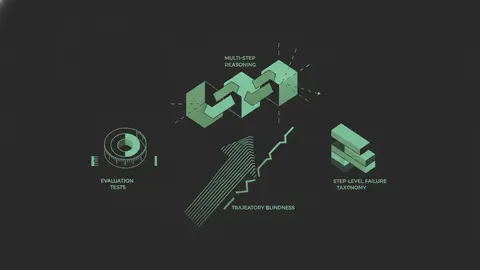
Step repetitions cause 17% of multi-agent failures and reasoning-to-action mismatches cause 14%, both undetected by final-output evaluation.
Behavior deviation detection, reasoning artifact capture, and adversarial prompt detection run continuously so human reviewers act on signals, not haystacks.

Span-based instrumentation and activity schemas surface prompt injection, unauthorized access, and multi-turn drift before incidents compound.

Span records, not prompt logs, are what make AI agent investigations possible. Each field you skip is a gap you cannot close after the fact.

Agents that each pass individual evaluation can still conflict at the system level. Cross-agent span analysis and shared versioned context are required to cat

We’re on a journey to advance and democratize artificial intelligence through open source and open science.
Showing 45 of 45 stories
You're all caught up.
Get the top AI news and tools straight to your inbox every week.
Weekly · AI news
Join 15,000+ AI enthusiasts